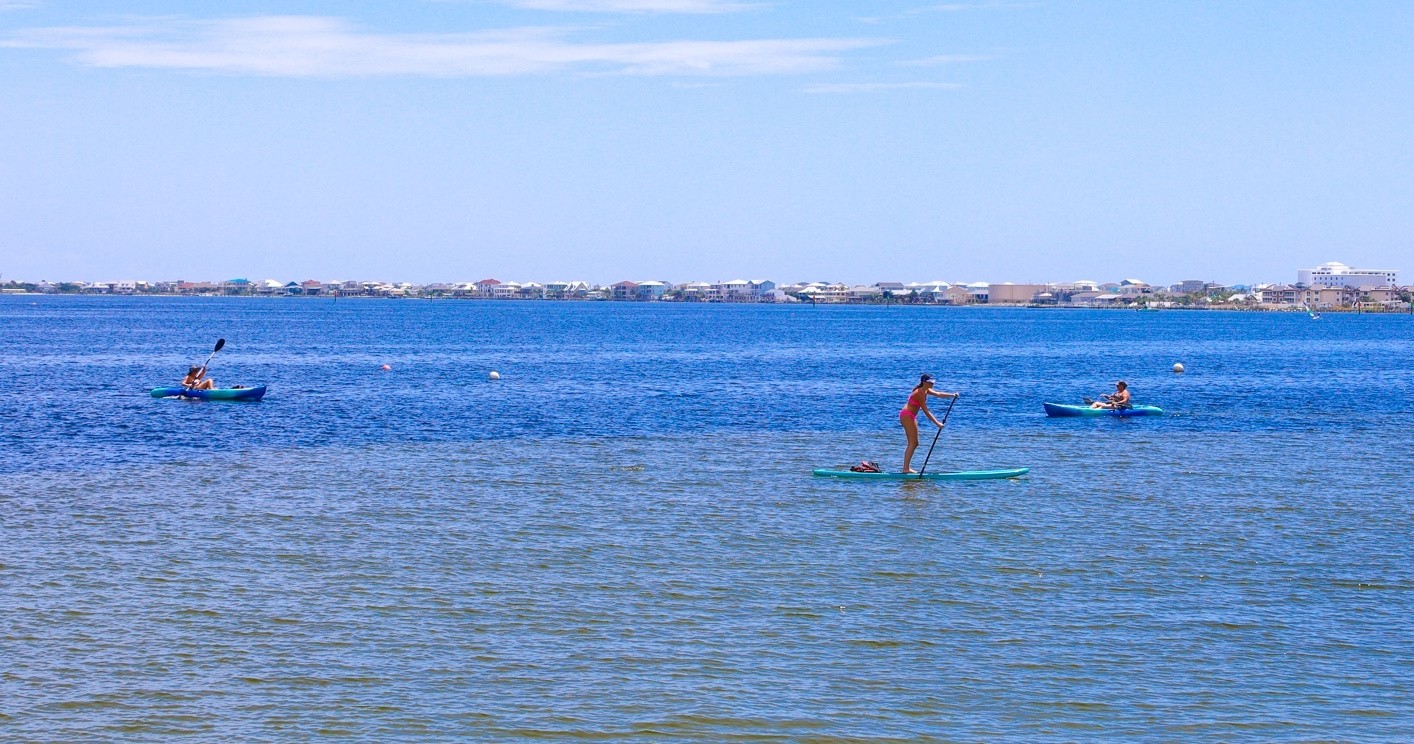
Warrington sits at the edge of Pensacola Bay where the maritime landscape is quiet but incredibly alive. Here, kayaking is less about whitewater drama and more about reading tides, tracing eelgrass corridors, and moving slowly alongside marsh edges where every bend reveals a different kind of activity: a flock of terns working a bait ball, a pair of ospreys cruising a channel, or a cormorant drying its wings on an exposed piling. The water is often glassy by dawn and becomes a pattern of shifting currents and tideline lines by midday. That subtle change—the difference between absolute calm and a brisk tidal push—is the pulse of paddling in Warrington.
History and human use are part of the scenery. This stretch of coastline has long supported fishing communities and naval activity, and remnants of docks, oyster racks, and low-slung warehouses give certain launches an industrial edge that quickly dissolves into sandbars and sea grass as you head away from shore. Ecologically, the estuary is a frontline habitat: seagrass beds and oyster reefs support fish nurseries while salt marshes stabilize the shoreline and host migratory birds. For paddlers this means trips are as much about observation as travel—bringing binoculars and a patient pace pays dividends.
Variety is compact. You can launch from urban ramps and be in a sheltered lagoon within minutes, or commit to longer bay crossings that link Warrington to barrier shorelines and quieter islands. Tide windows dictate where you can safely thread narrow creeks; wind determines whether a crossing feels friendly or fussy. Skill requirements therefore scale with the route: sheltered marsh loops suit novices and families; exposed bay runs and any crossing that reaches open water require solid boat control, route planning, and respect for tidal currents. Guided eco-tours and local outfitters can compress the learning curve, pairing local knowledge with wildlife interpretation.
Practical considerations—sun, mosquitoes, sudden squalls, and boating traffic—shape the experience. Best practice is to plan around tides, start early in warm months, and carry basic safety gear. When done thoughtfully, kayaking around Warrington delivers an intimate coastal experience: a layered, low-swell landscape where quiet travel reveals the nuanced rhythms of the Gulf coast.
Estuarine paddling is the core: expect tidal creeks, broad bay flats, and winding marsh channels rather than surf-facing beaches.
Wildlife viewing is exceptional for coastal birds, occasional bottlenose dolphins, and intertidal creatures—bring binoculars and a sense of patience.
The harbor is the gateway, and the Pacific becomes the classroom.
Routes range from short urban launches to multi-hour bay crossings; tide timing and wind forecasts are mission-critical.
Choose by purpose
Whale watching, snorkeling, sunset sailing, cultural canoeing, harbor sightseeing, or private chartering.
Start near the city
Waikiki and Honolulu Harbor are primary hubs, with some trips launching near Hanauma Bay.
Confirm the vessel
Gangways, shaded seating, and boarding requirements vary according to vessel size and operator.