Exploring Whitewater Canoeing Adventures on the Chattooga River — An Outdoor Enthusiast’s Guide
image

Exploring Whitewater Canoeing Adventures on the Chattooga River — An Outdoor Enthusiast’s Guide

Welcome to the wild and scenic Chattooga River, one of the most prized whitewater rivers in the Southeastern United States. Forming a natural boundary between Georgia and South Carolina, the Chattooga is famous for its stunning wilderness, clear waters, and legendary rapids. As one of the few remaining free-flowing rivers in the region, it offers a pristine whitewater canoeing experience embraced by both beginners and seasoned paddlers. In this guide, we’ll focus on outdoor adventures specifically for easy whitewater canoeing trips that stretch around 16 miles in length.


🛶 Overview of the Chattooga River

The Chattooga River, designated as a Wild and Scenic River in 1974, flows 57 miles from its origin in North Carolina, through the Blue Ridge Mountains, and eventually into Lake Tugaloo. The river is divided into four sections for recreational purposes, each offering different levels of difficulty and length. For an easy yet scenic whitewater canoeing adventure, your best bet is Section II, which covers approximately 14 to 16 miles depending on your take-out point.

Good to Know:

  • Canoeing is best undertaken from April to October, with spring and early summer offering optimal water levels.
  • The Forest Service regulates the river—permits aren’t required for Section II, but group sizes are limited to 12 people.
  • Motorized access is limited, making it a quieter paddling experience.

➤ Section II: Highway 28 Bridge to Earl’s Ford (Approximately 15–16 miles)

This is the prime stretch of the Chattooga River for easy whitewater canoeing:

  • Put-In Point: Highway 28 Bridge (also known as Russel Bridge), near the town of Walhalla, SC.
  • Take-Out Option: Earl’s Ford Road access.
  • Length: 15.5–16 miles.
  • Difficulty: Class I–II (perfect for beginners and families)
  • Paddle Time: 6–8 hours (or split over two shorter day trips with a primitive river campsite)

Highlights Along the Way:

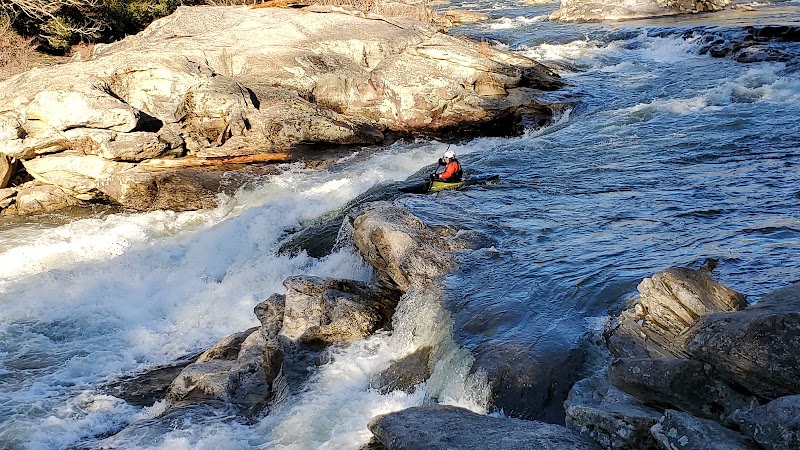
  • Gentle rapids like Big Shoals and Second Ledge provide splashy fun without being too technical.
  • A few peaceful flatwater pools allow for relaxed floating and picnicking.
  • Turn your gaze to the banks: you’ll often spot otters, kingfishers, and possibly black bears in the distance.
  • Gorgeous views of rhododendron-lined banks, granite outcroppings, and towering hardwood forests.

Local Tip: Pack light but bring river sandals, a dry bag, and mosquito repellent during the summer months. Cell service here is sparse, so carry a waterproof map and paddling app offline.


🏕️ Camping & Extras

Between the put-in and take-out points, paddlers can explore:

  • Primitive river camping at designated sites along the river. These are first-come, first-served, so early arrival is wise during weekends and holidays.
  • The adjacent Chattooga Trail gives you an opportunity to stretch your legs and hike alongside the river if you plan a multi-day trip.
  • Fishing opportunities for rainbow and brown trout, particularly near rock shoals and eddy lines.

🚗 Getting There: Travel Information

Directions to Highway 28 Bridge (Put-In Point):

  • From Clayton, GA: Head east on US-76 for 8 miles. Turn left onto GA-28 N and continue for 3.5 miles. The parking lot for the Highway 28 Bridge Access is on your right just before the bridge.
  • From Walhalla, SC: Take SC-28 west for approximately 18 miles to the Russel Bridge. Parking area will appear just past the bridge.

Expect a 25–35 minute drive from nearby towns like Clayton, GA, or Walhalla, SC. Earl’s Ford (take-out) is accessible via gravel roads; a shuttle service is recommended unless you leave a vehicle at each end.


🧭 Quick Tips Before You Paddle

  • Check real-time river levels through the USGS river gauge at Burrells Ford. Section II is best run when flows are between 1.5 to 2.5 feet.
  • Outfitters in Clayton, GA or Long Creek, SC offer shuttle services, canoe rentals, and guided trips.
  • Leave no trace: Pack out all trash, and avoid stepping on shoreline vegetation.

⚠️ Additional Cautions

While Section II is suitable for beginners, it’s still a river with moving water:

  • Always wear a Type III PFD.
  • Know basic self-rescue techniques.
  • Never paddle alone—go with a group or hire a guide.

Summary

For a laid-back, beautiful outdoor adventure within the heart of the Southern Appalachians, the Chattooga River's Section II offers one of the best whitewater canoeing experiences for beginners. Its quiet wilderness, manageable rapids, and scenic beauty make it a perfect spot for a 16-mile float packed with adventure and exploration.

Whether you're paddling solo, with a family, or a group of friends, this trip will leave you feeling refreshed and connected to one of the Southeast’s natural treasures. For those hungry for more, nearby sections like Burrells Ford to Licklog Creek provide equally engaging water trails for a second adventure.
Reviews

Mark Mefferd (TigerMark44)4 years ago
The Chattanooga River is a river unlike any other in the Southeast. It has so much to offer. If you love trout fishing, this is your place. Whitewater rafting is very popular and there are some amazing spots. Bull Sluice Falls is a class V rapid that many kayakers and rafters alike come to meet its challenge. Fun for the while family and for the more skilled as well. Burrell's Ford has a rustic campground that is a favorite all around. Highly recommend.
Jedd Austin2 years ago
The Chattooga River is unbelievably beautiful in the fall. Just got back from a weekend camping on it’s banks.
Gerald Roger jr4 years ago
Its was gorgeous out here today, cool and the sun was out nice and bright. Plenty of different views and trails.
Tyler Huskey8 months ago
One of the best rivers in the eastern U.S. to raft or kayak down, of course when the river is flowing at normal or above normal stage you can see a wide range of rapids 1's and 2's for the beginners,or 3-5's and above for the more advanced expert kayakers and rafters. Of course if you take a guided rafting trip down the river you can bet that you are going to be restricted from the 5's especially if it's at or above normal depths. Now private citizens in personal kayaks please use a modicum of caution, while the bigger rapids may look easy and not that big at all, they are very deceptive to say the least. A normal class 5, after a good day or two of storms will turn it into an unassuming looking rapid that could easily be classified as a 7-9 if there were such a rating or classification. I personally have guided rafting trips, rafted and kayaked down every section the Chattooga has to offer along with almost every other river in the eastern U.S. and in my opinion the Chattooga river is one that can change the most with the least amount of water change (rise from rain). So please start with a guided rafting trip, and do it soon! You will want to come back for more guaranteed, and then level up. They even have guided rafting trips that stop and camp alongside the river. Lots of fun for the whole family, age 12 and up. Then after a few beginner trips, then novice, you'll be ready to kayak down the whole thing during flood stage (JK) all by yourself. However don't forget to checkout the other incredible whitewater there is in the Eastern area of the U.S. there is a bunch, enough to satisfy the most ravenous of us thrill seakers, wanting big, bigger and the biggest rapids to be found. The Ocoeoe river is one that can be done really fast, by doing the man-made Olympic sections that offer a mind blowing race of back to back rapids without a real break, and all are big in your face rapids. Then there's the natural sections that have just as big a rapid as the Olympic section, but at more of a natural intended separation between them and depending on the descent of the riverbed itself decides the placement of the rapids, both the man-made and the Olympic section are amazing and like no other, bound to meet or beat the expectations of any river going enthusiasts. Then for a calmer whole family from young to the old there is the Nantahala River which has some fast paced movement and a few slight ups and downs, but no huge 4's and 5's that can and sometimes will spill your raft or kayak. This river is family fun at its best and safe at the same time no worries about a spill or tipp over unless done by want and design. Still this river offers the newbie to the sport of whitewater rafting a fairly gentle introduction to what can become an adrenaline filled, rapid after rapid, trip to never forget, but don't take my word for it get out there and see what the Eastern United States Mountains' Rivers have to offer. I have yet to go down all the rivers in the East, however I've kayaked or rafted down the majority of Rivers and streams, all the known main rivers, I'm proud to say I've accomplished going down them most more than on e of not several times over the year's. Just don't forget that there is a ton more to do besides rafting trips or kayaking. There's caves to be explored, gold and gem mines to try and find your own riches, for example when I was just a kid on family vacation in the early 90's my family and I went to a gem mine a couple hours drive outside of Murphy, N.C. where my Great Aunt had a cabin that was used primarily for vacations etc. well I was on my second bucket of paydirt or clay is what it looked like to me, and all I had found so far were a cpl dozen Garnet's, Sapphires, a few Emeralds, some rose quartz and other small amounts of gemstones when all of the sudden I was staring down into my sluice box at the biggest Ruby I had and to this day have ever seen... It ended up having a total weight of 287cts. They took a Polaroid and made me a member of the honker club. From then on I would receive free paydirt.gocamp2
Joshua Wilkins6 years ago
In my opinion this is the best trout fishing experience to be had in Georgia. The river flows south to the southern border of North Carolina then runs the border of Georgia and South Carolina. Georgia and South Carolina have an agreement allowing license holders from either state to fish the river. The portion of the river in North Carolina requires a North Carolina license. From Burrells Ford Campground and working your way up you'll find remote areas with wild browns and brookies. The North Carolina water is excellent as well. But respect the river and take care of it. Handle your fish properly and take your trash out.

Related Posts

featured

Best Mountain Biking Trails Near Lake Placid, New York

featured

Hiking the Finger Lakes: Moderate 8-Mile Trails Near Ithaca, New York

featured

4-Day Knoxville, Tennessee Itinerary – October Outdoor Adventures

featured

Best Moderate Hiking Trails in Gatlinburg, Tennessee