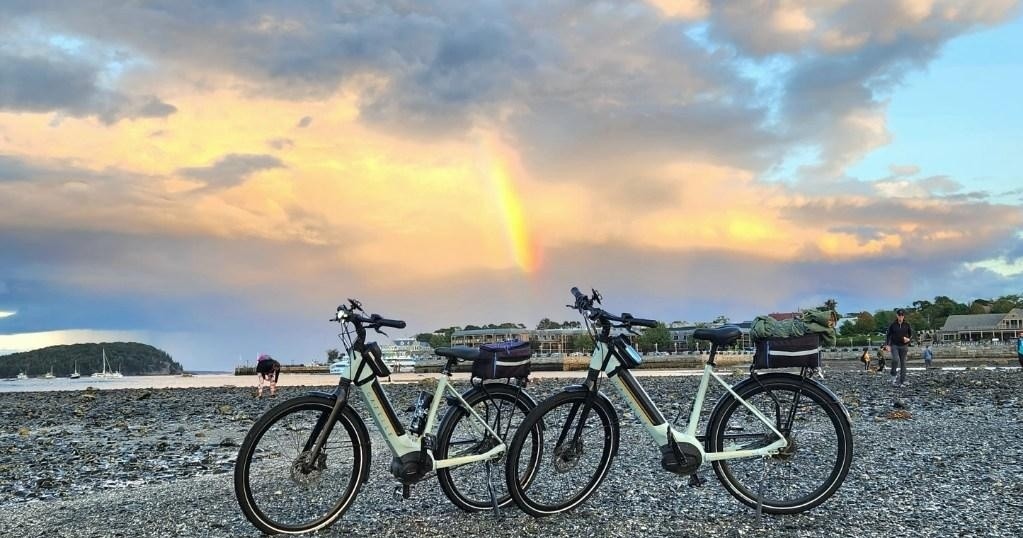
Why Ellsworth Works So Well for E-Biking
Ellsworth sits where the coast loosens into low hills and a patchwork of farms, salt marsh, and village lanes—an environment that rewards an e-bike’s expanded range without requiring a full day in the saddle. The town itself is compact and friendly to two wheels: a tidy grid of streets along the Union River links cafés, bike-friendly sidewalks, and riverside greenways. Venture out and you’ll find a surprising variety of pavement and packed-surface options: quiet county roads with wide gravel shoulders, former carriage roads and towpaths that welcome mixed-traction tires, and scenic coastal spurs where the ocean opens up between spruce and granite headlands.
What sets Ellsworth apart as an e-bike base is the access it provides. In a single ride you can thread tidal estuaries and salt marshes, climb to low wooded ridgelines for inland views, and roll toward the carriage roads and village centers that lead into Acadia’s periphery. Because e-bikes flatten short climbs, riders can explore farther along downeast corridors—linking coffee shops, farmstands, estuary overlooks, and seaside villages—without turning a day trip into a logistical headache. That accessibility makes the region appealing to a wide range of riders: families who want a scenic loop with minimal hill strain, mixed-ability groups where an electric assist keeps everyone together, and seasoned cyclists who use an e-bike to extend distance or carry gear for overnight touring.
The riding character in and around Ellsworth is quietly diverse. Road lovers will find stretches of smooth county pavement with light traffic and steady, rolling grades. Gravel and mixed-surface enthusiasts can connect secondary roads and old cart paths for exploratory loops that feel remote without being technical. Coastal riders are rewarded with tidal vistas and occasional salt-scented headwinds; inland routes climb wooded ridgetops and pass through farmland, offering shade and open vistas in short succession. The region’s seasons add another layer: late spring bursts with wildflowers and higher river flows, summer brings long daylight and warm coastal air, and autumn transforms low hills and roadside maples into a blaze of color—prime time for photos and quieter roads.
Environmental and regulatory context matters here. Many of the region’s most attractive lanes pass through or near protected lands; rules about where e-bikes are allowed can vary by town, land manager, and park. Acadia National Park sits close by and has specific regulations regarding motorized transport and trail access—verify current e-bike policies before you ride into park-managed areas. Likewise, private carriage roads, town conservation properties, and conservation trust lands occasionally restrict or seasonally manage wheeled access. Practical planning—checking local regulations, carrying a basic repair kit, and thinking through battery range for the day’s planned mileage—keeps the focus on enjoyment rather than logistics.
Ultimately, Ellsworth’s draw for e-bikers is how it opens up the coast without demanding heavy climbing or complicated logistics. The town works as a relaxed basecamp: fuel up at a bakery, deploy on a chilled coastal loop, pause at a tidal inlet for shellfish flats and herons, and ride home with energy left for dinner and local conversation. It’s an approachable, scenic, and fundamentally modular place for e-bike travel—one where a single battery charge can unlock multiple micro-adventures in a single day.
Ellsworth’s proximity to Acadia makes it an excellent springboard for rides that combine quieter country lanes with sections that brush national park boundaries. Even when park regulations limit certain trail uses, riders can often craft high-quality loops on adjacent town roads and conservation lands that preserve the same scenic character.
The small-town infrastructure—cafés, grocery stops, and a handful of services within a few miles—means riders don’t need to carry everything. That convenience eases the logistics of overnight touring or family outings where mid-ride resupply is helpful.
The harbor is the gateway, and the Pacific becomes the classroom.
Seasonality is a practical consideration: summer offers long, warm days but also the busiest road periods; late spring and early fall provide cooler temperatures and fewer cars, making mixed-surface loops feel more remote and enjoyable.
Choose by purpose
Whale watching, snorkeling, sunset sailing, cultural canoeing, harbor sightseeing, or private chartering.
Start near the city
Waikiki and Honolulu Harbor are primary hubs, with some trips launching near Hanauma Bay.
Confirm the vessel
Gangways, shaded seating, and boarding requirements vary according to vessel size and operator.