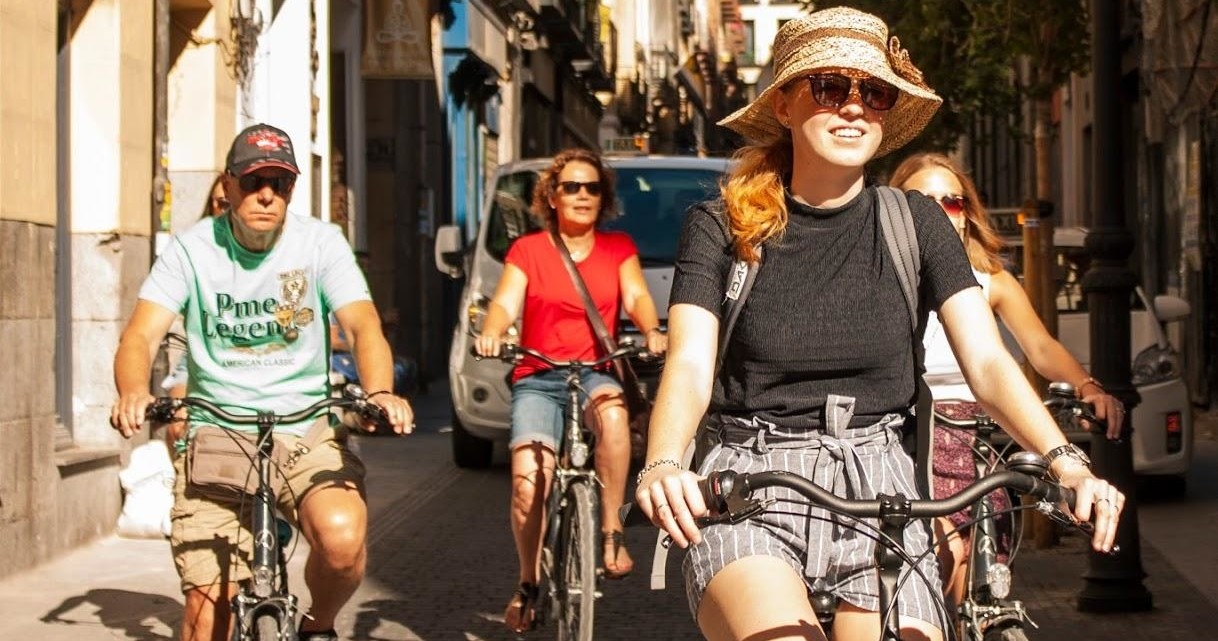
Madrid wears its contrasts on its sleeve, and for a cyclist those contrasts become the plot of the day. Pedal through the city at dawn and you’ll find soft light over stately plazas, joggers on park paths and workers wheeling market crates—an urban rhythm that reads beautifully from a saddle. The city’s central parks and riverside promenades stitch together safer, low-traffic corridors perfect for relaxed cultural loops: Retiro’s tree-canopied lanes, the sculptural stretches of Madrid Río, and the quieter backstreets of Salamanca and La Latina, where each turn offers a courtyard café or a century-old bakery that seems to know exactly how you like your café con leche after 20 kilometers.
But Madrid’s cycling personality is not only metropolitan. A short ride or train hop from the city center opens into varied terrain: the broad, forgiving trails of Casa de Campo; the neatly planted orchards and flat, bike-friendly roads of Aranjuez; and then the sudden grandeur of the Sierra de Guadarrama, where granite climbs, pine-scented descents and high-mountain roads attract serious riders seeking sustained elevation gain. For gravel and mixed-surface fans, the foothills offer crunchy dirt tracks, old military roads and country lanes that feel almost private by afternoon. Collectively, these options make Madrid unusually versatile: an ideal place to learn the language of Spanish cycling culture on a gentle guided tour, then graduate to a day-long mountain traverse or a self-guided exploration of historic towns and riverside estates.
Culturally, biking here is both practical and social. Cyclists encounter colleagues on morning commutes, families taking evening rides after siesta, and guided groups that fuse history, food and bike-friendly detours into half-day itineraries. The city’s growing network of protected lanes and the broad promenades along the Manzanares have made urban cycling more approachable in recent years, while nearby rural routes retain an old-world calm—olive groves, irrigation channels and royal gardens passed at a cyclist’s tempo. Seasonality shapes the experience strongly: spring and autumn deliver the most comfortable temperatures and long golden afternoons; summers can be hot and demand early starts or evening rides; winters are cool and still, offering solitude on popular climbs.
Practically, Madrid is easy to reach and easy to outfit: bike shops cluster near major transport hubs, and a variety of guided operators supply city bikes, e-bikes and gravel builds. For those interested in a mixed itinerary, pair a morning cultural ride with an afternoon train transfer to a foothill loop, or book a multi-day plan that begins with urban navigation skills and finishes with a mountain pass. Whether you crave an easy family loop, a tapas-lined social ride through historic neighborhoods, or a serious alpine-style effort into the Guadarrama, Madrid’s compact geography and layered landscapes make it one of Europe’s most rewarding places to explore on two wheels.
A range of route types in close proximity: city loops, riverside greenways, gravel foothills, and high mountain climbs.
Cultural richness: bike tours often double as history and food tours, with stops at plazas, markets, and local tapas bars.
The harbor is the gateway, and the Pacific becomes the classroom.
Growing infrastructure: protected lanes and wide promenades reduce exposure to heavy traffic in central neighborhoods.
Seasonality matters: spring and fall are ideal; summer requires early starts to avoid heat, and winter offers quiet roads for hardy riders.
Choose by purpose
Whale watching, snorkeling, sunset sailing, cultural canoeing, harbor sightseeing, or private chartering.
Start near the city
Waikiki and Honolulu Harbor are primary hubs, with some trips launching near Hanauma Bay.
Confirm the vessel
Gangways, shaded seating, and boarding requirements vary according to vessel size and operator.