BERLIN WALKING TOUR FIELD GUIDE
Cold War Berlin: Walk the Wall and Follow the Hidden Lines of a Divided City
A focused 2-Hour guided walking tour that traces Berlin’s Cold War frontlines—Tränenpalast to the East Side Gallery—showing how surveillance, protest and daily life shaped a city.
Cold War Berlin: Walk the Wall and Follow the Hidden Lines of a Divided City.
On this page
Rising from the ruins of WWII, Berlin became the epicentre of Cold War tensions—a city split between two ideologies and shaped by division for nearly three decades. On this immersive walking tour, an expert guide brings that story to life, revealing how everyday life unfolded on both sides of the Wall and how pressure from surveillance, dissent and mass protest eventually toppled a regime.
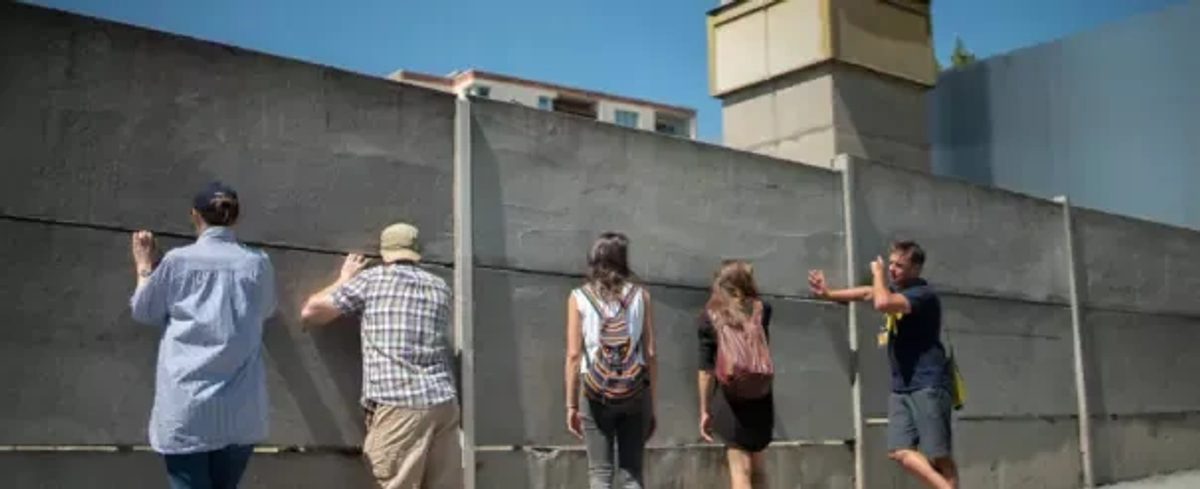
Cold War Berlin: Espionage, Berlin Wall, and a Divided City tour drops you into the cracked concrete and graffiti of a city that remembers. Beginning at Reichstagufer 17, 10117 Berlin — the square beside the Tränenpalast — this three-hour guided walk stitches together the landmarks and hidden seams of a split metropolis. Your guide moves from the Tränenpalast museum through the traffic-scarred spine of the Spree to remnants of the Berlin Wall at Bernauer Straße, where a 1.4-kilometer outdoor memorial preserves a segment of the original barrier and the adjacent death strip. You’ll stand over the sites of Tunnels 29 and 57 and trace the line of watchtowers, chain-link and the original concrete slabs scarred by history.
The route threads past Friedrichstraße’s ghost stations, long-closed platforms that once scraped the underside of the Cold War, and stops at the Admiralspalast, where the SED first organized. The itinerary pulls together physical artifacts — an original East German watchtower, the Window of Remembrance, the Chapel of Reconciliation — with human stories: escape attempts, Stasi surveillance techniques, and the civil-resistance momentum that built toward the Monday demonstrations in 1989. Guides explain how ordinary citizens, under intense observation and pressure, used everything from underground tunnels to coded radio chatter to pry open a repressive system.
What makes this experience special is its balance of material evidence and lived memory. The Wall is not presented as a single object but as a network of streets, stations and public spaces that shaped daily life. Walking the death strip at Bernauer Straße gives a visceral sense of distance and division; riding briefly through the ghost stations reveals how the city’s movement was itself a political battleground. The tour also weaves in surprising local textures: fragments of barbed wire repurposed into street art, the mural of Conrad Schumann frozen mid-leap, and the quiet of the Chapel of Reconciliation rebuilt on a demolished church site.
Practical notes matter. The meeting point is Reichstagufer 17; an AB single trip ticket is required. The pace is urban walking over paved surfaces for about three hours; bring comfortable shoes and a charged phone for photos. This guided walk is a compact, expertly narrated primer on Berlin’s Cold War geography — equal parts museum, memoir and urban field study — and an essential first stop for visitors wanting to understand how the city’s present was carved out of its divided past. Along the way your guide points out small surviving plaques, graffiti layers that mark eras, and everyday storefronts that once served as checkpoints, helping visitors make connections between architecture, policy and personal risk—details that give context to the headlines and make the history of the Cold War legible on Berlin’s streets today.
Route Schematic
Route Schematic: Key Stops
Expect a sequence of emblematic Cold War sites—border halls, theaters, public squares, grand boulevards, and the longest remaining stretch of the Wall—visited in a walking itinerary that may vary day to day.
Meeting Point – Tränenpalast (Reichstagufer 17)
Begin on the square beside the Tränenpalast, the former border crossing that framed countless emotional farewells.
Admiralspalast
See the historic theatre where the SED was formed in 1946 and hear how that event shaped East German politics.
Alexanderplatz
Stand at the heart of East Berlin and learn about the massive 4 November 1989 protest and its role in the fall of the regime.
Karl‑Marx‑Allee
Stroll this grand socialist boulevard to examine East German architectural ambition and hear accounts of the 1953 workers’ uprising.
The Stasi
Learn how the East German state used an extensive surveillance network to monitor and control everyday life.
East Side Gallery
Finish along the longest remaining stretch of the Berlin Wall, now transformed into a powerful open‑air gallery of murals and memory.
This is a walking tour lasting about 3 hours; the route is intended to follow the listed stops but is subject to change on any given day should unforeseen circumstances arise.
Highlights
Outing Highlights
Tränenpalast: Farewells at the Palace of Tears
Begin beside the Tränenpalast, the former border crossing whose daily goodbyes put a human face on a divided Berlin. The site frames much of the tour’s narrative about separation and reunion.
Admiralspalast and Alexanderplatz: Power and Protest
Visit the Admiralspalast, where the Socialist Unity Party (SED) was founded in 1946, then stand at Alexanderplatz—the heart of East Berlin and the scene of the 4 November 1989 mass protest that helped bring down the regime.
East Side Gallery: From Division to Open‑Air Gallery
Walk alongside the longest remaining stretch of the Berlin Wall at the East Side Gallery, where vibrant murals now cover a structure that once shut a city in two.
What the day feels like
What it Feels Like
The tour moves on foot through former borderlands and public squares, layering architecture, eyewitness stories and archival context. From the intimate atmosphere of a border hall to the broad sweep of Karl‑Marx‑Allee and the painted concrete of the East Side Gallery, the guide connects fragments of place into a running narrative of surveillance, escape and peaceful revolution.
Suitability
Who it's for
Who gets the most from this tour—and who should check first.
Practical planner
Details to review before reserving
The tour runs approximately 3 hours.
Meet on the square beside the Tränenpalast at Reichstagufer 17, 10117 Berlin.
The itinerary covers multiple outdoor and urban sites along a walking route; the route may change on any given day due to unforeseen circumstances.
Review cancellation policies before reserving.
Frequently asked questions
Planning Your Outing
Where is the meeting point?
The tour begins on the square beside the Tränenpalast at Reichstagufer 17, 10117 Berlin.
How long is the tour?
The tour lasts approximately 3 hours.
What sites will we visit?
Highlights include the Tränenpalast, Admiralspalast, Alexanderplatz, Karl‑Marx‑Allee, coverage of the Stasi, and the East Side Gallery, among others.
Is this tour suitable for children?
Yes; the tour listing notes it is 'for all ages'.
Can the route change on the day?
Yes—while the provided itinerary indicates the planned route, it is subject to change on any given day should unforeseen circumstances arise.
Will we learn about East German surveillance and the Stasi?
Yes. The guide covers how the East German state maintained control through an extensive surveillance network and how that shaped daily life.
How this guide was prepared
This field guide is synthesized using verified supplier specifications, route descriptions, and destination data. Some booking links may generate affiliate revenue for ADV Guides.
- Verified: 2026-09-05T19:27:43.958Z
Some booking links may generate revenue for ADV Guides or The Adventure Collective.
Availability, pricing, schedules and operating details can change.
Trip details and contextual sources were reviewed by ADV Guides Editorial.