SANTA BARBARA WHALE WATCH FIELD GUIDE
Gray Whales on the Long Run: Up‑Close Watching from Santa Barbara Harbor
A 2.5–4 hour cruise from Marina 2 to protected coastal waters during the mid‑February–mid‑May migration, where more than 25,000 gray whales pass through each season.
Gray Whales on the Long Run: Up‑Close Watching from Santa Barbara Harbor.
Adventure brief
Gray Whales on the Long Run: Up‑Close Watching from Santa Barbara Harbor
Santa Barbara’s nearshore waters become a corridor of relentless motion each spring as the gray whale migration threads shallow, protected ocean on a 14,000‑mile journey. Between mid‑February and mid‑May, SunSwept Sailing runs 2.5–4 hour whale‑watching cruises from Marina 2 that put you into the path of that migration and the region’s broader assemblage of marine life.
Whale watching in Santa Barbara offers a remarkable opportunity to witness one of nature's most incredible migrations. From mid-February through mid-May, over 25,000 Gray whales travel along the California coast, passing right by Santa Barbara’s serene waters. SunSwept Sailing provides private trips that bring you close to these majestic creatures, including the tender moments between mothers and calves, particularly active in April. The Pacific Ocean's gentle waves and the region’s protected coastal waters create the ideal setting for peaceful, thrilling encounters. Whether you’re a seasoned nature lover or experiencing whale watching for the first time, this adventure has something magical for everyone. The boat crews are knowledgeable and passionate, sharing insights about whale behavior, local marine life, and conservation efforts. Alongside the whales, keep an eye out for playful dolphins and sea birds adding to the vibrant ecosystem. Santa Barbara’s mild weather and stunning coastal views make it an exceptional location to enjoy this activity, combining relaxation with unforgettable wildlife encounters. This private experience offers personalized attention, ensuring the best possible sightings and moments to cherish. It’s an ideal way to spend quality time with family or friends, creating lasting memories amidst one of California’s greatest natural spectacles.
Route Schematic
Typical route and stops
A standard outing departs the harbor, runs to protected nearshore whale habitat for dedicated viewing, then returns to the slip.
Marina 2 — Departure
Guests meet and board at Marina 2 in Santa Barbara Harbor before departure.
Transit to Protected Coastal Waters
The boat moves into the shallow, protected coastal corridor where the gray whale migration funnels past the coastline and where other marine species are often encountered.
On‑site Whale Viewing
The captain and crew locate and approach whales for up‑close viewing with an emphasis on safety and minimal disturbance; mothers and calves are frequently observed in April.
Return to Harbor
After 2.5–4 hours the vessel returns to Marina 2 to disembark.
Boarding requires navigating a series of steps; the slip and vessel are not ADA accessible without risk, and final embarkation is at the captain’s discretion in compliance with USCG safety regulations. Passengers with mobility or weight‑concerns should contact the operator ahead of booking.
Highlights
Outing Highlights
25,000 Gray Whales Passing Through
Each season an average of 25,000 individual gray whales migrate along the Santa Barbara coast; from late winter into spring the protected shallow waters offer prime opportunities for sighting the long‑distance travelers.
More Than Two Dozen Species to Watch For
Marine wildlife sightings in Santa Barbara are possible year‑round, with over 28 different species of whale, dolphin, porpoise and pinniped regularly recorded—an expansive cast beyond the migrating grays.
Mothers and Calves in April
During April sightings of mothers and calves are common, offering some of the most intimate and memorable encounters of the season.
What the day feels like
What the cruise feels like
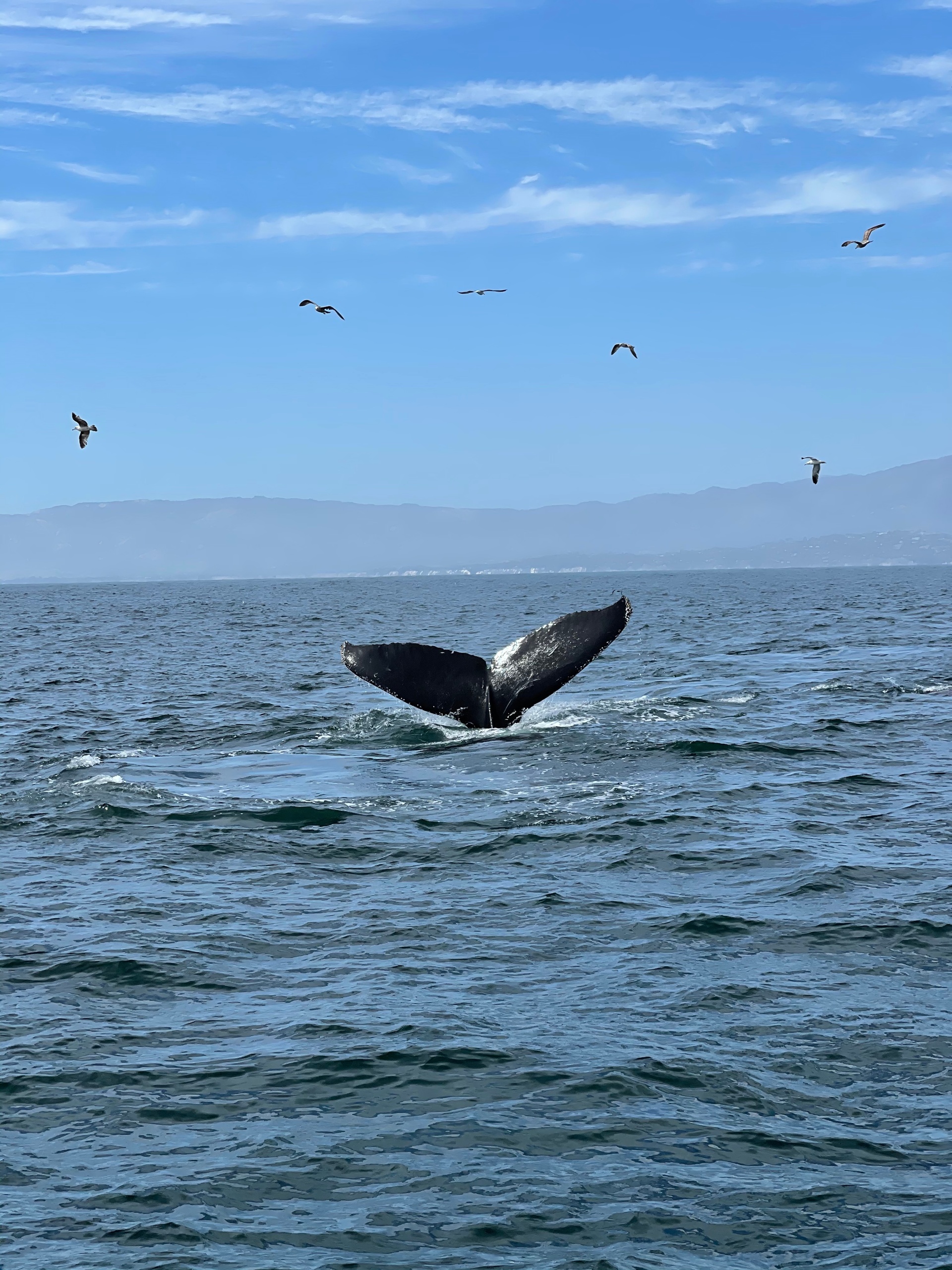
Boarding at Marina 2, you slip out of the harbor into cooler, wind‑scoured air and a taut horizon. Over the next 2.5 to 4 hours the crew searches protected shallow waters for spouts, flukes and the slow, rolling breaths of migrating gray whales, punctuated by sightings of dolphins, porpoises and seals. When a mother and calf are located—most often in April—everything tightens into a hush as the boat eases close for viewing under the captain’s guidance.
Suitability
Who it's for
Who this trip suits—and who should plan alternatives.
Practical planner
Details to review before reserving
Dress in layers—conditions are typically about 10º cooler on the water. Bring a hat, polarized sunglasses and a camera. Use non‑aerosol, reef‑safe sunscreen; spray sunblock is not allowed aboard.
If you forget a jacket, the Kelpie carries warm blankets for passengers.
Review cancellation policies before reserving.
Frequently asked questions
Planning Your Outing
Can we have more than 6 passengers in our party?
No. U.S. Coast Guard federal law prohibits uninspected passenger vessels from carrying more than six paying passengers; this includes children and infants.
Is the Kelpie wheelchair accessible?
No. The vessel is not wheelchair accessible; however the crew can assist guests who can walk a step or two and go down and up two stairs. If a guest is completely wheelchair bound, call the operator to discuss needs.
Can I bring my dog?
Pets should be left at home—varnished surfaces aboard the Kelpie can be damaged and sudden movements could put animals at risk.
Do the crew accept gratuities and how much should we tip?
Gratuities are customary. The operator outlines industry norms: roughly 15% for mediocre service, 20% for good service, 22–25% for great service, and 30%+ for outstanding service.
Will we see mothers and calves?
Mothers and calves are commonly seen in April during the migration through Santa Barbara’s protected coastal waters.
Why do captains emphasize safety and experience?
Captains are U.S. Coast Guard licensed Masters with thousands of days at sea; that training underpins professional standards for safety and navigation aboard the vessel.
How this guide was prepared
This field guide is synthesized using verified supplier specifications, route descriptions, and destination data. Some booking links may generate affiliate revenue for ADV Guides.
- Verified: 2026-08-13T22:11:53.429Z
Some booking links may generate revenue for ADV Guides or The Adventure Collective.
Availability, pricing, schedules and operating details can change.
Trip details and contextual sources were reviewed by ADV Guides Editorial.