FUSETA BOAT RENTAL FIELD GUIDE
On the Water with Flamingos: Birding the Ria Formosa from Fuseta
A two-hour, skipper-guided boat outing from Fuzeta that surveys the Ria Formosa Natural Park’s wetlands and its resident and migratory birds.
On the Water with Flamingos: Birding the Ria Formosa from Fuseta.
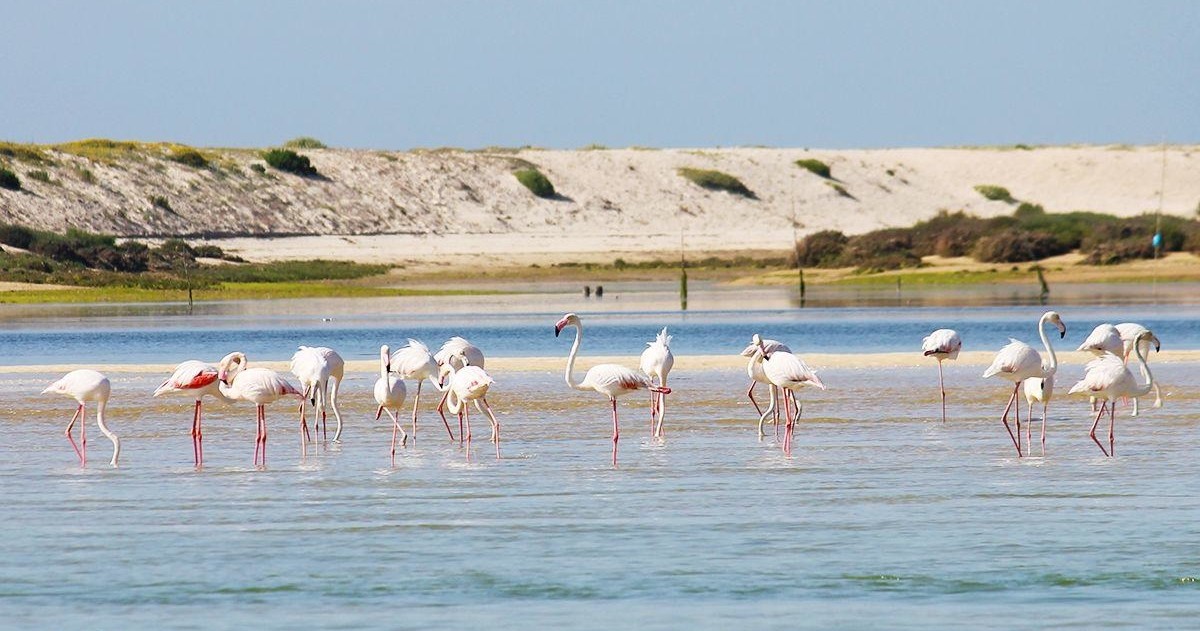
A braided landscape of sand barriers, dunes, salt pans and lagoons, the Ria Formosa Natural Park unfolds off Fuseta as one of Portugal’s most important protected wetlands — a Ramsar site and one of the country’s noted natural wonders. In a brief two-hour outing you scan habitats that host hundreds of species year-round, sheltering tens of thousands of waterbirds in winter and serving as a crucial stopover for migrants between Europe and Africa.
Highlights
Outing Highlights

Extraordinary species diversity
Ria Formosa regularly supports more than 20,000 waterbirds in winter and can yield over 200 species in a single day. Expect to encounter a roster that includes black-necked grebe, spoonbill, oystercatcher, flamingo, bar-tailed godwit, Mediterranean gull, cormorant, little egret, grey heron and white stork, among others.

Ria Formosa — a protected coastal wetland
The reserve covers some 14,000 hectares protected by a complex web of sand barriers and dunes that extend roughly 60 kilometers along the coast—habitats that support waders, passerines and rare, localized species found nowhere else in Portugal.

Skipper-biologist with optics and catalogue provided
The outing is led by a skipper who also serves as a biologist guide; the operator can provide binoculars and a bird catalogue for participants, bringing field identification into reach even on a short tour.
What the day feels like
What this two-hour boat outing feels like
From Fuseta you push out into the lagoon network and move between dunes, mudflats, salt marshes and reed beds, scanning shorelines and shallow channels for waders and waterbirds. The compact, guided format concentrates sightings across diverse habitats, making it possible to see both resident species and migrants on a single short trip.
THE BIRDS
Extraordinary species diversity
Ria Formosa regularly supports more than 20,000 waterbirds in winter and can yield over 200 species in a single day. Expect to encounter a roster that includes black-necked grebe, spoonbill, oystercatcher, flamingo, bar-tailed godwit, Mediterranean gull, cormorant, little egret, grey heron and white stork, among others.
THE PLACE
Ria Formosa — a protected coastal wetland
The reserve covers some 14,000 hectares protected by a complex web of sand barriers and dunes that extend roughly 60 kilometers along the coast—habitats that support waders, passerines and rare, localized species found nowhere else in Portugal.
THE GUIDE
Skipper-biologist with optics and catalogue provided
The outing is led by a skipper who also serves as a biologist guide; the operator can provide binoculars and a bird catalogue for participants, bringing field identification into reach even on a short tour.
Suitability
Who it's for
Who this outing is — and isn’t — for.
Practical planner
Details to review before reserving
The park regularly hosts more than 20,000 waterbirds in winter and supports migrant flow between Europe and Africa; peak concentrations of waterbirds are often observed in winter months.
Binoculars and a bird catalogue can be provided by the operator; consider sun protection and clothing appropriate for a short boat trip.
The outing departs from Fuzeta; the scheduled duration is two hours.
Review cancellation policies before reserving.
Frequently asked questions
Planning Your Outing
How long is the birdwatching outing?
The trip duration is two hours.
Where does the tour meet or depart from?
The meeting location is Fuzeta, Portugal.
Are binoculars provided?
Yes — the skipper/biologist guide can provide binoculars and a bird catalogue.
What species might I see on the tour?
Typical species include black-necked grebe, spoonbill, oystercatcher, flamingo, bar-tailed godwit, Mediterranean gull, cormorant, little egret, grey heron and white stork, among others.
Why is Ria Formosa important for birds?
Ria Formosa is a Ramsar-designated protected wetland that covers about 14,000 hectares with sand barriers and dunes along roughly 60 kilometers of coast; it regularly hosts large numbers of waterbirds and is a crucial stopover for migrants.