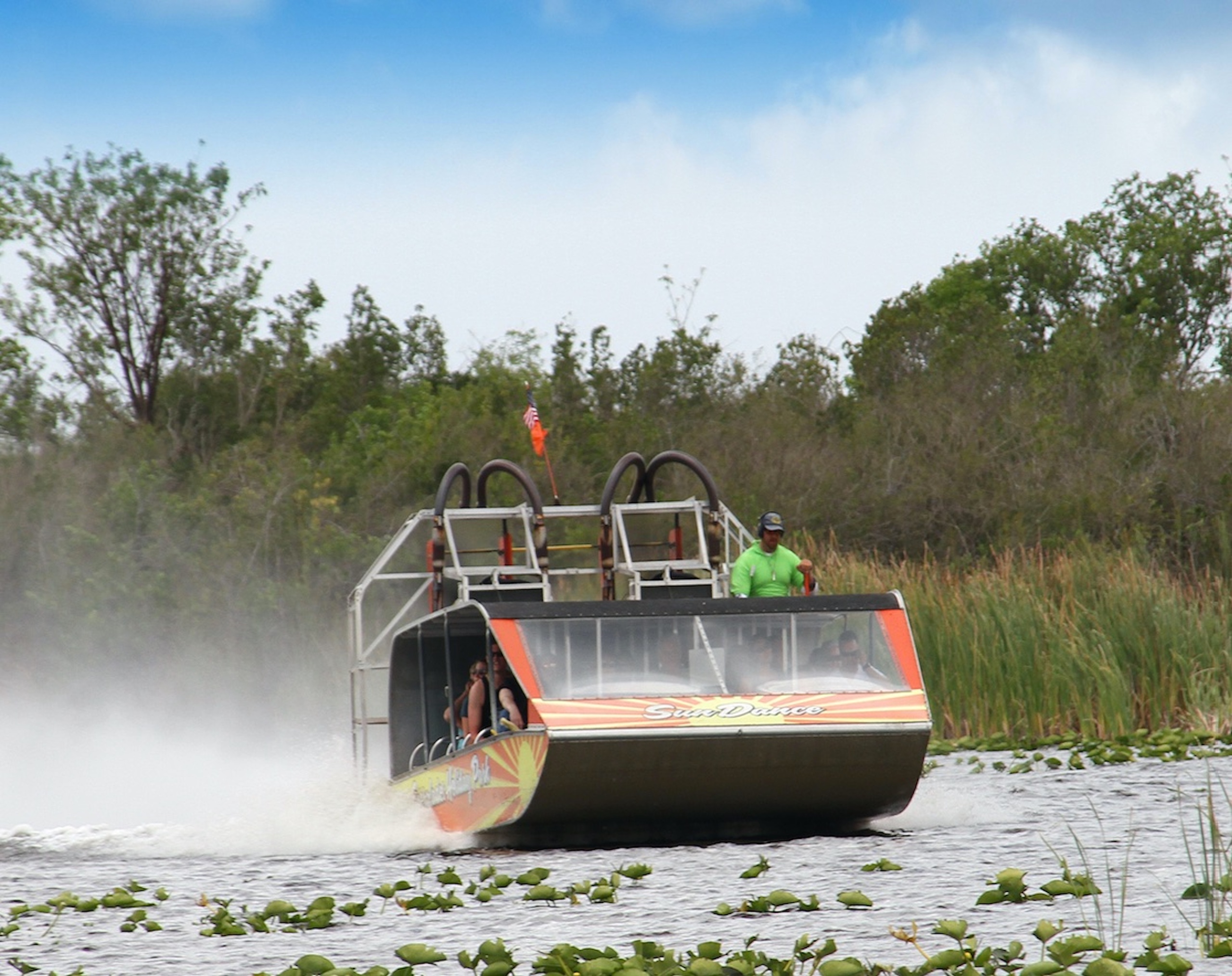
Airboating near Hialeah is less about wilderness solitude than it is about access—quick access to a landscape that feels primordial the moment the motor cuts loose and the sawgrass opens into broad water. The Everglades here is a shallow, slow-moving sheet of water that in the dry months reads like an alternately cracked and polished canvas, punctuated by islands of hardwood hammock and ribboned mangrove edges. Airboats are engineered for this exact environment: flat-bottomed hulls and a high-mounted fan keep propellers and disturbance above the fragile bottom, allowing guides to thread through channels invisible from shore. For travelers based in Hialeah—where cars, commerce, and dense suburbia give way to marsh within a few miles—an airboat tour is a swift doorway into an ecosystem that hosts alligators, wading birds, turtles, and migratory species in a single viewing.
There’s a tactile clarity to a good airboat run. Wind and motor produce a steady roar and a fine mist of marsh smell—earth, decayed grasses, sun-warmed water—that serves as context for the sights: a mottled alligator sunning on a grassy knoll, a heron frozen like a sentinel, the flash of a kingfisher. Guides on these trips are storytellers and stewards; their narration stitches local ecology to human history—the Seminole and Miccosukee peoples who have navigated these waters for centuries, early 20th-century drainage projects, and modern conservation efforts that aim to protect water flow into the Everglades. That combination of speed, sensory immediacy, and contextual interpretation is what pulls visitors back. Complementary adventures—kayak trips through mangrove tunnels, guided birding walks, and fishing outings—are easy add-ons for visitors who want a slower, quieter counterpoint to the airboat’s kinetic energy.
Airboats make seasonal differences legible. In the dry season (roughly November–April) wildlife concentrates in remaining water, making sightings more reliable; in the wet season (May–October) the marsh expands and boat routes open to places unreachable in dry months.
Operators vary: some run fast, adrenaline-focused rides while others emphasize natural history, photography stops, and quieter cruising. Choose based on whether you want speed or interpretation.
Tours are accessible to families and beginners; many operators offer short rides that suit first-time visitors, plus longer eco-tours for birders or photographers.