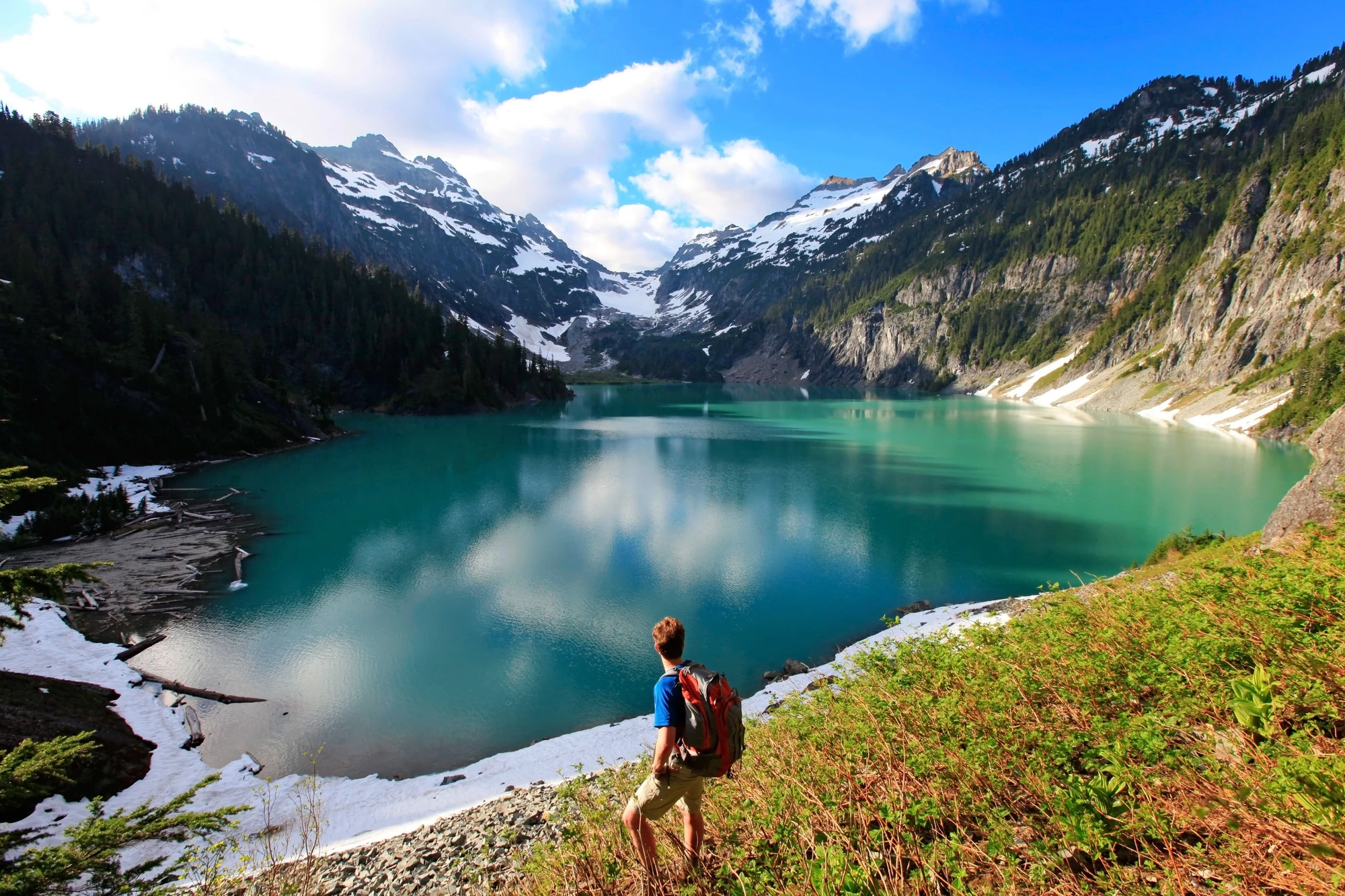
A breath of cold air bites at your cheeks as the forest opens and the lake arrives like an impossible gem. Blanca Lake sits cupped beneath knife-edged ridgelines in the Henry M. Jackson Wilderness—its color a startling, highlighter-green blue that shifts with the sun and the motion of wind across the surface. For much of the climb you move through a cathedral of western hemlock and Douglas fir, but toward the top the trees thin, talus fields take over, and the trail pivots to expose one breathtaking, wind-scoured view after another. By the time you step onto the moraine above the shore, you understand why hikers call Blanca a reward earned: 8 miles round-trip and roughly 2,700 feet of elevation gain condense into a visual punch that makes the sweat worthwhile.
The lake’s color is not fantasy but geology. Blanca’s brilliant hue comes from glacial silt—rock flour—ground from the surrounding glaciers and carried into the lake by meltwater. That sediment refracts sunlight in a way that gives the lake its signature color, and it’s the same reason you’ll see similar tones in a handful of alpine basins across the Cascades. The Henry M. Jackson Wilderness that holds Blanca was designated to protect these high-country waters and the forests that feed them, and the lake’s remote feel—accessible only on foot—helps preserve that fragile clarity.
This hike wears a mixed personality. The first miles are rooted in the quiet of old-growth forest: moss-draped logs, fern understory, and the occasional thrum of a winter-run stream daring you to linger. The middle section climbs relentlessly, switchbacking up through fallen trees and exposed roots. The last push moves into rock, and the trail becomes less a path than a route—steps cut into packed earth and carved into talus—where balance and attention matter. The final panorama opens with a suddenness that always gets a reaction: the jagged skyline, a glacier’s white edge somewhere up-valley, and the lake below, too vivid to be accidental.
Culture around Blanca is modest and outdoors-first. Darrington, the nearest town, is a logging and outdoor-recreation community where people swap trail information like weather reports. Monte Cristo’s mining ghosts sit not far away—remnants of 19th-century prospecting that remind visitors the Cascades have long been a place people risked a lot for big rewards. Those echoes of history sit lightly against the dominant story here: wilderness, access, and stewardship. Leave-no-trace principles apply in spades; human impact is visible in campsites along the lower trail and in the erosion that follows heavy use, which is why planning and packing right are part of the experience.
Practical guide: the Blanca Lake trail is often described as 8 miles round-trip with about 2,700 feet of elevation gain; expect 4–6 hours depending on fitness and photography stops. The trailhead sits on a Forest Service road—unsealed in places—so a vehicle with adequate clearance and attention to potholes helps. Parking fills up early on summer weekends; arrive before 8 a.m. to secure a spot and avoid crowded shorelines.
Trail conditions vary by season. Snow lingers into June some years, turning the middle slopes into a travel corridor that may require traction devices or microspikes. After high summer the route is largely dry but hot on exposed sections; water sources are plentiful early on but scarce above the treeline, so carry at least 2 liters per person and a filter if you plan to camp. The last approach to the lake includes steep, loose rock; treat it like a scramble and keep your center of gravity low.
Camping is possible, but campsites along the immediate shoreline are fragile and limited—check Forest Service rules before stepping off-trail to pitch a tent. If you plan an overnight, aim for dispersed sites away from water and pack a low-impact stove rather than building a fire.
Safety and etiquette: bring a map and know basic navigation—cell service is intermittent. Watch for changing weather; afternoons can bring thunderstorms. Dogs are allowed but expect exposure and rough terrain. If you encounter anglers or climbers, observe the same courteous trail protocols—step aside, lower voices near campsites, and pack out what you pack in.
Why go? Blanca Lake distills the North Cascades into one concentrated, high-reward hike: a forested approach, a stiff climb, and a dramatic alpine bowl whose color seems animated. It’s approachable for strong day-hikers and perfect for photographers who want saturated lake shots without technical climbing. For backpackers, it’s a short, high-elevation overnight with a show-stopping sunrise.
The lake asks something of you—fitness, attention, and a respect for fragile alpine systems—and repays that currency generously. When you stand on the moraine and the wind plays across the water, it’s easy to feel that this is one of those places the Cascades saves specifically to remind visitors why they came: for light, space, and a view that compels you to sit and look longer than you intended.