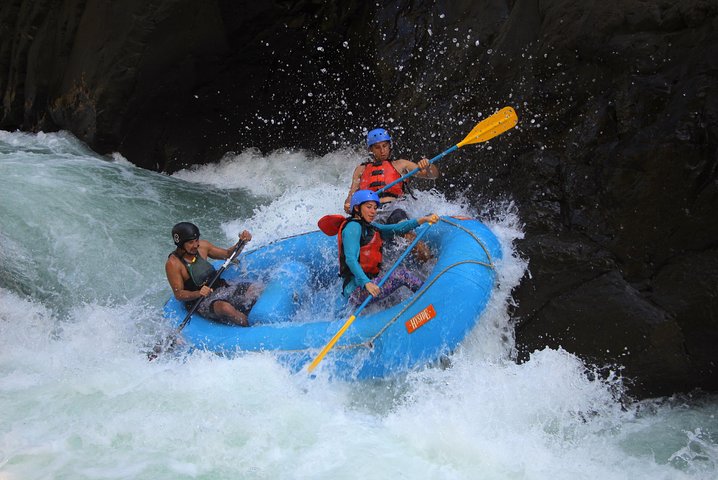
The raft nose bobs, then drives into a wall of water: a brief, violent inhale of the Naranjo River that throws spray into your face and leaves you laughing in a voice washed raw by adrenaline. Around you the canyon narrows, granite boulders crowd the channel like the teeth of some patient beast, and the rainforest presses close — orchids and ferns clinging to damp rock faces, a cascade somewhere upstream that seems to be daring you to look away. For 90 minutes of river time on the Chorro section, the world reduces to the rhythm of paddling, the guide’s commands, and the current that always, insistently, wants you downstream.
This is not a mellow scenic float. The “Chorro” run of the Naranjo River is Class IV–V: steep drops, tight technical lines, and sudden surges that punish hesitation and reward commitment. It’s the kind of river that makes you feel alive because it asks something of you — attention, teamwork, and a steady heart. For people who come with strong fitness and a taste for big water, it’s a highlight of Costa Rica’s Central Pacific that pairs rainforest theater with genuine whitewater intensity.
Geology and rain have carved the Naranjo into the canyon you raft today. Decades of high flows grind and rearrange the boulders, creating ledges and holes that, in the right (and occasionally wrong) combinations, become the rapids you read about. That geology sits inside one of the world’s richest ecological theaters. The Manuel Antonio–Quepos corridor is biologically dense: monkeys, toucans, and macaws move through the canopy above while the river corridor provides crucial habitat and migration routes for freshwater species.
Locally, river runs like Chorro are part adventure economy, part conservation partnership. Guides point to riparian trees and channel shifts with the same conversational ease as they shout commands over the roar of rapids; many operators hire bilingual local guides and safety kayakers and emphasize minimal-impact practices. Practical tourism dollars from trips help support communities in and around Quepos and Manuel Antonio, and responsible operators often contribute to watershed protection or community projects.
What makes Chorro distinct is the combination of raw technical river running and the accessibility for visitors who base themselves in Manuel Antonio or Quepos. The Viator-operated trip runs roughly 4.5 hours from pickup to drop-off, with about 1.5 hours on the water. The price point is competitive — starting around $118.65 — and includes bilingual guides, a safety kayaker, lunch, hotel transport to/from Manuel Antonio or Quepos, and a photographer who captures the runs for purchase. The trip is aimed at people who are physically fit and eager for a serious whitewater challenge.
If you go: timing matters. The Central Pacific’s wet season (roughly May through November) produces the higher flows that make Chorro’s rapids more pronounced and the lines more exciting; the dry season mellows things. Either way, expect the river to be demanding, your muscles to get a workout, and your smile to last the entire afternoon.
Practical guide: show up hydrated, with a modest breakfast, and ready to move. The operator provides helmets, PFDs, and safety instructions; you provide the effort. Wear secure footwear that won’t come off if you go for a swim, and don’t neglect reef‑safe sunscreen — the river and its downstream estuaries are living systems that benefit from small, thoughtful choices. On the logistical side, most travelers fly into Juan Santamaría (SJO) in San José and drive or transfer to Quepos/Manuel Antonio, or catch a short regional flight into Quepos (XQP). Expect cell service to fade in the canyon and for photographic opportunities to come from both onboard shots and the photographer following certain rapids.
The Chorro day is elegant in its simplicity: pickup, safety briefing, shuttle into the watershed, then the river’s work. You will get wet, you will laugh at your own shrieks, and, if your team reads the river right, you’ll punch through rapids that look like offline monsters in a guidebook. At the end of the day, a good lunch — typically local, fresh, and generous — is waiting.
Who should book? Experienced paddlers comfortable with Class IV lines will be happiest, but solid novices with a steady baseline of fitness and a willingness to follow commands can also have a safe, unforgettable day with the right guide team. If you want to build a Costa Rica adventure around more than the river, base in Manuel Antonio to combine rainforest trail hikes, beach time, and the region’s lively gastronomy.
Done well, an outing on Chorro is the perfect balance of adrenaline and place. The river asks for your focus and returns it with one of the better kinds of exhaustion: that wide, quiet smile in the shuttle back to town, a camera full of spray-framed grins, and a hunger for the next adventure. For anyone chasing the idea of Costa Rica as a wild, active playground, the Naranjo’s Chorro section is an uncompromising, utterly rewarding introduction.


