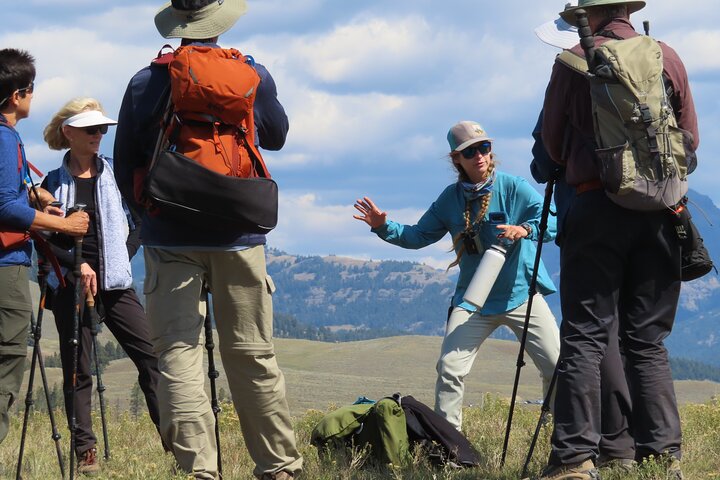
Before the sun breaks fully over the rim of the volcanic caldera, a low rumble moves across the valley—bison exhaling in unison, breath steaming into the cold. You sit in the backseat of a private vehicle as your guide eases onto the shoulder of a two-lane road, points with a gloved finger, and hands you a pair of binoculars. In the patch of sage at the far edge of Lamar Valley, a cinnamon-colored sliver of fur bobs: a bear, foraging at the edge of a river bend. A wolf’s call threads through the morning like an answer. For a day, the park’s Northern loop unfurls as a theatre of animal life, and you are placed exactly where the action is most likely to happen.
This is not luck alone; it’s knowledge and timing. The Private Yellowstone Wildlife Sightseeing Tour focuses on the park’s Northern loop—Lamar and Hayden valleys, river corridors, and the high forest ridgelines where elk, bison, bears, wolves, and pronghorn stage daily dramas. Guides read the land like a script: they know which thermal margins push game toward open meadows, which ridges funnel movement, and where a quiet pullout becomes a theater for a newborn pronghorn or a family of river otters sliding into willow-lined channels. If you want a shot at seeing a bear or wolf in their element, this private approach stacks the odds in your favor while offering interpretive context that turns sightings into stories.
Geologically, the Northern loop rides the rim of the Yellowstone supervolcano. The last caldera-forming eruption left a mosaic of basalts, tuffs, and thermal features—hot springs and fumaroles that feed lush riparian strips against high, wind-scoured plateaus. That juxtaposition—hot ground and cold air, wide-open valleys and jagged forest—creates a variety of habitats concentrated along accessible roads. Culturally, these valleys are the ancestral homelands of Native nations, and later staging grounds for trappers and early park explorers; Gardiner, Montana, at the north entrance, still feels like a gateway town where local outfitters trade stories and maps with travelers.
A private tour is practical as much as poetic. Compared with a free-for-all morning at a crowded pullout, a private vehicle moves deliberately: linger where the wildlife is, avoid the swarm where it’s not, and rely on guides who have radio networks and spotting scopes to triangulate animal locations. This particular offering is tailored to the day—guides may choose Lamar Valley at dawn and Hayden Valley later, or reverse the order depending on animal movement and light.
Planning-wise, expect a long day: tours run roughly 7 to 9 hours, often starting at first light. Dress in layers—the valleys can swing from frosty dawns to warm afternoons—and pack a camera with a long lens or a steady pair of binoculars. Keep meals simple: a thermos, sandwiches, snacks. Respect park rules: never approach wildlife, stay in designated pullouts and maintain safe distances (100 yards from bears and wolves, at least 25 yards from other animals). Private tours also cut through the noise—less time circling for space, more time absorbing behavior, and a higher chance for meaningful wildlife encounters.
Photography and observation etiquette matter. Your guide will likely use a spotting scope for distant shots; bring a telephoto lens (300mm or longer) and avoid loud shutter noises or sudden movements. Window positions matter—if you’re in a vehicle, be aware of which side faces the valley at different pullouts. The best light often arrives at the earliest and latest hours, when animals are most active and the landscape offers long shadows and saturated color.
If you’re curious about logistics, private tours typically depart from gateway towns (Gardiner on the north entrance is common) and include flexible routing across the Northern loop. Because the tour is private, it can adapt for families, photographers, or those with mobility considerations. Expect interpretive stops to discuss geology, predator-prey dynamics, and the park’s conservation history: Yellowstone was designated the world’s first national park in 1872, and its northern valleys have been central to modern wolf recovery, bison management, and ongoing bear ecology research.
Practical tips: book a private spot early—peak-season windows fill fast—and plan for limited cell service in the backcountry. Bring snacks, warm outer layers, and a sense of patience; the reward is the slow reveal of behavior rather than a rushed snapshot. For those who want a guided, immersive day that prioritizes wildlife over mileage, this private option is as close to an arranged field observation as most travelers will get.
For anyone who wants an efficient, expert-led route through one of North America’s richest wildlife corridors, a private Northern loop tour offers focused access, informed narration, and a higher likelihood of seeing the park’s iconic species in their element. Bookings and more details are available through the tour provider’s page: Private Yellowstone Wildlife Sightseeing Tour. If you are plotting a visit specifically for predators or newborn calves, ask the operator about seasonal patterns before you lock in a date. For a day in Yellowstone where the land feels alive and the guidebook reads like a field journal, head north and keep your eyes open—there’s always something moving just beyond the next knoll. Learn more and reserve a guided slot here: Yellowstone's Northern Loop private wildlife tour.