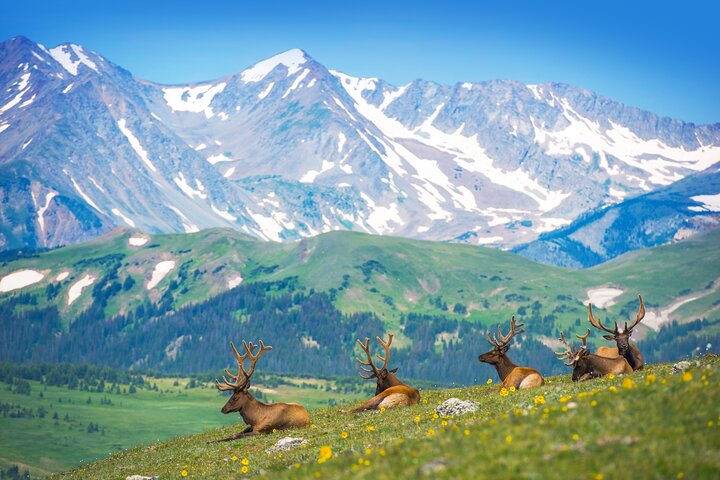
The sun arrives slow and hard in Rocky Mountain National Park, spilling over serrated ridgelines and catching on tiny facets of the remaining snow like a scattering of coins. At 6,500 feet the air still has the chill of morning; by midday the temperature will rise and the birds will sing as if narrating the day's itinerary. You leave Estes Park behind on a narrow park road, binoculars at your chest, and step into a rhythm that alternates between quiet craning and sudden exclamation as the guide lifts a finger and points skyward.
This is not a checklist birdwalk. It is a full-day, personalized exploration led by a naturalist whose altitude-savvy cadence and local knowledge compress a region's seasonal pulse into a single, intense day. Average group size is four, and that smallness matters: at high elevation and in sensitive habitat, a low-profile approach reveals things large groups disturb. Expect to move between montane forest, aspen groves, meadows, and creek corridors—habitats layered by elevation and carved by Pleistocene glaciers. Each zone hosts a different cast of characters: mountain bluebirds glint like lapis against the sage, the bubbly runs of yellow-rumped warblers in willows, and the more forensic sightings—white-crowned sparrows and elusive brown creepers—rewarding patient eyes.
Rocky Mountain National Park is more than birds. The park's jagged skyline and glacially scoured valleys are a lesson in geology: uplifted Precambrian rock and younger intrusions, shaped by ice into cirques and arêtes. The park, established in 1915, sits on lands historically used seasonally by Ute and Arapaho peoples; contemporary conservation programs work alongside guides to honor that history while protecting the habitats that sustain the birds. Conservation-minded guiding is an explicit part of this private day: the operator donates to global wildlife protection and emphasizes low-impact viewing techniques so each sighting is a quiet transaction between human curiosity and animal wellbeing.
What makes the day real for travelers is the specificity. This is a nine-hour experience priced as a private tour (from USD 700), not a herd-style shuttle. It’s timed and paced for comfortable elevation gain—expect roughly 8 miles and about 1,400 feet of climbing spread across well-maintained trails and occasional off-trail, low-impact scrambles to reach overlooks and riparian pockets. The guide will tailor the route to weather, ability, and seasonal migration patterns: spring yields thickets of warblers and the first aerial maneuvers of raptors; summer broadens the spectrum to alpine specialists; fall tightens the window to lingering resident species and migrating flocks.
Practical things: the altitude is a factor. Even steady walkers feel the thin air—pacing, hydration, and a conservative approach to elevation gain make the day enjoyable rather than punishing. Footwear should be supportive hiking shoes or light boots with traction for slick creek crossings and patches of talus. Binoculars and a small spotting scope (often brought by the guide) transform distant silhouettes into field-identifiable features. Bring layers—mornings are jacket weather, afternoons can warm fast, and weather on the Continental Divide changes in the blink of an eye.
Birding here is about listening as much as looking. The guide decodes songs and chirps in real time, translating the forest into likelihood maps: where an American dipper will probe the current, where a Clark's nutcracker caches seeds in the subalpine, or where a fleeting golden eagle might ride thermals over a ridge. The joy of a private hike is the teachable moment: a close approach to an unexpected scrub juncosong, a quiet minute watching a mountain chickadee inspect your hair for nest-building material.
Beyond the birds, the guide threads in local stories: how Trail Ridge Road opened views to early automobile tourists, how high-mountain meadows act as water towers for the Front Range, and how the park's managing bodies balance visitor access with seasonal protections. Visitors leave with more than species lists; they go home with an understanding of the living systems that make sightings possible—and a sense of stewardship.
For those targeting specific seasons, timing matters. Peak songbird activity in the park occurs in late spring and early summer; alpine specialists are most accessible in July and August when snow recedes. The tour is flexible and privately timed, so it can be arranged to hit migration windows or quieter shoulder-season days when timed-entry permits are easier to secure.
If you're a traveler planning this trip, think of it as a day of layered experience: a physical walk through high-country topography, a listening course in mountain ornithology, and a small-scale conservation workshop. The price reflects the private, expert-led nature of the outing and the logistical value of staff who know how to manage pace and safety at elevation. For photographers, the light is honest and fleeting; for families, the learning format appeals to older kids comfortable on the trail. For committed birders, the naturalist's ear and local contacts mean higher probability of quality sightings than a DIY route.
At day's end, you return to Estes Park with a longer list than you expected and a new attention to the way place shapes behavior: how streams dare insects to fly low, how winds push flocks along the spine of the range, and how a single, well-timed quiet moment can yield a lifetime's favorite sighting. The trip is crafted to leave you with actionable skills—how to identify calls at distance, best practices for observing without disturbing breeding birds, and a short reading list the guide will happily share—so the effect of the day extends beyond the trail.
This is a mountain-day of attention. It rewards patience, respects space, and offers the kind of intimate encounters that make you want to come back and give something back in return.


