The neon on 32nd Street does more than light the pavement; it argues with the night. Korea Way—two blocks of narrow sidewalk, stacked signs and stainless-steel exhaust vents—vibrates with steam, spice and karaoke. It’s easy to think of Manhattan’s Koreatown as a single sensory moment: the hiss of a grill, a chorus of soju shots, a bubble tea vendor threading her way through the crowd. But linger and the neighborhood reveals itself as a layered city within a city—an immigrant story folded into the Garment District, a late-night culinary laboratory and a pulse point in Midtown.
Start the evening at the Garment Worker Statue, where many walking tours assemble. From there the street unfolds in quick scenes: a tiled barbecue joint where the grill men work like clockmakers, a hole-in-the-wall dumpling place where steam fogs the window, a glossy café selling sheet masks and K-beauty products, and the inevitable karaoke parlor glowing purple. The air tastes of gochujang and sesame oil; the sidewalks are slick with runoff from tabletop grills. This is urban hiking with a menu.
Koreatown’s history is recent but consequential. The neighborhood grew in the late 20th century, as waves of Korean immigrants settled near the Garment District and commercial rents favored the compact storefronts of West 32nd Street. What began as a handful of restaurants and grocery shops expanded into a dense cluster of businesses catering to residents, students and late-shift workers. The result is a cultural corridor that compresses language, food culture and commerce into a single, walkable block.
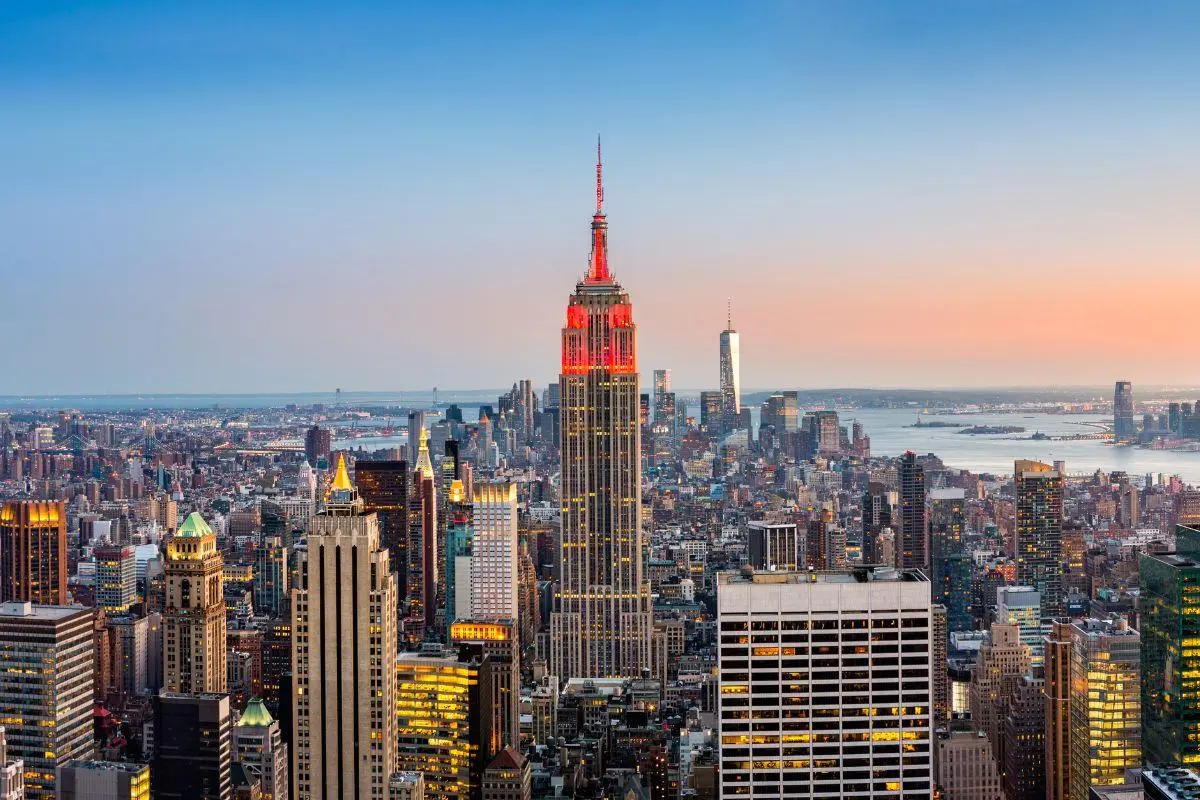
Geographically Koreatown is ordinary Manhattan—flat, paved, punctuated by subway grates—so the real terrain is social and culinary. The best way to explore is on foot, ideally with a local guide who can point out both the classic and the experimental. Walking tours like the Koreatown Food and Culture Walking Tour distill the neighborhood into a three-block tasting route—five dishes sampled at restaurants selected to show traditional, fusion and modern Korean cooking. For travelers who want architecture and skyline context, the Gilded Age Midtown and Empire State experiences fold Koreatown into a broader Midtown walk, ending with a high-up view of the city. And after you’ve eaten your way through Korea Way, a New York Night Open-Top Bus Tour provides a tidy skyline epilogue: the neon of Koreatown is washed away by the Empire State’s beacon and the Brooklyn Bridge’s string of lights.
Practical details are simple but matter. Koreatown is compact—expect 1–2 miles of easy walking depending on side trips into department stores and back alleys. There’s little elevation change; surfaces are typical city pavement, occasionally slippery from grill runoff. Wear broken-in shoes with good soles, and plan to stand or sit on low stools during tastings. Bring a light pack; many stalls are tight and you’ll want your hands free for chopsticks and photo ops.
Timing is part of the experience. Dinner rush in Koreatown is a lived-in ritual: from 6–9 p.m. the restaurants are full and waits are long, but the energy is at its highest. For a more intimate experience, aim for a late table—Korean restaurants here thrive past midnight, and some dining counters stay active until 2 a.m. Weekend nights bring louder karaoke and longer lines; weekday afternoons are surprisingly calm and good for wandering shop interiors and beauty stores.
Health and safety are urban basics. Hydrate between soju shots; the richness of banchan and grilled meats demands water and pacing. Keep a small hand sanitizer on you—the neighborhood’s benches and subway rails see heavy use. Watch for motorized delivery bikes and restaurant staff carrying hot platters; sidewalks narrow quickly.
If you want to make an evening of it, combine experiences. Start with the Gilded Age Midtown walk for historical context, spend late afternoon in Koreatown for a multi-course walking-tasting tour, and end the night on an open-top bus to see Midtown’s lights. Book tours that explicitly include tastings and meet-up points (the Garment Worker Statue is a common landmark). For a solo traveler, guided tours provide not only food but social framing: how to eat a whole live octopus? When to order soju? When to split the bill? These are cultural puzzles solved by local guides.
Koreatown is more than a destination; it’s a lesson in urban adaptation. Its restaurants are laboratories where tradition meets immediacy—one alley will have a 40-year-old bap-jip (rice house), the next a pop-up doing kimchi pancakes with pulled pork. That tension—between old and new, work and nightlife—is what makes Korea Way worth a deliberate visit. Taste widely, walk slowly, and remember that in Koreatown, the night keeps talking.