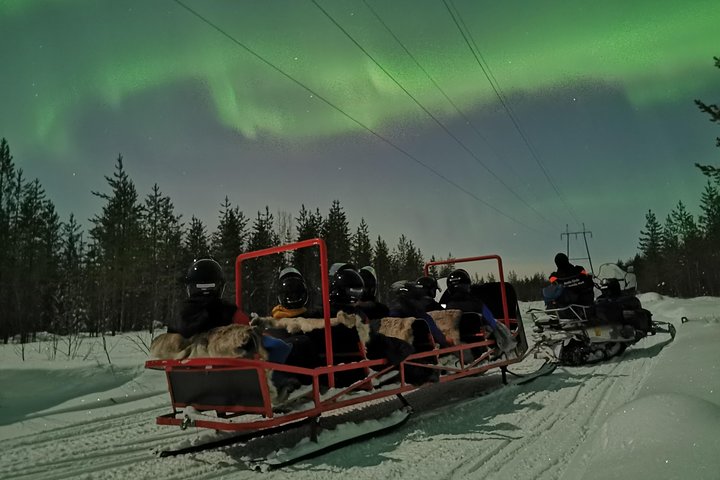
The engine tugs, the sledge sighs, and the forest leans in close—the trees a notch of black against a sky that starts to move. At first the aurora is a green wash, as if the night has been brushed from the inside. Then it tightens into curtains and coils that fold and unfurl like slow-motion waves. The driver nudges the sled across a frozen clearing. The snow underfoot has a voice—soft and cracking—and the night answers with a long, cold breath that smells faintly of pine and metal from the snowmobile. For two hours, you are held between the machine’s steady hum and a sky that insists on performing.
This Northern Lights Sledge Ride out of Rovaniemi is the kind of short, concentrated winter experience that does exactly what it promises: it places you in Lapland’s dark and open places with minimal fuss and the maximum chance to see aurora. The itinerary is compact—a roughly two-hour outing that combines a guided snowmobile transfer with a cozy sledge stop where the aurora chase becomes an act of patience and presence. It’s not a full-blown expedition; it’s a focused nocturnal window into the Arctic night.
Rovaniemi wears its contradictions well. It’s the administrative heart of Finnish Lapland and the modern gateway to deep boreal wilderness, but it’s also the official hometown of Santa Claus and a hub for winter tourism. The landscape here is a product of something older and larger than stories: the Fennoscandian Shield, scoured and scored by Ice Age glaciers, leaves a low, rounded terrain—frozen lakes, peatland, and mixed spruce-pine forest that stretches to the horizon. In the dark, those geological features become cues: a long ridge suggests shelter from wind, an open lakebed becomes a theater for the sky, and the trees frame the lights.
Culture threads through the trip, too. Local Sámi traditions and modern Lappish hospitality coexist—tour operators in Rovaniemi often link aurora tours with Sámi storytelling or local food offerings. Even in a short outing, you’ll hear the practicalities of life above the Arctic Circle: how reindeer were once the highway, how winters shaped architecture and cuisine, and how dark seasons are stitched into local rhythms.
Practicality matters on a night like this. You’re out after dark in Arctic winter: layers are not optional. Most operators provide warm outerwear for the sledge, and your guide handles the snowmobile, route, and safety briefing. Expect to be dropped at a prepared viewpoint with seating, hot drinks, and a small fire or shelter—an intentional pause to keep the experience comfortable while eyes and cameras adjust.
Why book this instead of a longer aurora expedition? Two reasons: accessibility and immediacy. The ride requires little technical skill and takes the guesswork out of transport; you don’t need to drive a snowmobile or navigate the dark. It’s an ideal option for travelers short on time or those who want a guided introduction to aurora watching without committing to an overnight camp.
That said, there are trade-offs. The experience is weather-dependent—clouds can erase the show—and the short duration means you’re banking on luck and timing. If the sky cooperates, the payoff is high: the lights can bloom over a still, snowy vista with the guide pointing out details and offering photography tips. If it’s cloudy, the tour still delivers a crisp night ride through forest and fields that feel wholly remote.
How to make the most of it: arrive on real sleep, bring high-quality batteries (cold kills capacity), and learn a few camera settings beforehand: manual mode, wide aperture, high ISO, and long exposure on a steady tripod or brace. Dress like you’ll be standing still for long periods—base layers, fleece or down midlayer, windproof outer shell, thick wool socks, insulated boots, and mittens. Keep your phone warm inside an inner pocket and avoid touching it with cold gloves; condensation can fog lenses and electronics.
Safety and sustainability are part of the package. Guides know the trails, watch for wildlife, and keep group sizes reasonable. Good operators follow a leave-no-trace ethic, limiting light pollution and picking locations that minimize disturbance to wildlife and local land use.
Two hours is enough to feel the Arctic night: the hush of snow, the sharp bite of air, the surprise of color that moves like a living thing. For many travelers, that compact, high-intensity exposure is the perfect introduction to Lapland—and a reminder that sometimes the most memorable adventures aren’t long; they’re well timed.
If you’re planning this trip from Rovaniemi, pair the sledge ride with daytime exploration: a visit to Arktikum for context, a reindeer or husky farm for hands-on culture, and a slow meal of poronkäristys (reindeer stew) to warm the conversation. Then return to the quiet: the auroras will likely be waiting.


