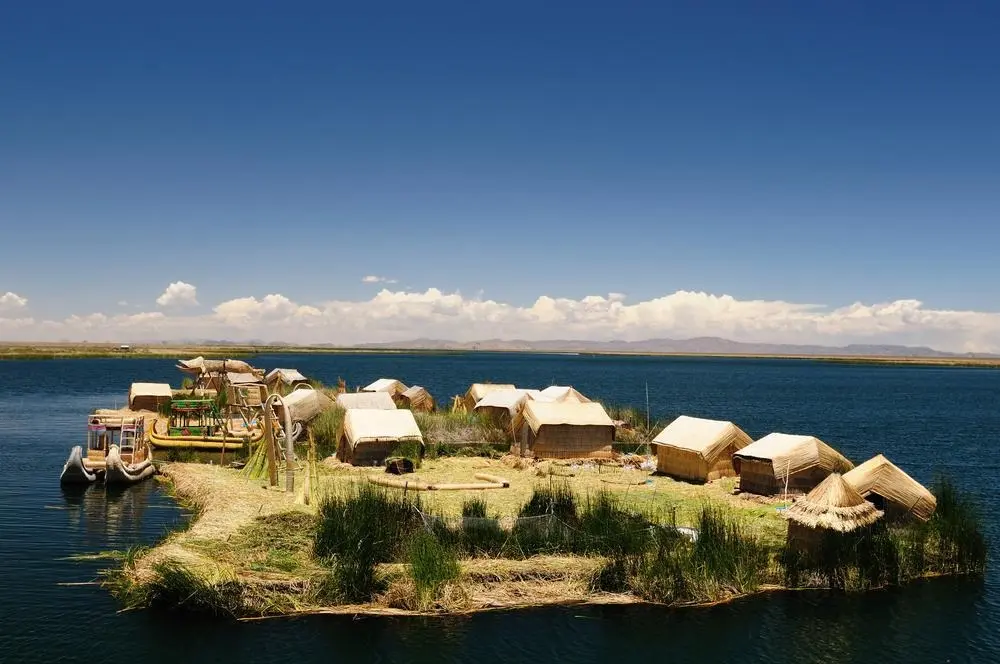
You push off from Puno at an hour when the lake still holds its breath. A thin silver seam of light traces the horizon and the high air tastes clean and unexpectedly cold. At 3,812 meters, Lake Titicaca feels like an ocean that climbed a mountain; the water opens wide around you, and every stroke is an argument with altitude and a conversation with wind. Your kayak cuts past clumps of totora reeds and a village that rises on a buoyant carpet of those same reeds — the Uros floating islands — where reed houses and children smiling into the lens feel both ancient and very much alive.
This is not a postcard of pastoral calm. It is a short, concentrated lesson in geography, culture, and the practicalities of paddling at altitude. The itinerary for the Kayak Adventure on Lake Titicaca brings you close to the living reed islands, where the Uros people sustain a way of life built on the totora reed. You glide beneath seawalls stitched from reeds, watch Andean coots slip like ink spots beneath the surface, and hear stories about a lake that the Inca called a cradle of creation. Along the way the guide teaches basic paddling technique, readies you for quick weather changes, and folds local context into the route so your strokes mean more than simply moving forward.
Lake Titicaca sits on the border of Peru and Bolivia, a tectonic bowl capped by arid plateaus and punctuated by islands with their own dialects and craft traditions. The Uros have been constructing floating islands from totora for centuries; the islands are both a response to historic conflict and a resourceful adaptation to a landscape where land can be as contested as it is sparse. Geologically, the lake is a remnant of a massive endorheic basin carved by glacial and tectonic forces, and its deep, cold waters host species found nowhere else, including the rare Titicaca grebe. Culture and geology sit side by side here, and the human story is inseparable from the reeds that support both house and economy.
Paddling on Titicaca is intimate and elemental. The lake can be placid as glass at dawn and, by noon, toss up whitecaps under a sudden breeze. That variability is why the tour balances technique with empathy for the environment. Guides will insist on short, efficient strokes in crosswind, teach bracing moves, and choose routes that thread between reed beds where birds nest. The work of navigating is also the reward: up-close encounters with reed craftsmanship, conversations with Uros hosts, and a sense of being small on a vast highland sea.
Why do this now, rather than simply watching the islands from a motorboat? Kayaking on Titicaca asks you to slow down and be present with the water. Paddling reduces noise, brings you lower to the reed line, and gives you time to notice things a passing boat can’t offer: the way the subtle currents bend reed mats, the light catching on a wavelet, a heron’s preening routine. For travelers who want a culturally respectful, active experience that mixes a light workout with meaningful contact, this trip fits neatly between a day tour and an immersion trip.
Practicalities matter. The tour is a half-day, roughly four hours on the water, and it starts from Puno, which is the most convenient base. Altitude is the constant consideration — allow a day or two in Puno to acclimatize if you can. Dress in layers, assume strong sun, and bring plenty of water; paddling at 3,800 meters will feel harder than a similar distance at sea level. The guides provide kayaks, paddles, and life jackets, but bringing your own comfort items — a small dry bag for electronics, gloves to avoid hot-spot blisters, and a brimmed hat — makes the trip smoother.
Sustainability and respect are woven into the visit. The Uros islands are living communities; handicrafts and a shared cup of tea are part of the welcome. Buying locally made reed items supports island economies, but avoid removing reed material or asking for staged photo setups that interfere with daily life. Good operators practice low-impact tourism, brief visitors on cultural norms, and share proceeds with host communities.
If you go, aim for the dry months, when the wind is more predictable and mornings tend to be clear. Book an early slot to catch the mirror-calm dawn and to avoid the mid-day wind that can turn smooth water into a workout. Take photographs at low angles to emphasize scale, and follow the guide’s lead when approaching the islands to protect both wildlife and reed structures.
The Kayak Adventure on Lake Titicaca is a short trip with long impressions: it locates you in a place where altitude sharpens sensations, where reeds are both floor and story, and where the quiet between strokes opens the most honest dialogue with the landscape. It’s for travelers who want to feel the lake moving beneath them, to learn with their hands, and to leave taller in their understanding of a place that calls itself both a cradle and a lifeline. For a half-day, you trade convenience for connection — and come away with stories about an ocean at the top of the world.