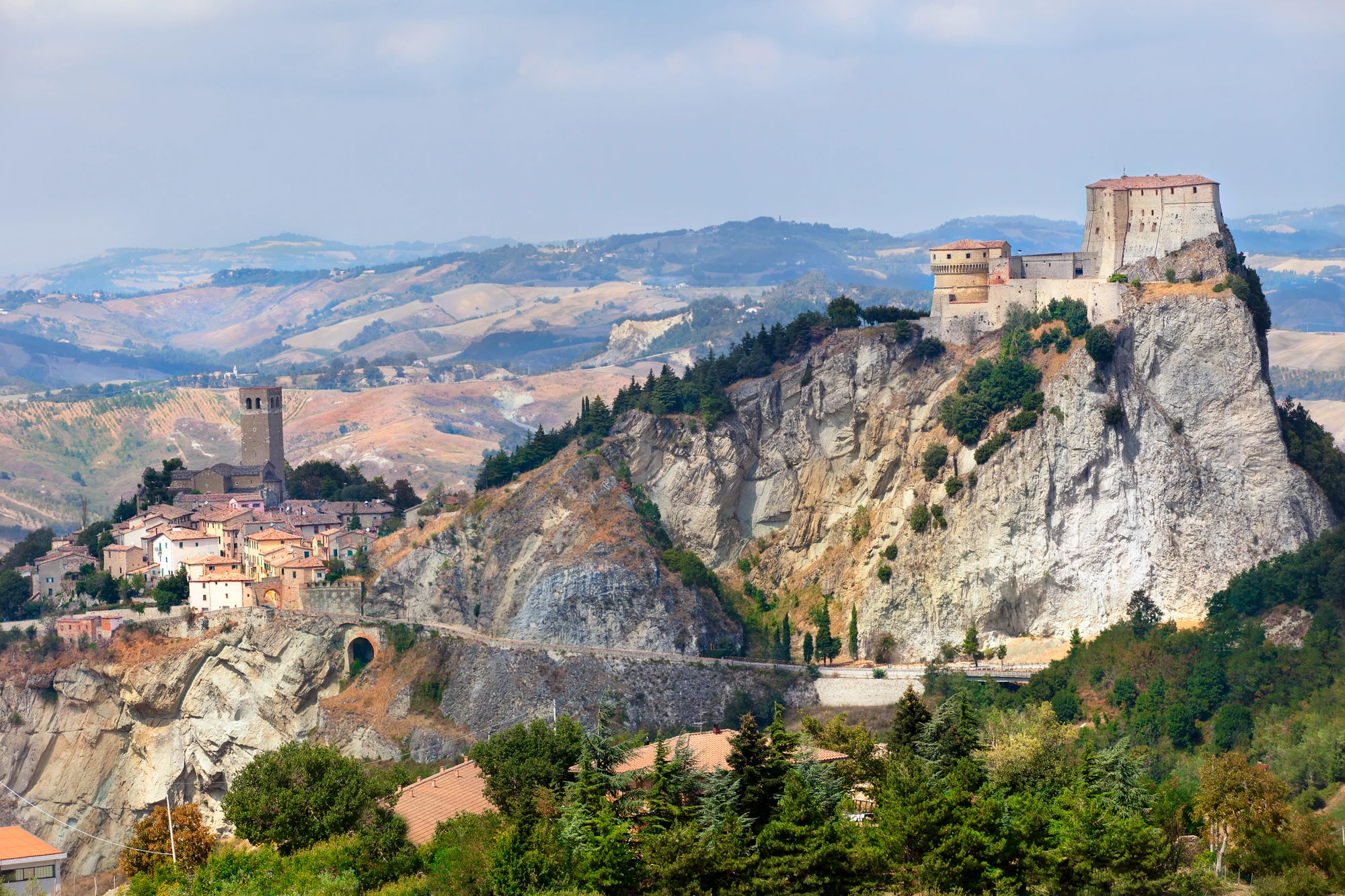
When you arrive in San Leo the town seems to have been set down on purpose—clustered stone houses, narrow alleys, and a single spine of basalt that lifts the fortress like a crown. The first time you walk the curve of the approach road, the fortress resolves itself from a silhouette into a structure of angles and shadow: buttresses catching the light, crenellations standing patient against wind, and a medieval keep that looks less built than grown from the rock itself. The air here has the particular dryness of hilltop towns; it carries the faint tang of sun-baked stone, chestnut trees, and the distant churn of agricultural life on the surrounding folds of countryside.
The Fortress of San Leo is not merely a ruin to gaze at from a distance. It asks to be walked, to be climbed, and to be listened to. A short but steep climb from the town center brings you to ramparts that look over a patchwork of fields and wooded ridges—an amphitheater of the inward-facing Apennine foothills. Wind moves differently up here; it seems to test you, nudging at your balance and reminding you that this was once a defensive vantage, a place chosen for sightlines as much as solidity.
History is tangible at San Leo. The stonework is layered with epochs: Romanesque foundations, medieval expansions, and Renaissance modifications repurposing the fortress as a state prison. It’s famously linked to Alessandro Cagliostro, the enigmatic occultist who died within these walls at the end of the 18th century. That convergence of legend and geopolitics—fortress as refuge, prison, and political instrument—makes a visit feel less like tourism and more like entering an archival room carved from bedrock.
Geology explains the fortress’ stubborn longevity. The outcrop is a hard volcanic or metamorphic plug, more resistant to erosion than the terrain around it; medieval builders exploited this natural pedestal, anchoring walls directly to bedrock. Below, valleys tilt away into agricultural basins where olives, grapevines, and sunflower fields carve the land into human-scale patterns. In spring the hills blush with wildflowers; in late summer the landscape dries to a brittle gold that sets the fortress in bright relief.
This is a place for multiple kinds of exploration. On a practical level most visits are short: the core circuit—climb from the parking area or town gate, tour the courtyard and ramparts, and descend—can be done in 60–90 minutes. For hikers, San Leo acts as a hub: there are ridge trails that extend into quieter woodland tracks, and a loop that follows old mule paths dropping into neighboring valleys for half-day outings of 5–10 km with intermittent elevation change. The most satisfying walks pair the fortress’ history with the nearby landscape—stopping at a vineyard, threading a chestnut grove, or dropping into the hamlet of Torriana to taste local piadina and a glass of Sangiovese.
Practicalities matter: the approach from town is steep but paved, and the ramparts and interior stairs are historic stone—uneven and sometimes narrow—so good footwear is essential. Bring water and a hat: the sun on the exposed parapets can be fierce in July and August. Timing your visit for early morning or late afternoon gives the best light for photos and avoids the crowds that come by day buses in high season. If you want a quieter, more contemplative visit, aim for shoulder season—spring and late fall—when the air is cooler and the town unhurried.
Local culture is modest but distinct. San Leo sits at a crossroads of traditions—cuisine that favors simple, well-made charcuterie and cheeses, the piadina flatbread of the Romagna/Marche borderlands, and wines that are expressive of the local calcareous soils. The town’s small museums and interpretive panels trace the fortress’ use over centuries, and friendly locals—often multigenerational families running a trattoria or a small B&B—are open to short conversations about seasonal farming and the town’s identity.
For travelers who want to layer the visit, combine a fortress tour with a short hike along the ridge or an hour at a local enoteca sampling regional wines. Families with older kids will find the fortress’ battlements exciting and tactile, while history buffs can linger over inscriptions, cannons, and the reconfigured prison cells. Photography enthusiasts should plan for the golden hours; light on the stone is dramatic and the valley vistas reward wide-angle framing.
To prepare: wear shoes with a firm sole, carry at least 1–2 liters of water per person depending on the season, bring sun protection, and check opening times, which can vary by season and local holidays. Respect the site: this is a cultural monument with fragile parts—stay on marked paths and follow signage.
San Leo’s appeal is straightforward—this is a hilltop fortress that preserves the tactile truth of medieval defensive architecture, set in a landscape that refuses to be picturesque only for postcards. It’s a place you can climb into, touch, and leave with an uncomplicated sense of having visited a vantage point in both geography and time. The climb, the air, the view—these are the things that remain when you walk away, a small ledger of a place where stone keeps its stories close and the wind keeps asking you to listen.

