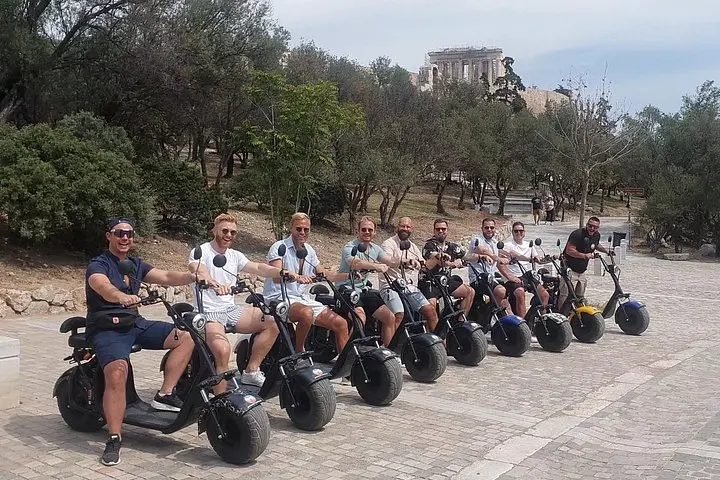
You start on three small wheels and a grin. The Trikke hums under your feet as you roll out from a square where history insists on sharing space with espresso cups and motor scooters. Athens, when approached on two—or in this case three—wheels, loosens its formal posture. Marble columns that once defined empires sit cheek-by-jowl with modern street art; the Acropolis watches like a patient, sun-baked landlord while the city below moves with the confident chaos of everyday life. In ninety minutes you’ll trace a ribbon of this city—narrow alleys, broad plazas, a steep climb or two—and see more than you could on foot, without breaking much of a sweat.
The electric Trikke is an odd little companion: part scooter, part carving skateboard, wholly suited to urban exploration. It lends momentum to the city’s rhythms, letting you slip into neighborhoods that are too compact for cars but too far for a leisurely stroll. Guides thread the route with local knowledge—where to angle for the best Acropolis frame, how to skirt the busiest pedestrian choke points, which streets carry the cleanest air at dusk. The machine invites a playful confidence. You lean, it answers; you push, it obliges.
Athens is a palimpsest. Its oldest stories are written in the stones of the Acropolis—temples dating to the 5th century BCE that still command the skyline. But the city’s modern chapter is written in the cafés of Plaka, the tavernas of Psyrri, and the creative energy of neighborhoods like Koukaki, where rooftop bars offer a view of history lit up in gold each night. Geologically, Athens is folded into a landscape of limestone ridges and shallow valleys; these create short, sharp slopes that give the Trikke its fun—gravity assisting each swoop and roll.
Culturally, a Trikke tour is an invitation to slow down in a hurry. You’ll pass Byzantine churches whose mosaics are so old they feel like private jokes; you’ll hear about Ottoman influences in the city’s layout and taste the persistent Mediterranean thread—olives, lemon, a vivid simplicity of ingredients—woven through neighborhood menus. Locals in Athens tend to treat the past with casual intimacy: ancient stones are part of daily life, not museum artifacts behind velvet ropes. That proximity is a thrill—and a responsibility. Guides emphasize this: stay on designated paths, use respectful volume levels, and photograph without climbing.
Practicalities matter here. The advertised 90-minute tour covers a compact cross-section of central Athens: Monastiraki’s flea-market energy, the layered streets of Plaka, the ascent for an Acropolis vantage point (you’ll get close; entry to the archaeological site itself is not included), and a sweep through the lively Thission and Koukaki districts. Expect paved streets, occasional cobbles, and short inclines—the Trikke’s electric assist smooths the effort but you’ll still need to brace on a few stretches. Speed is city-appropriate: efficient enough to cover ground, slow enough to navigate crowds and tight corners—think 10–15 mph (15–25 km/h) when safe.
Safety is straightforward: helmets are generally provided and should be worn; closed-toe shoes are recommended; keep a small gap between you and the rider ahead in traffic-heavy zones. Morning or late-afternoon departures are best. Midday in summer brings strong light and heat; in spring and autumn you have the light and crowds balanced for photography and comfort. Most bookings offer instant confirmation and free cancellation, so you can adjust plans with confidence.
Why pick a Trikke over a walking tour or e-bike? It’s a sweet spot between effort and access. You feel connected to the city because you’re outdoors, at street level, yet the electric boost means you see more without needing to be a hardened urban athlete. It’s also fun in a way that invites family groups and older travelers who still want pace without strain. And there’s an environmental upside: electric Trikkes emit no tailpipe pollution, letting you experience Athens with a smaller footprint.
On the ground tips: follow your guide’s line in tight spaces; watch for delivery scooters that punctuate Athenian traffic; and bring a small, easily accessible water bottle—hydration in a city of stone matters. When you pause for photos, take a moment to listen: the city has a soundscape of church bells, cafe laughter, the distant lilt of a radio—little human details that frame the monuments.
In the end, the Trikke tour is not about ticking off every site but about translating the city into motion. The ride compresses time in a useful way: you leave having met Athens’ layers—ancient and modern, noisy and quiet—without feeling like you were rushed. You’ll likely dismount wanting more: another glass of wine, a corner taverna, a rooftop to watch the city settle under its evening light. And that’s the point. The Trikke does not replace wandering; it primes you for it.