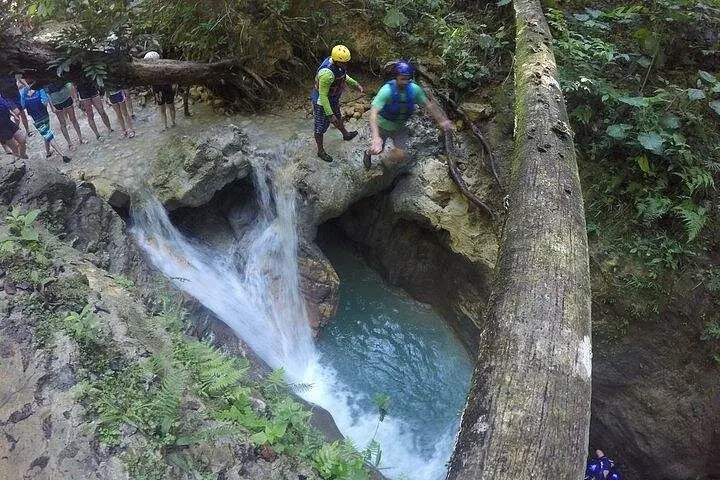
The first time you step into the canyon above Damajagua Falls, the forest seems to inhale around you. Heat and green close in; a mountain stream threads through limestone like a silver ribbon, and the canyon narrows until the sound of water becomes a language — a constant, urgent counting of pools. This is 27 Charcos: twenty-seven natural wells and waterfalls stacked like steps, each pool holding a different shade of turquoise and a different option for how you want to return to the trailhead — a careful wade, a belly-first slide over polished rock, or a belly-lurching jump into deep, cool water.
Start with the hike. Guides lead a scramble of roughly 25–40 minutes through humid rainforest to the top of the first big drop. It’s not a long climb, but it’s steep enough to raise your heart rate and reward you with the canyon’s first clear view: a string of glassy pools cascading away into the trees. From there the day unspools into a choreographed series of natural playgrounds. You move downstream, walking, clambering, sliding, and occasionally leaping. Every pool feels private until the trail deposits you into it — then it feels like a shared secret between you, the jungle, and the stone.
Geologically, the falls are a product of time and limestone. Rainwater dissolved channels into the rock and the river deepened its own route, creating a stairway of basins and small drops. The result is a canyon not carved out of granite but sculpted into smooth runs and bowl-shaped pools that, after a heavy season, are deeper and faster, and in dry months, lower but still vivid.
Culturally, Damajagua anchors a patchwork of northern Dominican life. The approach passes small farms and coffee and cacao plots where locals still cultivate crops by hand, and many of the tour options fold into a broader day: jeep safaris along dirt tracks, visits to small-scale rum and mamajuana producers, or a stop at a local village for lunch. Guides often share local lore between jumps — which pools are safest for a high jump, which rock makes the best slide, and which routes have the best light for photos.
The experience is modular. You’ll find full-day outings from Puerto Plata that combine a 4x4 jeep safari, the Damajagua hike and canyon descent, and a Dominican lunch afterward; others are tailored for cruise passengers and condensed into a tight three-hour window, with guaranteed return times. There are private tours for families and mixed-adventure options that pair the falls with wildlife sanctuaries where you might meet squirrel monkeys before you get wet.
What makes Damajagua work is its variety. There are gentle pools for swimmers who want an easy drift, mid-level jumps and slides for people who want a proper adrenaline fix, and a few cliffs that call to the committed jumper — the highest organized jumps reach about 8 meters (25 feet), with walk-arounds available for anyone who would rather not climb. Safety is taken seriously: licensed guides provide helmets and life jackets, and the route down is managed so groups move in sequence.
Practical details matter. Most guided trips include round-trip transport from Puerto Plata or the nearby resort corridor, entrance, gear, a bilingual guide, and lunch. Total time from hotel pickup to return commonly runs between 5 and 8 hours for full-day adventures; cruise excursions are shorter, typically under four hours ship-to-ship. The canyon portion — the time you actually spend sliding and jumping — typically totals around 2–3 hours.
If you go, bring water, reef or river shoes with good grip, and a secure way to carry a phone or camera (a dry bag or a waterproof case). Expect wet, slippery rock and sun on the exposed pools. Wear quick-dry clothing and a bathing layer underneath. For photographers, early-to-mid morning light is softer in the canyon and human crowds are fewer; late afternoon brings warmer tones but can coincide with return pickups and more traffic on the route.
As with any high-use natural playground, leave no trace. Guides enforce rules about where to jump, how to line up, and where to leave trash. Respecting those rules preserves both safety and the site’s fragile limestone ecology. Many tour operators also work with local conservation groups; choosing an operator that contributes to trail maintenance and community projects keeps dollars in local hands.
Why go? Damajagua is one of those escapes that fits a broad spectrum of travelers. For light hikers it’s a scenic half-day of swims and slides; for adrenaline-seekers it’s a playground of natural rock slides and towering jumps; for cultural travelers it’s a window into the rhythm of Puerto Plata’s rural north. And for the casual observer, it’s simply fun — loud, physical, and a little silly in the best way. By the end of the day you’ll have a handful of stories about a startling turquoise pool, a rock that sent you careening like a toboggan, and the satisfying, exhausted grin that follows a day spent negotiating water and stone.
Book with a reputable guide, come prepared, and allow the canyon to set the pace. The water will test you a little, the jungle will cool you a lot, and the limestone will remind you how patient the earth can be. If you leave a little wetter and a lot happier, you’ve done Damajagua the right way.