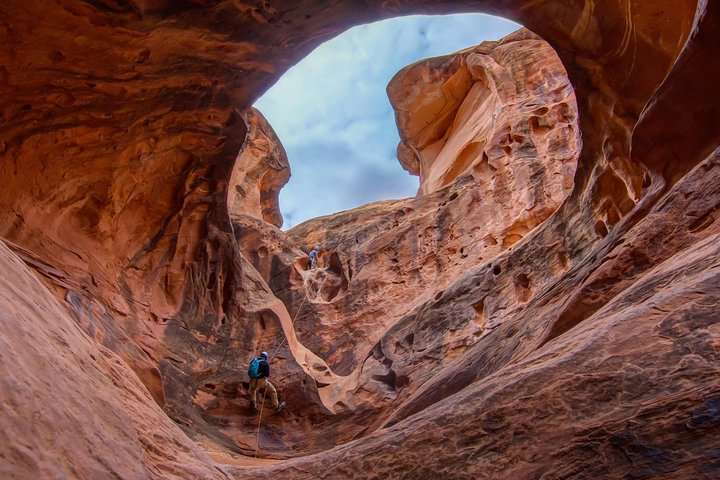
Dawn pulls across the Henry Mountains like a slow breath, the sky rinsed clean after a desert night. The first rappel station waits in cool shadow, a rope coiled like a sleeping snake at your feet. Ahead, the slot narrows to a whisper. Sand shifts, walls lean in, and the canyon tests the story you’ve told yourself about who you are. The rock doesn’t bark orders—it simply invites, daring you to trust friction, to lean into gravity, to move with focus. This is North Wash: a labyrinth of sculpted Navajo Sandstone cleaved by flash floods and time, where the desert keeps its voice low and the lessons are clear.
A day here is less about ticking miles and more about moving deliberately through terrain that changes by the yard. Routes vary from friendly introduction to full-body puzzle. One canyon might be a sequence of short, confidence-building rappels and playful downclimbs. Another might slim to a shoulder-width corridor that asks you to chimney, stem, and shuffle. Expect 2–5 miles of travel total, broken by multiple rappels—some as short as 15 feet, some stretching to 80—plus hands-on scrambling and the kind of problem-solving that makes you grin into your helmet. With professional guides managing anchors, safety checks, and route-finding, you get to lean into the good stuff: flow, focus, and the quiet thrill of moving through stone.
North Wash sits south of Hanksville along Utah Highway 95, a corridor where ravens ride thermals and the wind speaks in dry syllables. The geology here is textbook and cinematic. Navajo Sandstone—ancient dunes hardened into rock—has been planed and polished by flash floods into fluted corridors and bottle-shaped chambers. Look closely and you’ll see cross-bedding in the rock: frozen waves of a desert sea from 180 million years ago. To the west, the Henry Mountains loom—famously studied by geologist Grove Karl Gilbert, who used them to describe laccoliths, those mushroom-shaped intrusions of magma that uplifted the overlying strata. In both stone and story, this is one of America’s great open-air classrooms.
History folds in quietly. John Wesley Powell’s survey parties moved within reach of this landscape in the late 19th century, charting both rock and river. Since then, ranchers, miners, and a small constellation of desert towns have marked a modest presence on the land. Today, North Wash is best known in the adventure community for its approachable yet diverse canyons, a place where first-timers can learn the craft and veterans can fine-tune it. The culture that surrounds it is pragmatic and low-key—emphasis on self-reliance, Leave No Trace ethics, and a respect for weather that borders on reverence. Here, forecasts aren’t trivia. A storm fifty miles away can push water through these slots with a force that erases footprints and plans. The canyon does not negotiate; it pushes forward when it chooses.
That’s where a good guide becomes a kind of translator. Expect thorough briefings on movement techniques—how to rappel with control, how to wedge your back on one wall and your feet on the other, how to read a chockstone for a solid handhold. Expect instruction on anchor evaluation and backup protocols. And expect candor about conditions: monsoon season (typically July through early September) demands a heightened sense of timing and go/no-go discipline. When the route is on, though, the payoffs stack quickly. Light knifes down the walls at midday, ricocheting into soft gold. Cool air pools in the slots even as the desert bakes above. The canyon humbles and coaches, shaping your pace until your breathing matches its rhythm.
Practically, plan for a full desert day—8 to 12 hours including drive time from staging points around Hanksville or Moab. You’ll be in harness and helmet most of the time, carrying a small daypack with water, snacks, a shell, and a few personal layers. Shoes with sticky rubber matter more than brand names; the rock rewards traction. In shoulder seasons, neoprene socks can turn icy pools into a nonissue. In summer, early starts are standard to keep heat in check. Winter days can be crisp and beautifully quiet, with ice in shaded potholes that adds both challenge and texture.
For those new to canyoneering, North Wash is a clean entry point. The movement feels athletic but accessible with coaching: belly slides, controlled downclimbs, a rappel or three that turn into moments of pure confidence. For the more seasoned, the network of canyons—Leprechaun, Blarney, Shillelagh, and beyond—offers variations with tighter narrows, longer rappels, and spicier route-finding. No two descents feel the same, and the canyon’s mood changes with light, temperature, and recent flow. Nature is alive here; the rock listens and answers with a firm, unhurried voice.
Safety is straightforward: hydrate early and often, protect the biological soil crust by staying on durable surfaces, and treat anchors with respect—no adding hardware, no carving grooves. Pack out everything, including micro-trash. And always keep one eye on the sky, even when your other is on the next move. The desert is generous, but it keeps score.
End your day dusty and satisfied beneath a big sky, sifting sand from your shoes, already replaying the moment you leaned back over the lip and felt the rope sing through your device. North Wash doesn’t just show you a landscape; it calibrates your attention. That’s the gift. You come for the rappels and the sculpted stone. You leave with a sharper sense of how to move through the world—calm, precise, and ready for whatever the canyon writes next.