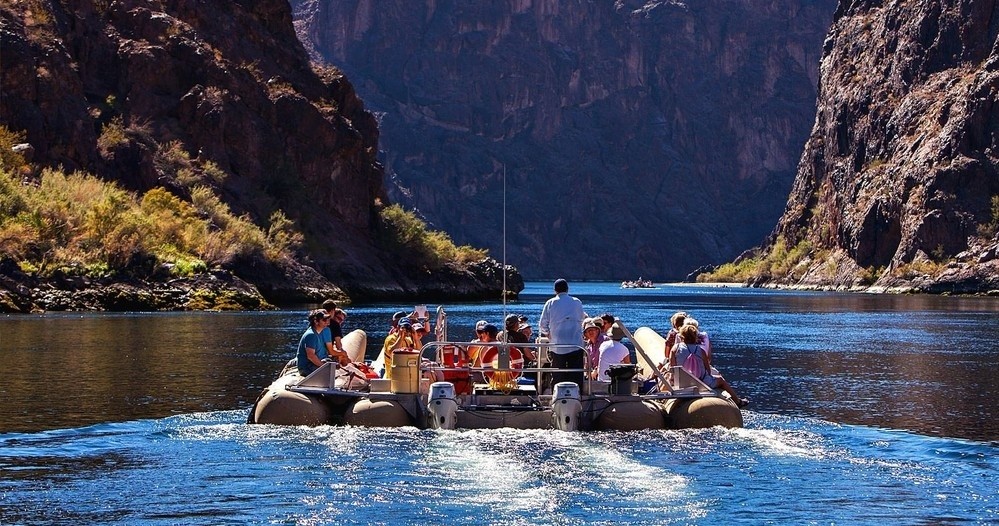
Sun wakes the canyon in slanted gold, and the Colorado River answers with a low, steady murmur. Down here below Hoover Dam, the air feels cooler—like the river keeps its own weather—and the walls of Black Canyon close in just enough to frame the day. You ease into a sturdy raft and push off, the current taking a quiet grip. Ahead, the dam towers like a monolith, a concrete cliff that bends light and dwarfs everything in its shadow. The water is glassy, emerald in places, and the canyon seems to breathe, pulling you forward at a pace that encourages you to look—really look—at the bones of the desert and the audacity of what humans built here.
This is the Hoover Dam Postcard Tour—compact, photogenic, and surprisingly intimate. In two unhurried hours, you drift below the dam and the Mike O’Callaghan–Pat Tillman Memorial Bridge, then slip just far enough downriver to feel the canyon’s rhythm. If your time is tight, this is the essential slice, a distilled encounter with one of America’s great public works that still leaves room for lunch back in Boulder City. To plan or book, use the official page for the Hoover Dam Postcard Tour - Without Transportation: https://app.advcollective.com/local-experts/hoover-dam-postcard-tour-without-transportation.
From the water, history reads differently. Your guide points out the Old Catwalk and the gauging station—relics clinging to volcanic walls, reminders that measuring and moving this river required both science and grit. The rock faces wear scars where hillsides were blasted clean; rusted anchors still grip the basalt like old knuckles. Hoover Dam, finished in 1936, tamed the floods that once bullied the Southwest and powered cities that didn’t yet exist. Boulder City, a tidy community that rose from the dust to house workers, still carries the dam in its DNA. You’ll feel that continuity later—maybe over a pint at Boulder Dam Brewing Co.—but for now the story is water and stone and a raft sliding through it.
Geology here is blunt and honest. Black Canyon’s dark volcanic rock swallows the sun, then reflects it back in heat that can build by mid-day. The river answers with coolness—typically in the low 50s Fahrenheit, even in summer—so the air feels refreshingly toned. A cormorant stitches the current, wings skimming. Great blue herons stand like sentinels. If you’re lucky, desert bighorn sheep pick their way along ledges, unbothered, as if the canyon were whispering the route.
Photographers come for angles you can’t steal from a roadside viewpoint. From the raft, the dam is all converging lines and vanishing points; the bridge, an arc of elegance levitating above the gorge. Toss on a polarizing filter to slice glare and make the water glow. The canyon’s light changes minute to minute—soft in the morning, hotter and higher by noon—so keep your camera ready. More tips, booking details, and timing advice are bundled on the official trip page: https://app.advcollective.com/local-experts/hoover-dam-postcard-tour-without-transportation.
This is not a whitewater day. The river here is mellow—a steady conveyor with occasional riffles—and the raft is packed with Coast Guard–approved safety equipment. Kids settle in quickly. Adults, too. There’s a fruit cup, a cookie, and cold water on board, and the pace invites conversation. You’ll hear about the engineering: 3.25 million cubic yards of concrete, a 726-foot-high wall holding back Lake Mead, power generation that lights homes across the Southwest. You’ll also get the quieter pieces—the old catwalk bolted into the cliff, the way the canyon narrows downstream, how winter light sits like silk on the water.
The practicalities are straightforward. You’ll check in at the west parking lot of Hoover Dam Lodge Casino by 10:30 a.m., meet your guide, and transfer to the launch point. The total time “door to door” from Las Vegas is about four hours, but you’re only on the river for two—ideal if you’re stacking adventures or traveling with a multigenerational group. This tour doesn’t provide transportation, so driving yourself is the plan. That’s a win if you want to linger afterward at Hemenway Park to spot bighorn or detour for a milkshake at The Coffee Cup.
Bring sun protection. The canyon is a solar collector, and the river will bounce light back into your face all day. Wear quick-dry layers and secure sandals or shoes that don’t mind getting wet. Keep your phone or camera in a small dry bag between shots and tether anything you really care about. The river never negotiates when it decides to keep something.
When to go? Spring and fall are prime: mild temperatures, calmer winds, and crisp color in the rock. Summer delivers long light and dramatic shadows under the bridge, but also serious heat—plan the earliest departure you can and hydrate constantly. Winter trades warmth for solitude; the sun tracks low and soft, a gift for photographers. Whichever season you choose, this is a half-day that feels bigger than its footprint.
It’s easy to overlook short experiences in a landscape that promises big, bigger, biggest. But brevity can sharpen the senses. Two hours on the Colorado is enough to feel the river’s pulse and the canyon’s personality. The dam looms, yes, but the place does not bow to it. The canyon goes on being a canyon; the river keeps shouldering west. You step off the raft lighter, with photos that look like postcards and a memory that feels like you stayed longer than you did. Ready to go? Start with the Hoover Dam Postcard Tour - Without Transportation here: https://app.advcollective.com/local-experts/hoover-dam-postcard-tour-without-transportation.


