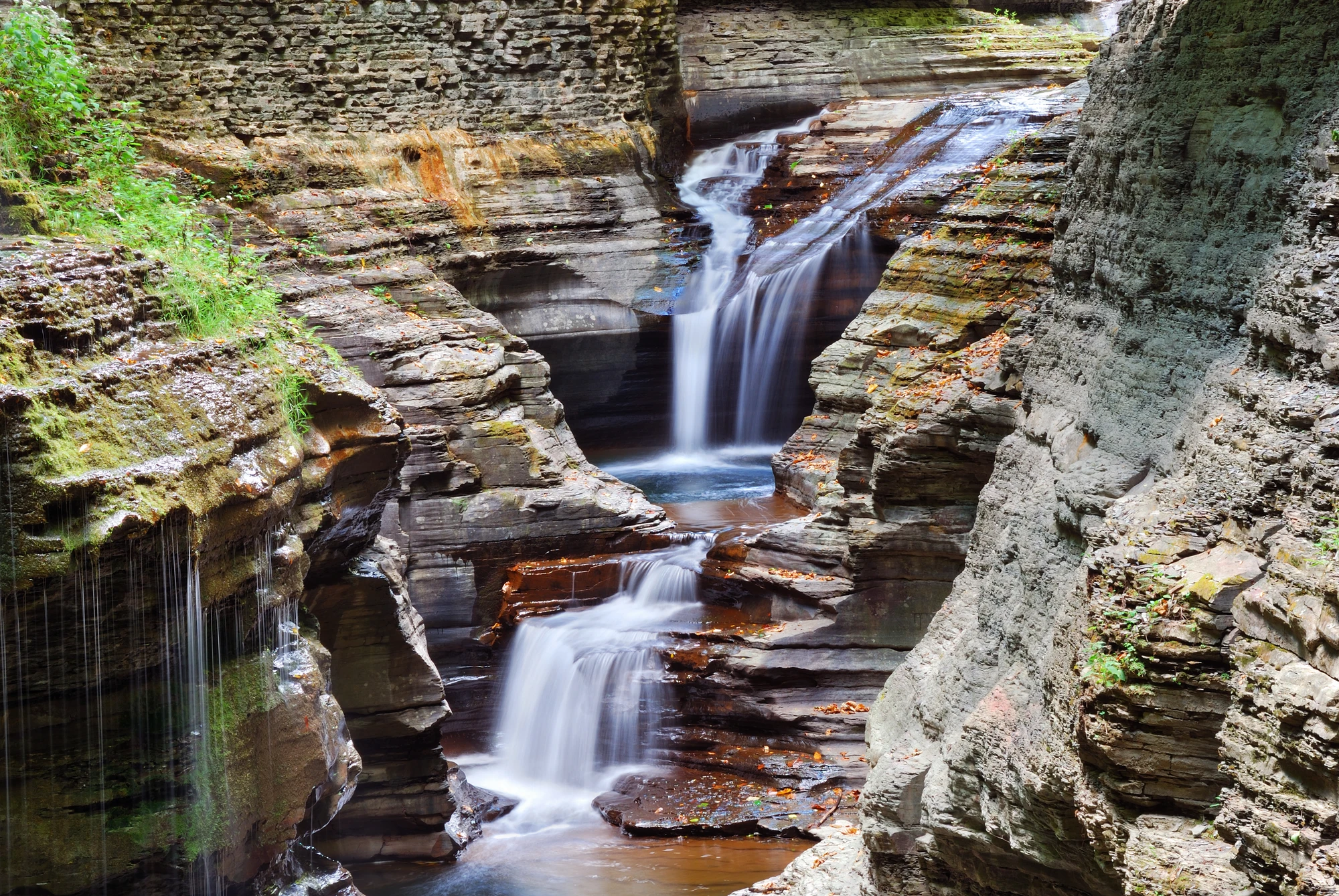
You step into the throat of the gorge and the world rearranges itself. The air cools, the light runs in silver ribbons across wet rock, and the creek—no longer a stream—asserts itself, carving the canyon with a sound that lifts the cadence from your heartbeat and replaces it with spray. Moss cushions the step beside you; the boardwalk narrows to a stone staircase, and somewhere above, water drops again. This is Watkins Glen State Park: a short, relentless theatre of waterfalls where every bend produces a new viewpoint and, if you slow your pace, a new thought.
The Gorge Trail is compact in distance but expansive in effect. In roughly 1.5 miles you negotiate more than 800 stone steps and roughly 400 feet of elevation change as the trail threads through a two-hundred-foot-deep cleft cut into shale and sandstone. For hikers it’s an exercise in rhythm—up, down, a pause for a photograph, a careful step around a slick ledge—punctuated by the forced attention that falling water demands. The falls are both spectacle and metronome: they push you forward, they hush you, they remind you that the landscape here is not static but an act of ongoing erosion and renewal.
Geology and history conspire to make Watkins Glen feel inevitable and fragile at once. The gorge was formed as the last ice age melted, when torrents of glacial meltwater exploited weak seams in bedrock and gouged a stair-stepped channel that now hosts a series of named cascades. Indigenous people knew this landscape for generations before European settlement; in the 19th and 20th centuries the gorge became an early tourist magnet for travelers crisscrossing the Finger Lakes region. Today the state park preserves the corridor and its ladders of falls, while the surrounding valley has evolved into a mix of small-town community, lakefront vineyards, and a seasonal tourism economy built around the natural drama.
Culturally, Watkins Glen sits at the western end of Seneca Lake and feels distinctly Finger Lakes: vineyards slope down to the water, farm stands dot the roads, and local inns and taverns champion regional produce and wines. The nearby village of Watkins Glen serves as a practical base—groceries, cafés, and lodging—while the broader region mixes outdoor pursuits with agritourism: paddleboarding on Seneca, a wine tasting at a lakeside vineyard, or a drive along Highway 414 to watch the light shift across the lake.
Why you should go now: the Gorge Trail is a rare, concentrated hit of raw water energy that suits a broad range of travelers. Families can experience thunderous falls without committing to a full-day backpacking route; photographers find compositional candy in every sluice and plunge pool; hikers with limited time can earn a view that feels far removed from the parking lot within 30 minutes. It’s accessible without being trivial—the steps and narrow catwalks require attention and steady footwear, and in high water the gorge shows its teeth, reminding visitors that nature’s performance is a live event.
Practical guidance: the trail loop is most commonly done as an out-and-back along the Gorge Trail and then up the rim trail to return, or by following the official loop that combines stone paths and forested trails. Allow 1–2 hours to move deliberately, longer if you linger for photos or picnic stops. Shoes with aggressive tread and a grippy midsole are the single best preparation; neoprene-soled water shoes are fine for summer if you plan to stand close to spray, but they lack ankle support on stone steps. Bring water—there are no services inside the gorge—and dress in layers; the shaded canyon can be chilly even on summer afternoons.
Timing matters. Arrive at opening (which varies seasonally) for the clearest light in the lower gorge and the fewest people on narrow sections. Midday light cuts harshly into the canyon and creates strong contrasts that can frustrate camera exposures; late afternoon softens color but can produce long shadows in the deeper intervals. Heavy rains will raise flow and make the trail slick—park staff sometimes restrict access after storms—so check park alerts before you go.
Safety and etiquette: keep to the marked trail; the gorge walls look inviting for shortcuts but are unstable and fragile. Heed signage; some overlooks are fenced for a reason. If you’re visiting with children, plan for close supervision on the steps and bridges. Photography is part of the ritual here—tripods are useful but can bottleneck narrow catwalks during busy periods, so be courteous and mobile.
Connections and add-ons: pair a morning at the gorge with an afternoon tasting at one of the Finger Lakes wineries along Seneca Lake or a paddle on the water to understand how the landscape shifts from confined canyon to broad lake. In fall the valley ignites in color and the falls add steam to the air, producing some of the most dramatic photo opportunities of the year.
Watkins Glen is not a backcountry expedition; it is a concentrated lesson in how water shapes land and community. If you come with respect—for the rules, for fellow visitors, and for the slipperiness of wet stone—you’ll leave with the memory of a place that stages its power at close quarters and rewards attention with a seemingly endless series of small revelations.
Plan simply, prepare practically, and let the gorge do the rest. The falls will dare you to keep pace, to slow down, and to notice what the valley keeps in its cool shaded pockets.