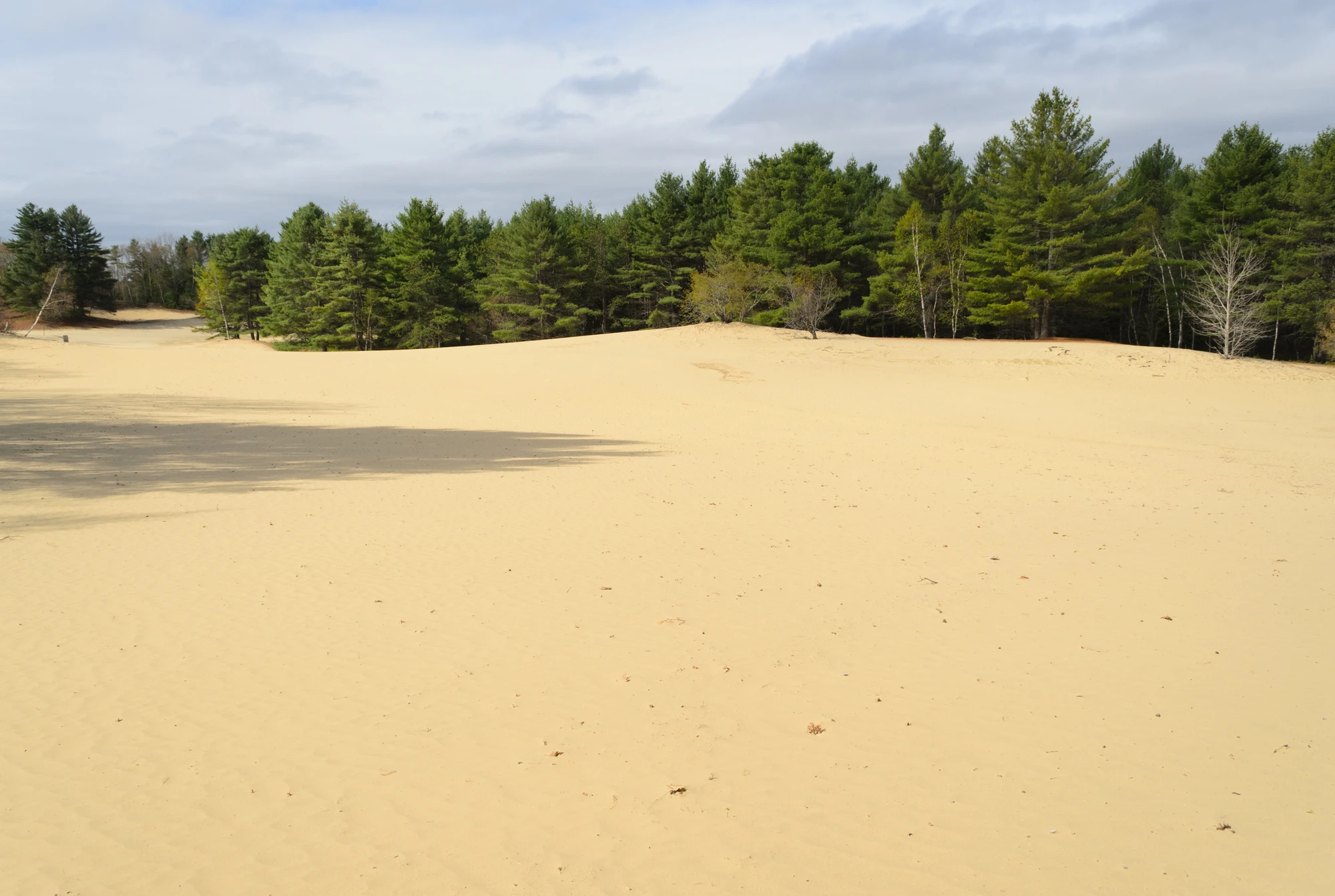
You arrive in Freeport with the salt tang of Casco Bay still clinging to your clothes and the low, civilized bustle of the town—outlet shops, the flagship LL Bean, the steady parade of pickup trucks—giving no hint that a landscape more commonly associated with the American West sits just a few miles inland. Then you turn off Route 1 and the road bleeds away into a narrow, tree-lined lane. The pines close in, green and familiar, until they don’t: the ground opens up into an expanse of wind-sculpted ridges and pale sand that looks for a moment like a mirage. This is the Desert of Maine, a 40-acre slip of glacial silt that refuses to behave like the rest of New England.
The first step onto the dunes is oddly disarming. Sand hushes footsteps. The pines stand like sentries at the edge, their roots knotted and filigreed with the pale grit. The dunes move differently here—slower, more resigned than the coastal dunes of the Atlantic. The wind teases the ridges, pushing up thin crescents of sand that appear to have a memory of storms that never were. Nature here feels opinionated: the dunes dare you to walk them, while the forest watches with cool, patient judgment.
Geologically the place is straightforward and surprising all at once. The “desert” is not a Saharan remnant; it’s glacial silt left over from the Ice Age and exposed in the late 19th century after heavy clearing and poor farming practices removed the stabilizing vegetation. Without roots holding the soil, wind and erosion did the rest, revealing acres of sand that look out of place in a state known for rocky shorelines and dense hardwoods. Locals have long treated the site like a curiosity—a geological hiccup that tells a tidy environmental cautionary tale about land use and stewardship.
The human story stitches through that geology. What is now a family-run tourist attraction once served as cleared farmland, and later became an oddity capitalized upon by proprietors who saw an opportunity to educate and entertain. Interpretive signs along the short walking loops trace that arc: Ice Age deposits, nineteenth-century agriculture, and the slow pivot to conservation-minded recreation. The Desert of Maine is both exhibit and exhibit-er—an object lesson in how fragile landscapes respond when human management misfires.
Culturally, Freeport is a comfortable base for this kind of curiosity. The village’s identity centers on outdoor life—gear, craft, and a quietly competitive fondness for lobster rolls. Visit between errands and you’ll find families and solo travelers who pair an afternoon on the dunes with a stop at a local brewery or a dinner at a seafood shack. The Desert itself leans practical: short interpretive trails, a small visitor center, and guided history sessions during the high season. It’s not a wilderness expedition; it’s an invitation to experience a rare micro-landscape and consider the larger environmental lessons it offers.
On a practical level, plan for something short but tactile. Most visitors treat the site as a 45-minute to 90-minute outing—enough to walk a roughly one-mile circuit, scramble a few low dunes, and read the exhibits without rushing. Terrain alternates between loose sand and compacted paths; wooden boardwalks protect the most delicate patches and guide visitors around sensitive areas. Elevation change is modest, but the effort feels bigger than the numbers because sand steals energy—expect a light cardio workout when you climb the ridges.
Footwear matters more than you’d think: closed-toe shoes with good tread make the walk pleasant; flip-flops and soft-soled sandals let sand migrate into the shoe and spoil the experience. Bring water and sun protection—there’s little shade across the open dunes and Maine sun can be deceptively strong even on cool days. Mornings and late afternoons offer the best light for photos and the most comfortable temperatures; if you time it for golden hour, the dunes take on a warm, tawny glow against the dark green pines.
For families, the Desert of Maine is an ideal short adventure. Kids can learn the history without a long trail, and the tactile nature of sand and stone offers immediate engagement. For photographers, the contrast of textures—the matte, pale sand against backbone-dense pines—creates strong compositions; wide-angle shots work well, as do low-angle details that make the dunes appear larger than life.
Conservation is part of the visit. The Desert of Maine is a reminder that landscapes are made and unmade by people; much of the site is managed to limit further erosion and protect the edge habitat where forest and sand meet. Visitors are asked to stay on designated trails and boardwalks to preserve fragile areas and to respect interpretive signage that marks sensitive ground.
In summer, the dunes feel like a curiosity you can comfortably walk off the beaten path to explore; in fall, the surrounding forest goes crimson and the cool light sharpens every ridge. Either way, the site rewards a slow pace and a curious mind. Don’t forget to pair the outing with local flavors—lobster, fresh-baked goods, and a stroll through Freeport’s gear shops remind you that Maine’s outdoors isn’t an abstract ideal but a lived, consumable culture.
Why go? Because the Desert of Maine is a lesson and a surprise: an unlikely geography that collapses expectations about what northeastern landscapes can be. It’s small enough to explore in an afternoon, teachable enough for kids, and textured enough to satisfy photographers and the mildly adventurous. Walk the dunes, read the land, and leave knowing you’ve seen one of the region’s more peculiar—and instructive—natural sites.


