The Adventure Collective Journal · Regional guide

Greater Yellowstone

Steam above the boardwalks, rivers through lodgepole country, and mountain days worth giving their own address. Start with one base and let the landscape set the pace.

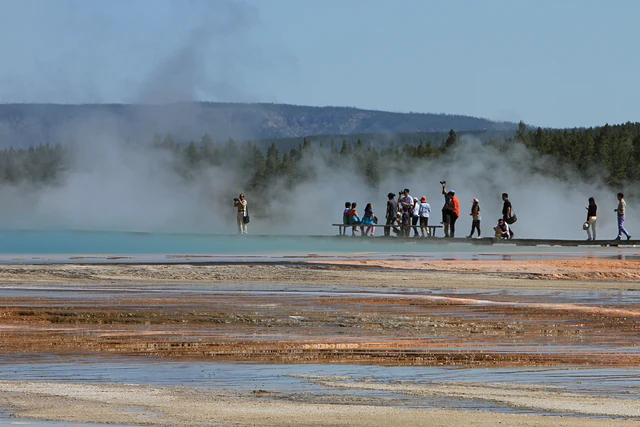
Visitors on a boardwalk amid steam rising from Grand Prismatic Spring.
Visitors on the boardwalk beside Grand Prismatic Spring in Yellowstone’s Midway Geyser Basin. · Photo: NPS/Jim Peaco · Resized with Lanczos and encoded as lossy WebP; aspect ratio and full frame retained. No crop, generative edit or content removal.

A little less driving. A little more time outside.

Greater Yellowstone is an invitation to choose. A map can make Jackson, West Yellowstone, and Idaho Falls look like three convenient corners of the same holiday. On the ground, each starts a different trip. West Yellowstone points toward geyser basins and the Madison corridor. Jackson belongs with the Teton skyline and lake trails. Idaho Falls makes sense for an eastern Idaho chapter or an arrival night before moving closer to the park. The best base is the one that puts tomorrow’s main outing within a sensible day, rather than the one that lets you claim the largest circle on a map.

For a first three-day visit, make West Yellowstone home and concentrate on Yellowstone’s western side. Give Old Faithful a full day’s attention, approach Grand Prismatic as a place rather than a photograph to collect, and leave a third day for Norris and the Gibbon corridor. This is deliberately a partial Yellowstone trip. Its reward is time to notice how different the basins feel, sit with a river view, and change course without losing the whole plan.

Choose where to linger

Choose the trip before the town.

West Yellowstone anchors these three days. Jackson and Idaho Falls serve different priorities, not interchangeable nightly commutes.

01

West Yellowstone

For the west-side park itinerary

Choose West Yellowstone when Yellowstone’s western geyser country is the reason for the trip. The town sits at the West Entrance, making it the clearest fit for this itinerary. Staying put means returning to the same room, reorganizing layers, and making tomorrow’s decision over dinner instead of packing the car again.

The tradeoff is a gateway’s daily rhythm: other visitors are heading through the same entrance and along the same corridor. Treat a restaurant booking or an evening commitment as something that needs a generous buffer. Before choosing lodging, ask practical questions about parking, breakfast arrangements, and the exact room features you need. Proximity to the entrance does not promise quick passage through the park.

02

Jackson

For a Teton-centered stay

Choose Jackson if your imagined day begins with the Teton Range rather than a geyser prediction. Build the stay around Grand Teton’s lakes and valley viewpoints, selecting a trail for its terrain and your party’s comfort. A lake walk and a long lunch can make a complete day; there is no obligation to turn every mountain view into a climb.

Jackson is a separate chapter in this guide. If both parks matter, add nights and make an intentional lodging transfer after checking the connecting roads. Avoid using a Jackson booking as a reason to attach a hurried Old Faithful excursion to an already full Teton day. The wider region is more satisfying when the itinerary admits its scale.

03

Idaho Falls

For arrival logistics or an eastern Idaho chapter

Idaho Falls is useful when eastern Idaho is part of the journey, or when an arrival and supplies day belongs outside the park gateway. Visit Idaho identifies the city within an eastern Idaho region that also includes Island Park and the Teton Valley. That broader geography can support a different trip rather than simply serving as the road to somewhere else.

For repeated Yellowstone days, move closer to the park instead of turning Idaho Falls into a daily starting line. Keep any city time deliberate: recovery from travel, a museum visit chosen after checking its hours, or a relaxed meal before the next chapter. A commercial region can legitimately connect several towns without making them equally practical bases for the same trailhead.

Ways into the landscape

Geyser basins. River pauses. A different mountain chapter.

01

Give Old Faithful more than an eruption

Start at the visitor center for the current prediction, then choose a length of Upper Geyser Basin walk that leaves room to wait. A prediction helps organize the visit; it is not an appointment. Looking closely at a few features is a better use of the day than marching between every named geyser.

Make room for interpretation alongside the scenery. When operating, the Yellowstone Tribal Heritage Center offers a way to engage with the living Indigenous connections to this landscape. Check its program and seasonal schedule rather than assuming it opens whenever the road does. Yellowstone’s human story deserves attention beyond the park’s establishment date.

02

Choose your view of Grand Prismatic

The Midway boardwalk and the Grand Prismatic overlook are different outings with different trailheads. The boardwalk puts you near the basin’s steam and color. The overlook begins from the Fairy Falls trailhead and adds an uphill walk. Choose the experience that fits the day; doing both is an option, not a requirement.

NPS identifies accessible parking, boardwalk, and toilets at Midway. It describes the overlook route as inaccessible, with steep grades. Do not let a familiar elevated photograph become a promise about the view from a wheelchair-accessible route. Keep the plan flexible if parking is full, and use only designated access.

03

Read a different landscape at Norris

Norris offers a useful contrast to the Old Faithful area. Porcelain Basin is open and spare, while Back Basin carries the route into more wooded terrain. Choose one section thoughtfully, allowing time for its textures and sounds, rather than treating the entire network as a compulsory circuit. Do not build the day around a hoped-for Steamboat eruption.

Boardwalk does not mean barrier-free here. NPS describes stairs, steep grades, uneven ground, and changing surfaces in the basins; ask a ranger which view and approach suit your mobility. Gibbon Falls can be a separate stop along the corridor when the road and parking allow. Let that be enough instead of extending the day into another park district.

04

Leave a little room for the Madison

The entrance corridor need not be only a transfer. Stop at a legal pullout and give the river some attention without expecting wildlife to appear on schedule. If conditions and your group’s abilities fit, Harlequin Lake is an uphill out-and-back near Madison, offering a small-scale walking alternative to a basin circuit.

The official Harlequin Lake description does not establish wheelchair access. Treat the walk as a trail choice to investigate, not an accessible substitute for the boardwalks. A river-view pause is also a valid outing. There is value in ending a park day with enough energy left to enjoy the evening.

05

Make the Tetons a separate stay

For the Jackson alternative, use String and Leigh Lakes to organize a lake-centered day. Choose a short shore section or a longer hike only after reviewing the route and current conditions. Leigh Lake has no road access, so it should not be promised as a quick scenic pull-off.

The paved approach to Jenny Lake Visitor Center is a different proposition from rougher lake trails. Grand Teton’s mobility guidance describes steps, roots, and uneven surfaces along portions of the String Lake shore. Build an accessible visit around a specifically confirmed route and facility rather than the general label ‘lake walk.’ This alternative deserves its own time and overnight base.

A suggested journey

Three days from West Yellowstone

Arrive before the first outing if possible. Keep one lodging base, swap days around conditions, and give each day one main area.

  1. Day 1

    Day one: Old Faithful and the Upper Basin

    Leave the morning centered on one destination: Old Faithful. Collect the current prediction, choose your basin walk, and build the day around those two pieces rather than an exact eruption deadline. Add the visitor center and, when its schedule fits, the Tribal Heritage Center. Keep the return along the west-side corridor unhurried. Midway can wait for tomorrow; an empty slot on the map is not a problem to solve.

    Return to your West Yellowstone base.
  2. Day 2

    Day two: Midway, then a smaller afternoon

    Make Midway Geyser Basin the main outing. Choose its boardwalk or the separately approached overlook according to mobility, conditions, and lawful parking. If the day still has room, consider Fountain Paint Pot, choosing a section after checking its terrain rather than assuming the whole loop is level. Otherwise return toward Madison for a river pause. Keep this the lighter day, with an earlier dinner and time to reset.

    Return to your West Yellowstone base.
  3. Day 3

    Day three: Norris and the Gibbon corridor

    Travel toward Norris and choose a manageable basin section. Leave enough attention for the landscape itself rather than collecting every spur. Consider Gibbon Falls on the return if conditions permit. If Norris’s surfaces or access do not suit your group, use a confirmed suitable Old Faithful-area route instead. Finish without a last-minute dash to Lamar Valley or Jackson; those priorities deserve a redesigned trip or extra nights.

    Return to your West Yellowstone base, or begin a separately planned transfer the following day.

Plan for the elevation

Four seasons, different access.

Spring

Reopening is a sequence, not a date that unlocks the whole park. Roads and visitor services return on different schedules, and snow can interrupt the plan. Choose spring for flexibility: a smaller itinerary with current access confirmed is more useful than summer ambitions carried into a thawing landscape.

Summer

Summer offers the broadest conventional road-trip possibilities, along with strong demand. Decide where to sleep before building an elaborate list of stops. Carry warm layers despite a bright afternoon, allow for thunderstorms, and preserve some spare time for crowded parking areas or a slower-than-expected basin walk.

Fall

Autumn is a good season for a less ambitious daily plan, not a guarantee of empty roads. Services begin closing while some routes remain open, and snow can change access abruptly. Check the exact facilities you need and finish walks with daylight to spare. The booking calendar and the weather forecast deserve equal attention.

Winter

Winter requires a new itinerary. Most Yellowstone roads close to ordinary vehicles; the northern route between the North and Northeast entrances is the general year-round exception, subject to conditions. Reaching Old Faithful commonly means arranging authorized oversnow travel. Confirm the operator, season, equipment, and accessibility before booking. A West Yellowstone hotel reservation alone does not provide winter access to the geyser basins.

Make the trip work

Plan the details that matter.

Separate entry from the activities you book

NPS currently states that Yellowstone requires an entrance pass but no vehicle reservation to enter. Lodging, camping, and guided outings are separate arrangements. Overnight backcountry stays require a permit; a campsite reservation is not itself the permit. Fishing and boating have their own park requirements, including relevant permits and, for watercraft, inspection rules. Read those pages before adding either activity.

Give wildlife and thermal ground their space

Stay at least 100 yards from bears, wolves, and cougars, and 25 yards from other wildlife, including bison and elk. Increase your distance if an animal approaches; never disturb it or feed it. Carry accessible bear spray and learn its use before walking in bear country. Keep food and scented items secured.

In thermal areas, remain on boardwalks and designated trails. Thin ground can conceal scalding water. Do not touch features or runoff, and never enter hot springs. Keep children close. Pets are prohibited on thermal boardwalks; trained service animals follow different rules. A closed route is a reason to change the outing.

Ask about the route, not the destination

Old Faithful has accessible approaches from parking and the visitor center. Norris presents substantially more difficult terrain. Fountain Paint Pot has an accessible initial section, while other portions include stairs and steep ground. Confirm the precise path, current surface, toilets, and any equipment needs with the park before departure. Winter snow and temporary closures can change a route’s usefulness.

Before you settle on a plan

A few useful questions.

Can three days cover Yellowstone and Grand Teton?

Choose one focus for three days. This itinerary covers western Yellowstone; a Jackson and Grand Teton stay is a separate option or extension with additional nights.

Is the Grand Prismatic overlook the same as the boardwalk?

No. They use different approaches. Midway has an accessible boardwalk; the overlook is an uphill trail from the Fairy Falls trailhead and is not an accessible route.

Can this itinerary be used in winter?

Not as an ordinary driving trip. Rebuild it around current winter access and any authorized oversnow arrangements.

Why is Idaho Falls included?

It is an existing region member and a useful eastern Idaho or arrival base. For these repeated park days, the editorial recommendation is to stay in West Yellowstone.

Before you go

Check the day’s conditions.

This plan is conditional on open roads, suitable weather, and current trail access. Confirm official notices and any reservations before travel; no live inventory is represented.

Keep the essentials simple.

  • Check road status and operating dates separately before every outing.
  • Give each day one main area and leave a return margin.
  • Use current official route information to match terrain to your group.
Sources & editorial scope

Research checked 2026-10-17. An original research-backed planning guide, not firsthand reporting or a live conditions feed. Confirm current rules, roads, and route accessibility before travel.