The Adventure Collective Journal · Regional guide

Mackinac & the Straits

Leave the car ashore. Follow the water around Mackinac, then climb into the island’s wooded interior.

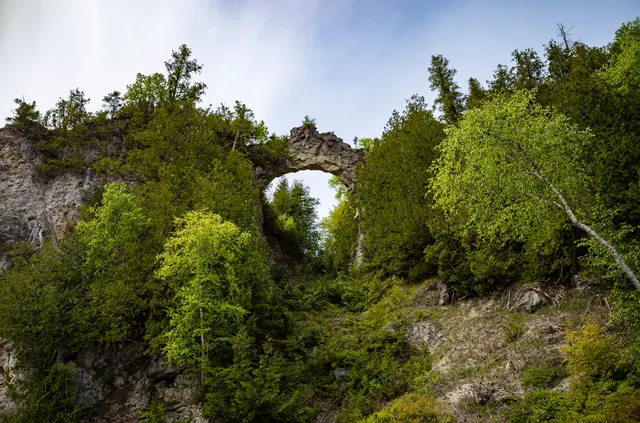
A natural stone arch rises above a densely wooded rocky slope.
Arch Rock on Mackinac Island, photographed in June 2024. · Photo: rboed (RB Photo) / Wikimedia Commons, CC BY 2.0 · CC BY 2.0 — image and resized versions · Copyright (c) 1998 Hewlett-Packard Company (ICC profile notice, not photo copyright) · Full-frame proportional Lanczos resizing and WebP compression; no crop, retouching or generative change. Embedded ICC profiles converted with Pillow ImageCms to sRGB before resizing where present, output sRGB ICC embedded; original EXIF stripped, credit/license/provenance retained in XMP and manifest.

A little less driving. A little more time outside.

At the ferry dock, the journey changes scale. Luggage comes off the boat, bicycles roll toward Main Street, and the next decision is made on foot. The water remains close enough to organize the day around it: a shoreline ride, a pause beneath the bluffs, a return to town with no parking space to find.

Mackinac rewards a little separation between its experiences. Give the shore its own outing and the interior another. A landmark seen from below becomes a different place when approached through trees; a fort on the skyline becomes more than scenery when there is time to go inside. Three nights on the island make that slower reading possible.

Choose where to linger

Choose where the journey begins

Stay on the island for the full itinerary. Use the mainland gateway only when arrival timing or onward travel calls for an extra night.

01

Mackinac Island

Choose an island stay when you want the ferry to mark the beginning and end of the trip rather than interrupt each day. A room near downtown simplifies luggage handling and access to meals; ask the property about the actual route from its dock, including hills, steps and porter arrangements.

The mainland car stays behind. Walking, pedal bikes and horse-drawn transport shape the visit, so pack for the journey between dock and lodging as carefully as for the journey to Michigan.

02

St. Ignace

St. Ignace offers a mainland staging point on the Upper Peninsula side of the Straits. Both principal ferry operators identify it as a departure port, with parking arrangements for overnight island visitors. Confirm which dock your sailing uses before leaving your vehicle.

An extra night here can take the pressure off a late road arrival or an early onward departure. Keep it outside the island itinerary: repeated crossings consume attention that is better spent on the shore and in the woods.

Ways into the landscape

Shore road, wooded heights

01

Ride the island’s waterline

M-185 follows the island perimeter for 8.2 miles. The mostly level shore road makes a satisfying first encounter with the geography, but distance and headwind still matter. Start with a short out-and-back if anyone is unsure about a full circuit.

Build the ride around pauses rather than a target pace. British Landing and the Native American Cultural History Trail’s interpretive stops give reasons to get off the saddle. Share the road carefully, keep sightlines clear when stopping, and leave enough energy for the return through town.

02

Approach Arch Rock through the trees

For a different view of Mackinac, approach Arch Rock from the interior. The Botanical Trail connects plant interpretation with the rock formation; Leslie Avenue offers a wooded continuation for walkers wanting more. Choose a loop from the park map that matches your footing and stamina.

Do not confuse a paved route with a level one. The island’s interior rises above the shore, and the shoreline staircase is a different approach entirely. Return by the route you have planned rather than following an inviting descent that leaves you an unwanted climb.

03

Read the harbor from Fort Mackinac

Fort Mackinac sits above the town and harbor, turning the view into an explanation of why this place mattered. Allow room for the exhibits and scheduled interpretation instead of treating the fort as a lookout stop.

Pair it with the downtown historic sites included in the fort ticket, subject to seasonal opening. Biddle House, featuring the Mackinac Island Native American Museum, adds an essential perspective to a day that could otherwise be dominated by military buildings.

A suggested journey

Three days with the car left behind

Designed for the main visitor season, generally May through October, with three nights in the same Mackinac Island lodging and departure the following morning. Confirm the actual opening dates for your trip.

  1. Day 1

    Day 1: arrive, settle, find the shoreline

    Take a confirmed sailing from your chosen mainland port and settle luggage before starting out. Keep the first outing close to downtown and the waterfront: this is a day for finding the visitor center, orienting yourself and learning how far your lodging sits from meals and transport.

    If time and energy allow, sample a short section of the shore road on foot. Save the complete circuit for tomorrow. Finish with an unhurried evening near your lodging rather than adding another crossing.

    Mackinac Island; same lodging all three nights
  2. Day 2

    Day 2: make a day of the perimeter

    Choose the better-weather day for the M-185 ride, switching days two and three if needed. Collect a suitable pedal bike and check fit and brakes before leaving town. Use the shoreline adventure as the plan, stopping for interpretation and a break at British Landing rather than rushing the circuit.

    If the full loop is too much, turn the outing into a shorter shore-road excursion. After lunch, leave the rest of the day open: the value of staying here is having room to stop.

    Mackinac Island; same lodging all three nights
  3. Day 3

    Day 3: the interior and the stories below it

    Make Arch Rock the morning’s walking objective using the interior approach; add Leslie Avenue only if the chosen route and conditions suit. Return to town for lunch before an afternoon at Fort Mackinac or its associated downtown sites. Check admission and closing times before deciding the order.

    For a lower-exertion day, replace the interior walk with a shoreline outing and arrange appropriate transport to the fort’s north entrance. Spend the final night at the same lodging, with a confirmed mainland departure planned for the following morning.

    Mackinac Island; same lodging all three nights

Plan for the elevation

Four versions of the island

Spring: a measured reopening

Spring is a transition, with many businesses returning in late April or early May. Wind and rain can make a modest walk the right outing. Check each needed service before committing to dates, then let the first full day be flexible.

Summer: leave room around the busiest hours

Summer brings the fullest visitor season and the most company. Reserve lodging and essential mobility arrangements ahead, then protect unhurried parts of the day for walking or sitting by the water. There is no need to turn every open attraction into an obligation.

Autumn: color with a shorter operating calendar

Fall lends the interior woods a new palette, while October brings a reduced ferry schedule and the approach of seasonal closures. Put transport and meals on the checklist before trails. A quieter street does not mean every service will still be running.

Winter: plan a separate kind of trip

Winter is not the summer itinerary with a warmer coat. Lodging and food options are limited, and ice can halt ferry travel so that flying becomes the only arrival option. Cross-country skiing may be possible when conditions suit, but arrange transport and essential services first. Do not use lake ice as an access plan.

Make the trip work

Plan the details that matter.

Confirm the whole accessible journey

The tourism bureau reports wheelchair- and scooter-accessible ferries, but verify your device and boarding needs with the operator. Ask lodging about doorways, bathrooms, stairs and the dock-to-room route. Accessible horse-drawn transport is limited and should be arranged rather than assumed.

At Fort Mackinac, the south approach ends in steps. The north entrance is the recommended access point, although Fort Street is steep; discuss a suitable taxi or alternate route. Historic interiors retain barriers. Check the park’s access guide and demonstration schedule if loud cannon or rifle sounds are a concern.

Treat e-cycle approval as advance planning

Ordinary recreational e-bike use is not the default here. The official May 2026 guidance ties e-cycle permission to a mobility disability and city licensing, including within the state park. It recommends submitting the required documents at least 14 days before a visit; same-day approval is not assured. Check current device-class requirements with the city before bringing an e-cycle.

Keep the shore as the flexible option

Before heading into the woods, ask the visitor center about current routes and closures. In poor weather, shorten the outdoor plan and use open downtown museums instead; do not count on every historic building as an all-season shelter. A mainland hotel night can be a useful travel buffer, but it does not resolve a canceled island departure by itself.

Before you settle on a plan

A few useful questions.

Does the three-day trip require daily ferries?

No. Stay on Mackinac Island all three nights. St. Ignace is an optional separate gateway stay before or after the island portion.

Can a wheelchair user follow the same route?

The visit needs an individually checked route. Ferries can accommodate mobility devices, while interior grades and historic-site barriers require advance planning. Arrange the fort’s north-side approach and suitable transport directly.

Is this a year-round itinerary?

Use it for the main visitor season after verifying openings. Winter requires a separate plan for limited services, air access when ferries cannot operate, and current trail conditions.

Before you go

Check the day’s conditions.

Check ferry timetables and service notices, park conditions, seasonal openings and current e-cycle requirements before travel. No live sailing, lodging or trail availability is promised.

Keep the essentials simple.

  • Book the island stay and verify both outward and return transport before building the rest of the trip. Check the operator’s dated timetable again near departure; a general seasonal description is not a reservation or a guarantee of sailing.
  • Bring a wind-resistant layer, rain protection, water and a way to carry essentials without relying on a car. Let weather, footing and the least comfortable person in the group set the outing’s length.
  • Use official park maps and posted signs. Keep to established routes and respect historic structures and rock formations. Paid historic-site admission and bicycle transport arrangements are separate planning decisions; check current terms directly.
Sources & editorial scope

Research checked 2026-10-17. Planning sources were checked October 17, 2026. Confirm ferry operations, attraction openings and mobility arrangements directly before travel.