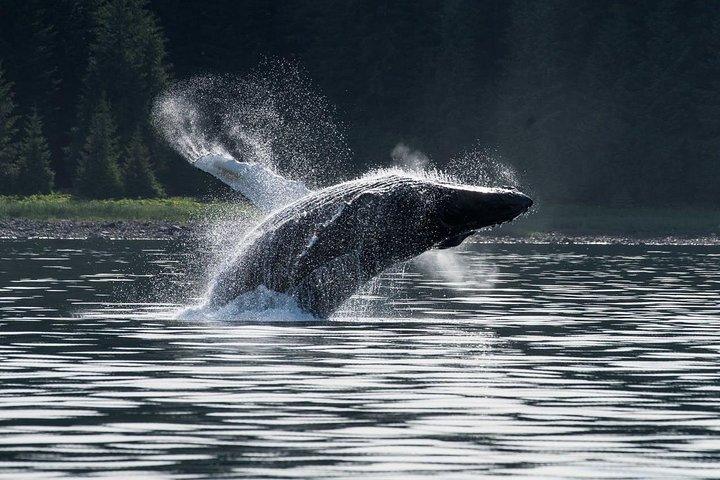
The bow cuts through a kaleidoscope of sea—peeling waves, foamy wakes, and the cold-blue glass of Icy Strait. Salty wind bites at your cheeks and the first exhale of a humpback rises like a punctuation mark across the horizon: a misty plume that hangs for a beat and then is gone. The little custom-built vessel rocks and hums, a heated cabin humming behind you and a handful of travelers pressed to the rail, eyes scanning for splashes and the architectural certainty of flukes.
This is the seasonal theater of Southeast Alaska. Hoonah, a small Tlingit community tucked near Icy Strait Point, is one of the places where nutrient-rich currents conjure a feast for humpback whales, porpoises, sea lions, and seabirds. The 3-hour, small-group cruises that depart here are compact and focused: professionally crewed, outfitted with restrooms and heat, and designed to get you close to wildlife while meeting federal guidelines that keep animals wild and safe.
Geologically, you are in a fjord-scored landscape. Millennia of glacial carving created deep channels that funnel cold, plankton-rich water into narrow arms; that plankton draws herring and other forage fish, and where bait congregates, predators follow. Culturally, the water has always been the lifeblood of the Huna Tlingit people—salmon runs, seal and whale knowledge, and navigation skills passed through generations. Today, local guides and tour operators work alongside the community to showcase the abundance while protecting traditions and marine life.
The best time to be here is May through September, when humpbacks stage massive feeding forays before migrating south. On any good day you’ll see lunge-feeding humpbacks rising like living walls, often with a scattering of gulls and terns that act as avian spotters. Otters raft in kelp beds just inside the shoreline, and if you’re lucky a transient orca might cruise by scouting for seals. Because these trips run in smaller groups, the experience is intimate—less like a crowded observation deck and more like a shared conversation with the ocean.
There’s a practical rhythm to success: the skipper reads the tides and the birds, the naturalist points out indicators of subsurface life, and everyone trades binoculars. Bring a plan for comfort—layers, a waterproof outer shell, and motion-sickness prevention if you know you’re sensitive. The cabins are heated and welcoming, but much of the magic happens on deck; a brisk ten minutes outside is often worth the chill when a whale breaches within sight.
This tour is as much about learning as it is about spectacle. Guides weave biology and local stories into the narration—how humpbacks use bubble-net feeding, how currents in Icy Strait concentrate prey, and how historical whaling and modern conservation have shaped the present. NOAA’s approach rules are part of the on-board briefing: boats give whales space and never chase behaviour for a better view. That ethic makes the sightings steadier and more meaningful.
For planners, the logistics are straightforward: the tour is a fixed 180 minutes and is offered seasonally. It’s designed for a broad audience—first-time whale watchers, families, and photographers—without demanding specialized skills. That said, a few steps make the day smoother: book early on popular dates when cruise ships visit the region, arrive with waterproof binoculars, and leave the drone at home unless you have explicit permission (there are strict rules around aircraft near marine mammals).
Beyond the whales, the experience ties into local culture. Hoonah’s bay is a living community—commercial fishers, subsistence harvesters, and cultural stewards all share the shoreline. Visiting respectfully means supporting local businesses when possible and listening to local guides who connect sightings to seasons, spiritual practices, and stewardship goals.
Why do travelers choose this trip? It’s compact and efficient—three hours that can fit into a single day of an Alaska itinerary—and it delivers frequent, high-quality sightings in a landscape whose scale is hard to convey in photos. It’s also accessible: vessels are modern with heated cabins and restroom facilities, and small groups mean better learning and fewer elbows at the rail.
If you go: time your trip in the shoulder mornings for calmer seas, bring a camera with a telephoto lens if you want close shots, and plan a leisurely afternoon in Hoonah afterward to soak in the local flavor. The sea does what it wants, but between the patterns of tide, fish, and migratory instinct, your odds of leaving with a memory of a humpback’s tail slapping the water are excellent.
Practical takeaways—dress in layers, carry motion-sickness remedies, respect distance rules around wildlife, and leave room in your schedule for weather flexibility—and you’ll come home with more than photos. You’ll have been part of a place where ocean processes write a seasonal story, and for a few hours, you were close enough to read a few lines.