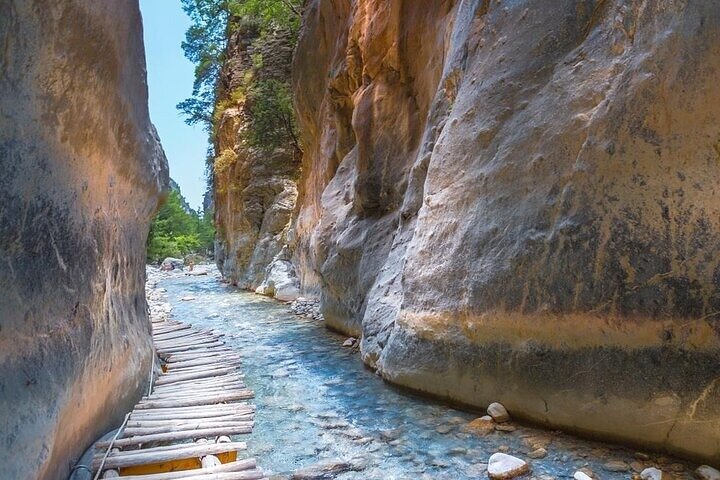
You begin the day before the sun fully wakes: a ribbon of diesel hum along a coastal road, the island cooling behind you as the White Mountains shrug off dawn. The trailhead at Xyloskalo perches on a plateau called Omalos; below, the Samaria Gorge yawns open — a raw cut through limestone that narrows and widens like a lung. First steps are on pale rock, the path angling down through sparse pines. The air smells faintly of resin and dry earth, and somewhere ahead the gorge narrows until the cliffs lean in close, shadowing the track and turning every footfall into an intimate exchange with the land.
Samaria is not merely a hike; it's a landscape with a spine. Over roughly 16 kilometers the trail drops about 1,200–1,300 meters from the Omalos plateau to the Libyan Sea at Agia Roumeli. Geologically, the gorge is a ledger of tectonic compression and karst erosion: limestone and schist folded and cracked, water carving narrow passages where cliffs rise like the walls of an amphitheater. Culturally, Samaria has been a corridor of survival — villagers used it as refuge during times of conflict, and its remote southern exit, only reachable by foot or by sea, helped preserve a way of life longer than on the lowlands.
Ecology is a main character here. Cretan date palms cluster at the gorge mouth, an almost tropical flourish before the sea; higher ups you’ll see Cretan maple and patches of thyme and oregano that perfume the air when crushed. Animal life includes the endemic kri-kri, the Cretan wild goat, which often appears as sure-footed silhouettes on distant ledges, and a rich cast of birds and reptiles. Because the gorge channels everything — wind, water, season — the mood can turn quickly: olive-dry summer heat gives way to cool shade in the slot canyon, and sudden gusts push sea-salt air inland.
A guided day trip gives Samaria a practical rhythm. Many operators, including local experts, organize pickups from Chania in the early morning, a transfer up to Xyloskalo, the 16-kilometer descent through the gorge, and a late afternoon ferry from Agia Roumeli back to the southern ports. If you want an easy way to join a well-run group, consider booking a guided Samaria Gorge hike with local guides who know the route, the tides of foot traffic, and the best places to watch for kri-kri without disturbing them.
Why go? It's the combination of scale and intimacy — the long slide from mountain to sea, the shifting ecosystems, and the human aftertaste: the village of Agia Roumeli, whose whitewashed houses and handful of tavernas feel earned after hours in the gorge. For most walkers the reward is both visual and practical: an afternoon swim on a pebbled beach and a cold beer in a place accessible only by foot or boat.
Practical reality: the trail itself typically takes 4–7 hours depending on pace, but full-day tours run 9–12 hours to accommodate transfers and ferries. The footing is mostly rock and scree; there are short sections with ladders and narrow passages but nothing technical. The route is one-way downhill — which sounds gentler than it is. Long descents can be punishing on knees; trekking poles and steady pacing help more than speed. Summer temperatures often top 30°C (86°F) in exposed sections; start early and carry more water than you expect to need.
If you’re planning a trip, think seasonally. Spring paints the gorge with wildflowers and mild temperatures; late summer can be hot but offers clearer seas for a post-hike dip. Ballpark logistics: fly into Chania, join a transfer to Omalos, hike the 16 km to Agia Roumeli, then take the ferry to Sougia or Hora Sfakion, with a return coach to Chania. Good footwear, layered clothing, sun protection, and an attitude of patience will make the day feel straightforward rather than fraught.
Respect also matters. Samaria is part of Crete’s protected areas; trails confine impact and wildlife like the kri-kri still depend on the buffer of humans behaving responsibly. If you prefer solitude, aim for shoulder seasons or start at first light. Otherwise, go with a knowledgeable local — you’ll learn small stories that don’t make guidebooks: which slab of rock holds rare orchids, where shepherds still bring goats for saltwater baths, and the best taverna that plates grilled sea bream at day’s end.
For the traveler who wants a single, full-throttle day that sums up Crete’s geology, biology, and understated maritime culture, Samaria delivers. The gorge is honest: demanding in places, generous in views, and stubbornly real. Book a guided Samaria Gorge trek or plan a self-guided route, but go with respect for the elements, the wildlife, and the small communities that keep this ancient cut alive. When you step off the ferry with salt still in your hair and gravel in your shoes, the island’s layers feel connected — mountain to sea, past to present — and the day feels like an earned piece of Crete.