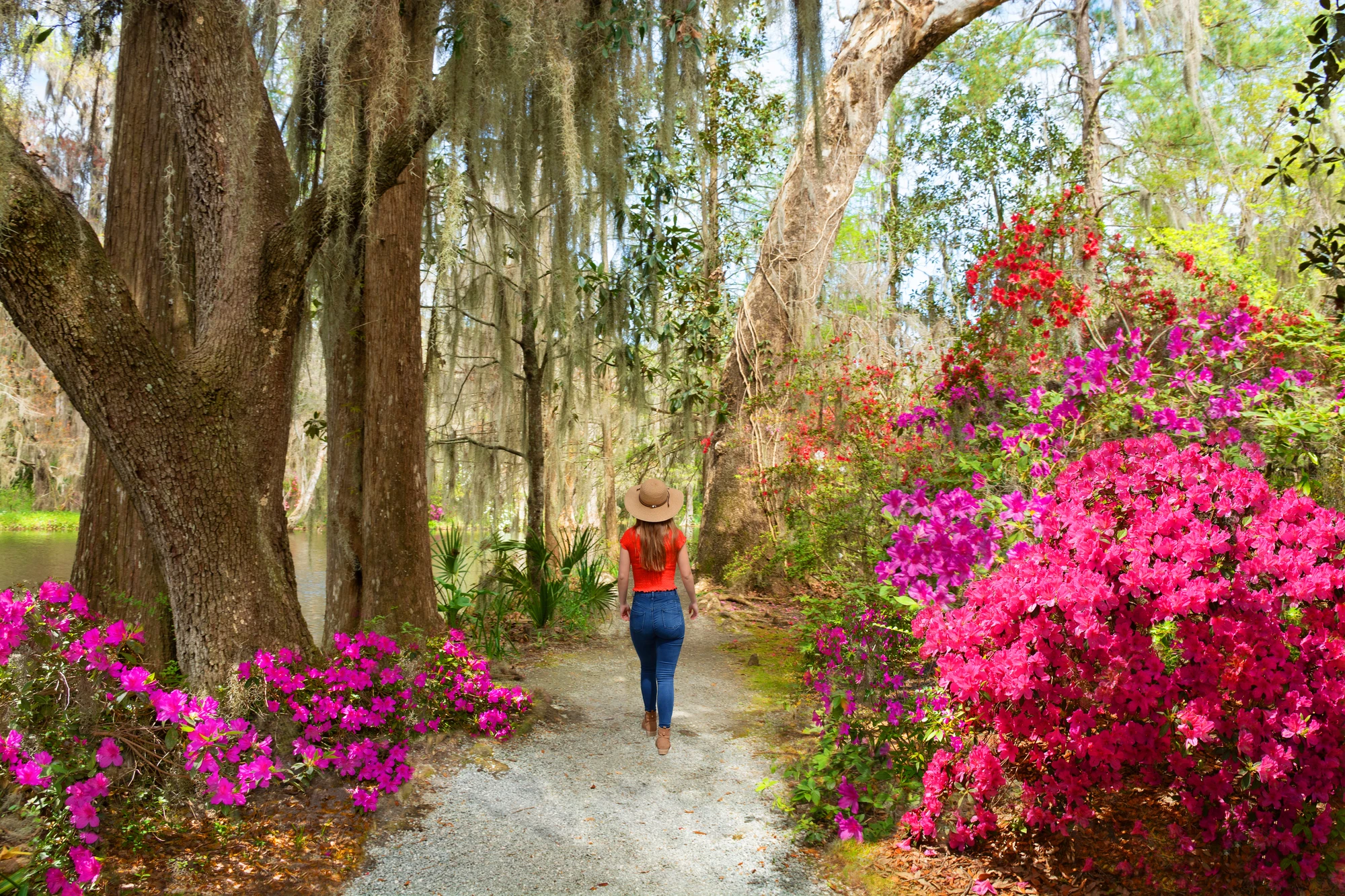
You arrive beneath a cathedral of live oaks—massive limbs draped in Spanish moss that sways like a slow, deliberate breath. The path underfoot is soft with leaf litter and punctuated by blastings of azalea color: reds, pinks, and an almost electric fuchsia that seems to glow against the deep green. Somewhere ahead a wading bird lifts from the marsh with a pause and a hush of wings. This is Magnolia Plantation & Gardens, a place where history and habitat meet in the humid, tidal edge of Charleston’s Ashley River.
Magnolia reads like a Lowcountry primer. Founded by the Drayton family in the 17th century, its landscape is a layered record—formality softened by centuries of live oaks, the imprint of rice-era hydrology, and the gradual hand of horticultural experiment. The gardens as visitors know them were shaped in the 19th century, when romantic tastes favored winding paths, exotic plantings, and designed views that feel both intimate and expansive. Today the site functions equally as a living museum and an active ecosystem: carpeted flowerbeds give way to a freshwater marsh and the Audubon Swamp Garden, where cypress knees puncture fog on an early morning.
Geologically the place is defined by the tide. The Ashley River’s slow currents and the region’s low gradient created the marshes that made rice cultivation economically possible—and that same tidal influence supports a variety of habitats today. The soil here is rich, often waterlogged; plants that thrive in the garden’s beds have to contend with humidity, summer heat, and the occasional storm surge. These constraints are what make Magnolia feel distinct from a mountain botanical garden: everything here has adapted to water, to salt spray on a bad day, and to a climate that moves from lush abundance in spring to a quieter, structural beauty in winter.
Culturally, Magnolia sits inside the story of the Lowcountry: its landscape is both a place of recreation and a living record of plantation-era economies and the people—enslaved and free—who tended these fields. Modern visits can be mindful without being reverent; tours now work to contextualize the plantation’s full history while visitors absorb the sensory pleasures of azaleas, magnolias, camellias, and the occasional rose. The onsite Audubon Swamp Garden is home to a different sort of history, an ecological archive where old cypress and tupelo trees map centuries of water and wildlife.
What you do here depends on your pace. The easiest way to orient is to take the narrated nature tram—an hour-long loop that rolls through the main garden beds, past historic structures, and into the marsh edge. For a closer look, walk the garden trails yourself: a main strolling loop of roughly 1–2 miles lets you linger at the Dell, the Camellia Garden, and the romantic Water Garden. The Audubon Swamp Garden is a half-mile boardwalk and slope that demands slow walking; bring binoculars. Magnolia also runs boat tours on the Ashley River—opt for an early-morning trip to have the river and its herons to yourself. If you’re interested in architectural history, the plantation house tour runs on a shorter schedule and gives a sense of the built environment that sits within these grounds.
Practicalities are simple but matter. Expect soft, sometimes uneven footing—packing comfortable, broken-in walking shoes will pay dividends. Summers are hot and intensely humid; plan a morning arrival to beat both the heat and the tour buses. In spring, the garden’s color is at its peak (azalea season), but it’s also more crowded; structure your visit around the tram schedules to avoid back-to-back group arrivals. Photography is rewarding: low light beneath the oaks creates deep colors and dramatic contrasts, but bright midday sun can blow highlights from the garden beds.
The appeal of Magnolia is not purely its Instagram-ready blooms. It’s the way the place asks you to slow down—to follow a shaded path, to listen for the skitter of a crab in a drainage ditch, to watch a great blue heron strike. Garden lovers will appreciate the collections, birders the marsh edge and swamp, and history-minded visitors a landscape that tells multiple stories. For families, the space is manageable: there are structured tours, a short boat ride, and enough variety that kids can alternate between quiet observation and active exploration.
If you go: arrive early, wear insect repellent and sun protection, and leave time to sit on a bench under the live oaks. Buy a map at the welcome center, ask about guided options (the tram and boat tours fill), and consider pairing Magnolia with a half-day exploring nearby Middleton Place or the Battery in Charleston for a fuller sense of the region’s landscape and history.
Magnolia Plantation is not a wilderness destination; it’s a cultivated wilderness, where human tastes and ecological processes have formed a place both fragile and resilient. Walk slowly, tread lightly, and you’ll find the reward—an afternoon that feels both restorative and quietly instructive. The garden’s charm is not in a single dramatic view but in a sequence of small attentions: the sheen on a magnolia leaf, the sudden chorus of frogs as dusk tightens, the way a flooded meadow holds the sky. That cadence—the mixing of history, horticulture, and habitat—is what makes Magnolia worth a trip to Charleston and a necessary stop for anyone wanting to understand the Lowcountry’s particular poetry.


