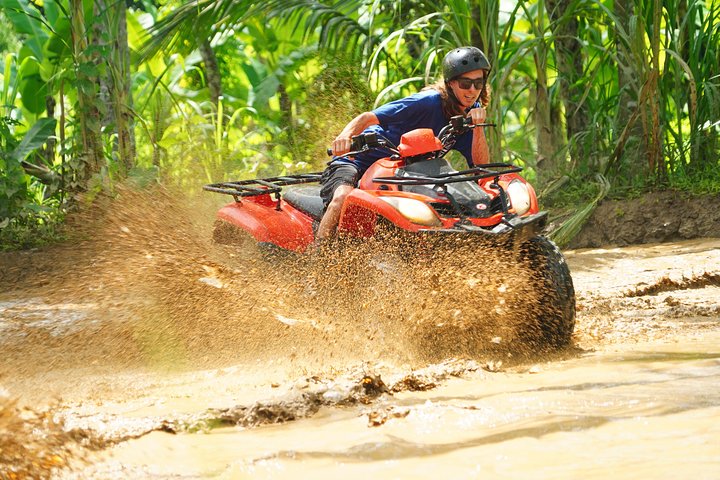
You know you’re in Bali the second the engine blips and the jungle answers back. An ATV’s rumble becomes part of the landscape — less a machine than a way of reading the island’s pulse. You pull forward, squinting through a fine spray of mud and sunlight, and the terraces open like green pages. Downriver, the Ayung keeps its own counsel, water threading through limestone and volcanic rock, daring you to find a faster line.
This hybrid half-day is uncomplicated in promise and generous in payoff: two very different ways to move through the Balinese interior. The quad portion drives across rice paddies, small village tracks, and sticky red earth, while the rafting leg runs you through carved gorges and playful rapids. Together they form a tidy essay on Bali’s physical and cultural landscape — human-managed fields above, a river that remembers its volcanic origins below.
Ubud sits at the center of this story. Tucked into Bali’s central highlands, its name has become shorthand for slowed-down culture, rice terraces, and arts markets; the town also acts as a gateway to activities that are less about resort pools and more about dirt under your nails. The rice terraces you’ll ride past are part of Bali’s centuries-old subak system, an irrigation method rooted in cooperative water management and designated a UNESCO World Heritage Cultural Landscape. Downstream, the Ayung River slices through layers of ash and lava from the island’s volcanic past, shaping rapids that vary from playful to heart-thumping.
Culturally, the ride-and-raft combo is a modern overlay on a very old place. Balinese Hinduism informs the rhythms here: small woven offerings at the edge of a field, umbrella-topped shrines by the trail, a procession of daily rituals that stops you and reminds you that adventure is happening in lived-in country. Local guides — often young, quick with a joke, and fluent in the practicalities of getting you safely across a river or through a technical corner — are your translators not only of the land but of its etiquette.
The geology is visible in the textures: volcanic soils that produce famously lush rice and jungle, and river gorges cut into soft tuff and harder basalt. The Ayung has been sculpting this valley for millennia; today, it offers rapids classified commonly as Class II–III — accessible for most people who are comfortable with moderate exertion and an appetite for a little spray.
Practicality: this tour is flexible in length — operators commonly package it between one and six hours depending on your chosen route and whether you combine the two activities. Expect the ATV leg to last roughly 60–90 minutes on trail, with climbs and descents that are more about terrain than altitude gain. The rafting stretch averages 8–12 kilometers and takes 1.5–3 hours depending on flow and how many photo stops your guide wants.
What you’ll want to know before you sign up: the operator supplies well-maintained ATVs, helmets, safety gear, and life jackets for rafting. You’ll get a short safety briefing for both activities; pay attention. The riding is forgiving but can get messy; the river is playful but has technical lines that reward listening to your guide. There are standard weight and age restrictions — typically a minimum age around 12 for rafting and a weight cap on quads — so check specifics when booking.
Timing matters. Book a morning slot if you want soft light on the terraces and cooler air on the trail; afternoons can get hot, and the later the day, the muddier the ATV routes become. If you’re visiting during the wet season, flow on the river increases and the thrill factor rises at the cost of fewer calm pools for photos.
Fitness and skills — no specialist expertise required, but a baseline of fitness helps. You should be comfortable shifting your weight on a vehicle for turns and able to paddle for several stretches on the river. Dress for function: quick-dry clothes, closed-toe shoes you don’t mind wrecking, and a waterproof case for your phone if you insist on taking pictures.
Why bother? Because this pairing gives you the best of Bali’s contradictions: a cultivated human landscape interleaved with raw, moving water. The ATVs get you where photos fail to explain — up close to terraces and into shadowed tracks — while the river reorients you to the island’s physical origins. Together, they make a compact, full-sensory score that’s easy to slot into a longer Ubud itinerary.
If you go: carve out a day to do it slowly. Eat a light breakfast, drink well beforehand, and leave room for cold Bintang or fresh coconut water afterwards. Bring a sense of curiosity and a willingness to get muddy. Local guides expect nothing less and will reward it with stories, shortcuts, and vantage points you wouldn’t see on foot.