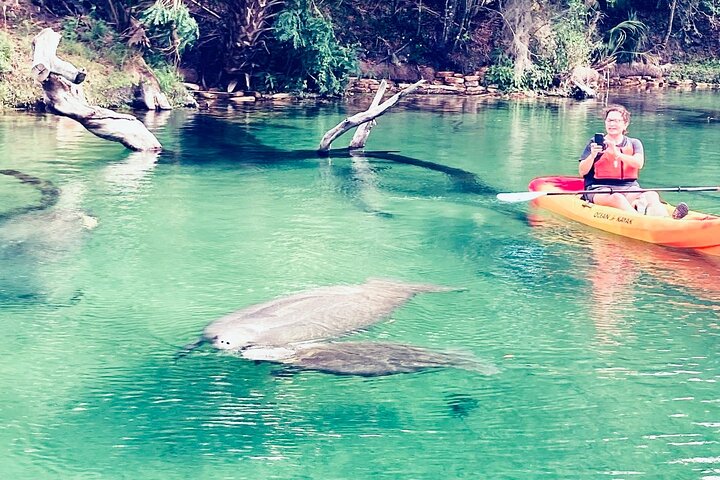
The river waits in a hush that almost feels deliberate—an easy, cool current threading a corridor of bald cypress and hibiscus. Mist lifts off a pool of glassy, 72-degree water; the spring is the room and the manatees are its gentle, lumbering residents. Your guide nudges a kayak into that green-blue light and the world narrows to the soft sound of paddle blades and, eventually, the rounded backs and whiskered faces of sea cows making slow arcs beneath the surface. It’s intimate, calm, and a little electric: these are not zoo animals, but wild creatures shaped by the spring’s steady pulse.
Blue Spring State Park, an hour north of Orlando and near Daytona Beach, is one of Florida’s most reliable winter sanctuaries for manatees. Each year, as ocean and river temperatures dip, dozens to hundreds of Trichechus manatus congregate in the spring’s constant 72°F water—an oasis in a variable landscape. The effect is both biological and cinematic: clear spring flow, tannin-streaked river, sunlight cutting through submerged vegetation, and the patient presence of slow-moving mammals who treat the warm pool like a neighborhood lounge.
Geologically this is a first-magnitude spring—part of Florida’s karst landscape where limestone, dissolved over millennia, allows an underground aquifer to find the surface. The result is a steady, cool discharge that feels like a natural thermostat for the St. Johns River basin. Historically, the spring and the river were travel and resource corridors for indigenous Timucua people and later for settlers and steamboats. Today it’s a protected state park, with visitor infrastructure balanced against the biological imperative of keeping manatee habitat intact.
On a guided kayak tour you’re coached on silent paddling, given distance rules, and taught to read the water—where a manatee’s breath will break the surface, which channel holds warmer eddies, how submerged vegetation both feeds and hides them. A Florida Master Naturalist narrates the scene: how manatees graze, why they favor springs in winter, and how the spring’s clarity allows unusual views into their behavior. That blend of biology and quiet observation changes the way you look at the river. Trees stop being just scenery; their roots become columns in a living aquarium. The current stops being an obstacle and starts to feel like an encourager, coaxing you downriver to better viewpoints.
Practicality matters here: tours typically last about two hours and are family friendly, with most companies supplying kayaks, PFDs, and instruction. Expect calm, shallow channels interspersed with wider pools. The physical demand is moderate—steady paddling with short moments of rest. Timing is everything: early morning light and cooler air produce the best chances of concentrated manatee sightings because the animals often linger in the spring before scattering to feed.
Respect is the rule. Florida law and park regulations protect manatees from harassment. Your guide will insist on keeping distance, never chasing or cornering a manatee, and on minimizing noise. That careful etiquette preserves the experience for everyone—and keeps the animals wild.
If you’re planning this trip: go in mid-winter for the highest density of manatees; book in advance, especially on weekends, because tours sell out quickly during peak months; and give yourself time before or after the paddle to explore the park’s boardwalk, which offers shore-based viewing and interpretive exhibits. For many visitors the day becomes a simple loop: drive in, kayak, walk the boardwalk, then head into nearby DeLand or Daytona Beach for dinner.
In short, the attraction here is not adrenaline, it’s presence. The thrill is the slow-motion intimacy with a species whose movement seems to rewrite the tempo of the water. For families, photographers, and nature lovers, a guided kayak among Blue Spring’s manatees is a tidy and deeply satisfying way to encounter Florida’s wild side without leaving a trace.
Practical snapshot: bring layers (mornings are cool), a dry bag for phones, sunscreen and a hat, and a reusable water bottle. Follow your guide’s distance rules, and keep camera shutters quiet—manatees are curious but respectful too, and your calm helps maintain that balance. If you approach with patience, you’ll find the river offering small, defining moments: a muzzle rising for air, a calf shadowing a parent, a ripple that turns into a bubble-blown exhale. Those moments are what keep people returning to this liquid pocket of Florida time.