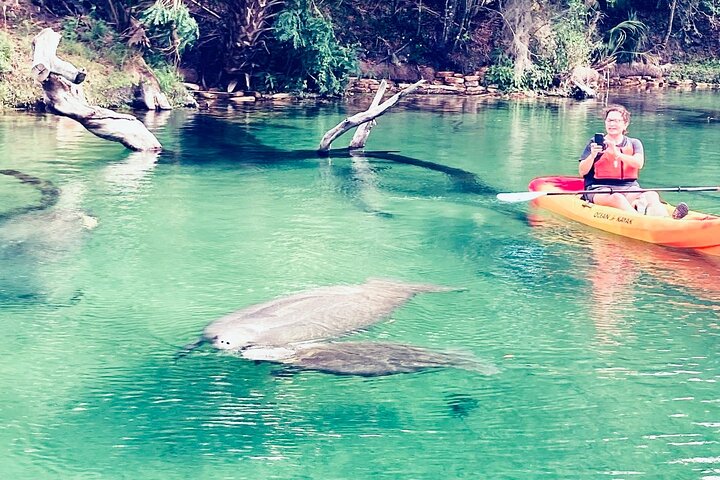
The motor hums to life and the St. Johns unfurls ahead like a slow, silver ribbon. Cypress knees puncture glassy water; Spanish moss drapes like curtain swags. Within minutes the boat eases out of the park’s dock and into the current, and the world narrows to the low, patient language of the river. You don’t fish for spectacle here—the river reveals itself gradually: a flash of white as an egret lifts, the tail of an otter disappearing into tannin-colored water, and then, if you time your visit for winter, the surprising round backs and whiskered faces of West Indian manatees surfaced at the spring’s mouth.
This is the St. Johns River at Blue Spring State Park: a place where geology, hydrology and human history converge to create one of the best—and gentlest—wildlife-viewing experiences in Florida. The two-hour guided tour that departs daily from the park’s docks is intimate by design. Guides point out nesting eagles in canopy hollows, explain the spring’s year-round 72°F discharge, and narrate a regional arc that runs from Indigenous peoples to steamboat commerce to contemporary conservation. For anyone who wants to see manatees without the jostle of crowded observation platforms, the cruise is a quiet, efficient way to connect to the river’s seasonal drama.
Blue Spring exists because the peninsula’s limestone—the Floridan aquifer—gives up its groundwater in concentrated, powerful vents. Those vents produce a constant flow of clear, cool water that pours into the St. Johns and creates thermal refuges for manatees when ocean temperatures dip. It’s why the site was historically important to the Timucua and later became an early tourism draw in the steamboat era: the spring is readable geology and human story layered into a single landscape.
Culture here is river culture—boats, fishing, and small-town hospitality—and nearby towns like DeBary and Orange City feel the slow pulse of that tide. Guides on the St. Johns River Cruise thread natural history with local lore—how 19th-century river trade shaped settlement patterns, where to watch for otters, and which backwater bends are best for late-afternoon light. The cruise also functions as a primer for anyone considering deeper exploration—kayak trips, state-park hikes, or seasonal volunteer programs to help monitor manatee populations.
Practical realities: the tour runs about 120 minutes, is family-friendly and rated highly by past guests. Boats are low-slung for good visibility, and the crew keeps commentary accessible without drowning out the quiet. If you go during winter’s manatee season, expect to trade the canyon silence of high desert hikes for a gentler, observation-based adventure—bring binoculars and a mid- to long-lens for photos. If you cruise in warmer months, the focus shifts to birds, turtles and the river’s plant communities.
Why book this trip? For the combination of dependable wildlife viewing, interpretive storytelling, and accessibility. It’s an easy two-hour window to witness Florida’s freshwater ecology in a setting where protections and local environmental stewardship have preserved seasonal behaviors. For photographers, historians and families alike, it’s an approachable way to learn why this spring matters.
When you plan, keep logistics pragmatic: the river’s light changes fast, so morning and late-afternoon departures offer the best photo conditions and cooler air. Dress in layers—the spring-fed water can keep river-side temperatures a few degrees cooler—and bring sun protection even on overcast days; reflected light from the water is real. Respect crew instructions: manatees are protected animals and the best viewing happens when the boat maintains recommended distances and the crew cuts the motor when animals are nearby. For booking and local-expert background, see the official cruise page and local guide details at this link.
It’s a soft kind of adventure—no scrambling required—yet it leaves the same impression as a good hike: you come away with a better sense of place, sharper eyes for the ecosystem, and an appreciated responsibility to protect it. On the dock, with the afternoon sun warming the return, a child points toward a line of manatees and the guide whispers, with the kind of reverence that’s partly education and partly affection. That is the crux of this cruise: a low-impact, high-meaning encounter that threads natural history and human story down one of Florida’s iconic waterways.