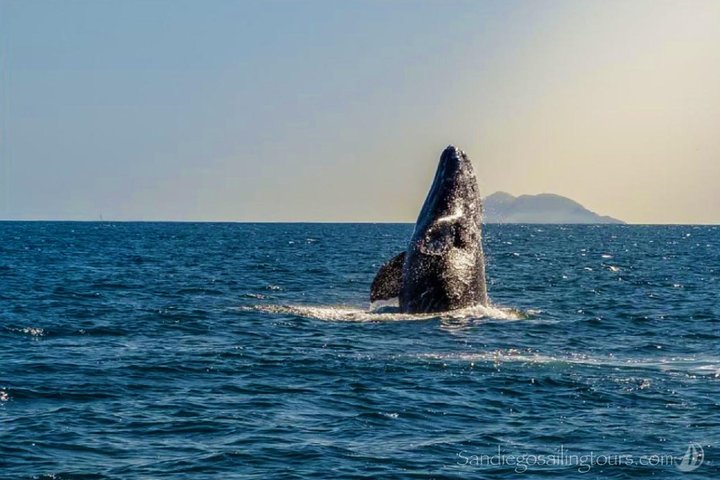
The harbor wakes with a low hum—ferry horns calling across the bay, gulls heckling breakfast boats, the horizon pulling a clean line where city glass gives way to blue water. You step onto the deck and the Pacific gives you that look it’s famous for, a mix of mischief and promise, as if to say: keep up. Moments later the engines roll you out past the Embarcadero, past bobbing sail masts and the shadow of Point Loma, and San Diego’s skyline loosens into the open ocean. It’s here, along a migratory corridor older than our maps, that the gray whales move—20,000 of them every year—writing their own season across the surface.
From December through April, gray whales commute between Alaska’s Bering Sea and the warm calving lagoons of Baja California. Few places along the West Coast offer a front-row seat quite like San Diego. Cold, nutrient-rich currents fold into the coastline, the bottom drops off quickly, and the continental shelf acts like a highway shoulder where giants draft the coast. On this San Diego whale watching cruise, marine educators from Birch Aquarium point out spouts long before you see them, translating the horizon’s shorthand into stories: a 15-foot exhale stacked like a ghostly candle flame; a rolling back that keeps going and going; flukes lifting like punctuation.
There’s drama, but it’s the grounded kind—the kind of day where nature does the talking and your job is to listen. Swells shoulder the bow and the boat answers, steady and sure. The coastline slides by in sandstone bands, and kelp forests rake their fingers along the surface. Common dolphins race in, mischievous and fast, pushing their noses against the bow wave as if inviting you to a dare. Sea lions heckle from channel markers. Every so often, the ocean clears its throat: a blow. You follow the plume, and then a mottled gray back breaks the surface. Gray whales don’t rush. They glide as if towing the season behind them.
San Diego’s maritime identity is layered. Long before its modern harbor, Kumeyaay people read these waters with practiced precision; later, whalers and schooners crowded charts with ambition. Today, science and stewardship lead the way. Onboard interpreters explain the migratory map, dorsal ridges, and why gray whales often travel within a few miles of shore during winter. You’ll learn how the submarine canyons off La Jolla funnel nutrients into these waters, feeding krill clouds that draw blue and fin whales in summer. And you’ll hear the field rules that keep animals safe: vessels should slow, give space, and let encounters happen on the whales’ terms. The ocean sets the pace; we’re the guests.
Expect plenty of time to settle in. This trip runs roughly three and a half hours—long enough to breathe into the rhythm of the swells. Layers are your friend. Even on sunny days, the deck breeze bites, and wind loves to find any gap in your jacket. Sunglasses help you track spouts without squinting. Binoculars, if you have them, turn distant signals into close conversation.
When the whales do choose you, it can be subtle—a broad back rolling through slate water—or it can be cinematic. Sometimes a tail lifts into full frame, water streaming from the trailing edge like spun glass. No one on board pretends they’re blasé, not even the crew. You’ll feel the deck shift as everyone moves in a quiet dance, keeping balance with the boat as it yawns and dips. The ocean nudges, but you learn to read it, flexing your knees to the swell. It’s presence training, and the payoff is a kind of focus that follows you back on land.
Season matters. Winter is the headline act for gray whales. Spring can bring cow-calf pairs lingering nearshore. Late spring into summer, you might chase blue whales—Earth’s largest animal—offshore if conditions deliver; the boat will aim for areas where bait is thick and birds are working. Fall sharpens the light and smooths the sea on calmer days, with common and bottlenose dolphins by the hundreds. Whatever month you pick, remember that wildlife is on its own schedule. That’s part of the magic. No two trips write the same script.
Practical advice carries the day. Arrive early for the best viewing spots. Mid-ship is the most stable place if you’re motion-sensitive; the bow gives you the thrill of speed but catches the wind. Eat a light, non-greasy meal beforehand and bring ginger chews or motion relief if you’re unsure about your sea legs. Listen to the naturalists—they’re your interpreters in a fast-moving theater. And consider booking a morning trip, when winds are typically lighter and seas are kinder.
After you step back onto the dock, the city returns, brisk and easy. But you won’t shake the feeling that the ocean asked you to slow down and watch. The gray whale highway runs whether we show up or not, but stepping out to meet it is an invitation: to learn, to keep distance, to cheer quietly, to let the current do what it does best—push life forward. If you want more context or to plan your day around the seasons, bookmark this coastal wildlife guide to San Diego whale watching. And when you’re ready, the harbor—and the whales—will be waiting.
As for the skeptics who think a city day can’t hold real wildness, San Diego begs to differ. The Pacific doesn’t perform on cue, but it does keep time. Show up, and it may just roll out a sequence you’ll remember for years: a blow on the horizon, a back like a barn roof, and a fluke that waves once before slipping cleanly into the blue. Book the San Diego whale watching cruise and let the ocean write you into the story.