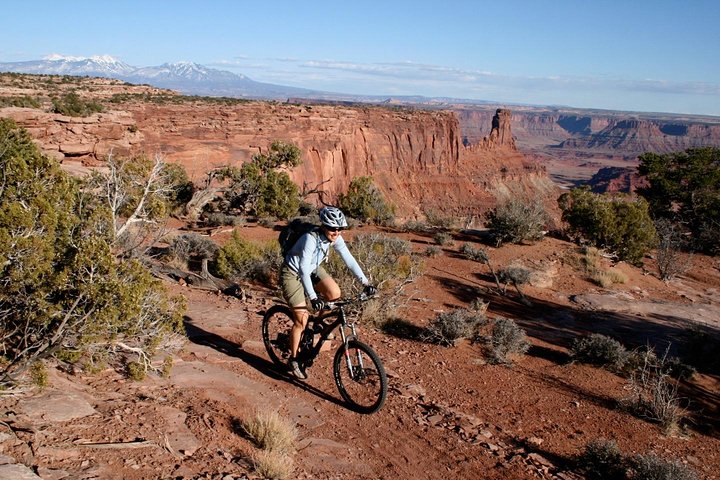
Morning light scrapes across the mesa like a match, striking color from rock that slept red and wakes on fire. On the rim, juniper knots twist toward the breeze and the Colorado River loops in a gleaming oxbow far below, a ribbon that dares gravity to try something new. The trail threads the edge—never reckless, just confident—and your bike hums along slickrock that feels older than time and surprisingly friendly under tire.
This is Dead Horse Point State Park, the relaxed cousin to Moab’s rowdy reputation, and one of the only places where beginner- to intermediate-friendly singletrack welcomes e-bikes. It’s a rare alignment: flowy desert riding, cliff-side panoramas, and a trail network designed to ease newcomers in while giving seasoned riders enough corners and views to keep the dopamine steady. Base yourself at the park’s Intrepid Trail System and roll straight from the trailhead with a rental from Dead Horse Point Bike Rentals (https://app.advcollective.com/local-experts/dead-horse-point-bike-rentals)—helmets included, routes highlighted, and on-trail mechanical support on standby.
The mesa does its own storytelling. Wingate Sandstone falls away in dramatic tiers, a stack of time that once moved as dune and sea floor before it hardened into today’s balcony over Canyonlands. Look east and the La Sal Mountains hold their snow like a promise. Look south and the Island in the Sky district hovers as its name suggests. The wind doesn’t just blow here—it nudges, it negotiates, it carries whispers about cattle drives and uranium booms and the legend that gave the park its stark name. Dead Horse Point likely earned its moniker from a 19th-century practice: cowboys drove wild mustangs onto the narrow point, fenced them in with makeshift brush, and selected the best stock. Accounts say the rest were sometimes left without water on the cliff-top corral. It’s a hard story, and the landscape remembers.
Today’s riders encounter a gentler script. The Intrepid network totals roughly 16 miles of signed singletrack—well-marked loops with names that give away the character: Raven Roll, Great Pyramid, Big Chief, Crossroads. Entry-level riders can stick to the Intrepid and Raven Roll loops for a scenic, low-stress hour along packed dirt interspersed with small slickrock domes. Intermediates can string together Great Pyramid and Big Chief for a longer perimeter ride that tracks the rim, each overlook throwing down another photo op. The surface shifts from fast dirt to sandstone plates and back again, asking for balance more than bravado. E-bikes (Class 1 pedal-assist) are welcome here on state-park singletrack—one reason Dead Horse Point is such a standout—so families and mixed-ability groups can ride together without turning the day into a pace negotiation.
Rentals are straightforward. Dead Horse Point Bike Rentals (https://app.advcollective.com/local-experts/dead-horse-point-bike-rentals) outfits riders with hardtails, full-suspension machines, and Class 1 pedal-assist e-MTBs, plus kid-sized bikes and e-bikes. The staff hands over a trail map with highlighted routes and shares practical advice—where the wind tends to bluff, how the sandstone rolls better than it looks, and which junctions lead to the best views. All bikes are due back at the trailhead by 3:00 p.m. (2:00 p.m. in June), a timing that favors cool morning miles and a relaxed lunch on the rim.
Desert riding rewards those who plan ahead. There are no reliable services for food or fuel within about 45 minutes of the park, so go in topped up and bring lunch. Water is available at the visitor center, and you’ll want more than you think, even in shoulder seasons. Wear breathable layers and sturdy shoes; the sun here has opinions, and the rock radiates long after noon. The surface is forgiving compared to Moab’s burlier classics—no punchy ledges or off-camber trapdoors—yet the exposure near the rim is real. The trails are set back from the edge with a courteous buffer, but the views have a way of pulling your eyes off the line. Pause, look, then ride. The canyon isn’t going anywhere.
Geology is the quiet co-star, and it’s relentless. The mesa’s Wingate cliffs stand like sentinels while the Kayenta and Navajo layers step down into deep time. The river pushes forward, as it always has, carving a chorus line of goosenecks and side canyons. On a calm day, ravens surf thermals with an athlete’s focus. In spring, a brush of wildflowers dots the sand with improbable color. By fall, the light lowers and the shadows do their own choreography, extending rock features into dark echoes that ride along beside you.
Cultural footprints are here, too—ancestral lands of the Ute and Navajo people, trade routes and hunting grounds long predating county maps. More recently, film crews turned this view into an icon; the final scene of Thelma & Louise was staged from this very rim, the canyon delivering drama no set could fake. Respect feels like the right mode—stay on signed trails to protect fragile cryptobiotic soil, yield to hikers, and keep e-bike assist in check around blind corners.
As the day lengthens, the trail cadence becomes familiar. The bike climbs small sandstone rolls that push you forward like a subtle tailwind. Corners whisper for a little lean. Overlooks dare you to stop, and you should. Each pause rewrites the scale of the place; you shrink in the best way. If you’re not ready for Moab’s technical hits, or you just want a mellow day with enormous payoffs, this is the sweet spot: a ride that’s easy to start, hard to forget, and well supported.
Finish your loop, hand off the bike, and linger. Canyonlands National Park is just 15 minutes down the road if you’ve packed extra snacks. Or let the mesa have the last word. It speaks in wind and color, but it’s never cryptic. It says: come back when the light changes. The trails will be waiting, ready to show you the same story from a different angle.