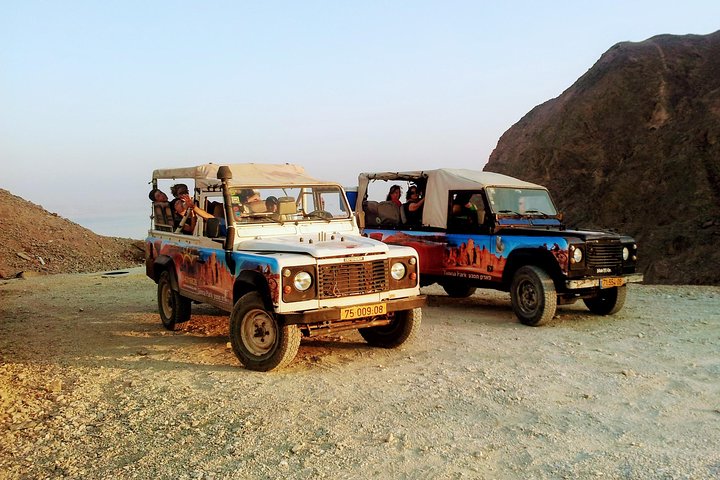
The Jeep thumps over a washboard track and then eases into a basin that feels both alien and intimate: red sandstone cliffs crowd the sky while wind-smooth domes and freestanding pillars cast long, theatrical shadows. A gust lifts dust in a gold filament that catches the afternoon sun. You lean out of the vehicle for a better look at Solomon’s Pillars—vertical ribs of stone that have stood like sentinels above the valley floor for millions of years—and for a moment you can imagine copper ore being hauled by hand, fires flaring, and the clink of metal being worked by an artisan’s hammer. This is Timna Park, thirty minutes north of Eilat, where geology, archaeology, and the sharp, merciless beauty of the Negev converge on a half-day jeep route.
There’s a reason drivers here talk in terms of landmarks—not distances. The park’s draws are visual and tactile: Mushroom Rock balancing improbably on a stem of compacted sand; the natural sandstone arches that frame the low desert sky; and the remains of ancient mining activity, where the ground is a palimpsest of human labor. Timna sits on the Syrian-African Rift, a tectonic seam that has sculpted the land into dramatic folds and exposed layers of iron-stained sandstone and copper-bearing ore. That geology is the backstory to a surprising human history: Timna contains some of the earliest evidence of copper smelting in the Levant, with remains attributed to both local and Egyptian miners. For travelers, the landscape is a live museum—doorways to antiquity that you can walk through rather than only view behind glass.
A guided jeep tour compresses a lot of that context into 3.5–4 hours. The vehicles traverse mostly compact desert tracks—sandy flats, rocky ruts, and short climbed inclines—covering roughly 15–25 kilometers of off-road route between viewpoints. Hikes from stops are generally short, from a few hundred meters to 1.5 kilometers, but the terrain is uneven and occasionally sharp-rocked. Total elevation variance is modest—expect climbs up to 150–200 meters on short stretches, nothing technical, but all under direct sun. You’ll get out to explore engineered sites—ancient mine shafts and smelting remnants—as well as natural features like the Arches and the mushroom-shaped rock. On a clear day, the high desert air is crisp, and the colors of the stone become almost hyper-saturated.
Culturally, Timna sits at an intersection. The park’s modern management blends conservation, tourism, and archaeological research. Bedouin communities in the region add contemporary cultural counterpoint—guides and local vendors often weave stories of daily life in the Negev into the rocky narrative. Nearby Eilat offers the coastal contrast: seafood, market stalls, and the Red Sea’s coral reefs—so a visit to Timna is easy to slot into a broader southern-Israel itinerary.
Practicalities matter as much as the picture-perfect moments. Tours are typically 3.5–4 hours (210–240 minutes), so you should budget for a half-day out of Eilat. The jeep route suits people who are comfortable getting dusty and moving at a steady but unhurried pace; expect multiple stop-and-explore points rather than a single long march. Weather defines the experience—spring and fall are ideal for warmth without the desert’s fiercest heat, while summer demands early starts and serious sun protection. Winter mornings can be brisk.
Bring water—lots of it—and layered clothing. Good trail shoes are essential; leather soles or rigid trainers will be uncomfortable on gritty sandstone. A sun hat, sunglasses, and a lightweight long sleeve will guard against the sun and the wind. Photography deserves a mention: the low-angle light in the morning and late afternoon is spectacular, and the contrasty sandstone rewards a polarizing filter to deepen the sky and tame reflections.
On the ground, honor the site. The copper-smelting remains and engraved rock faces are fragile; don’t touch exposed artifacts or inscribe your own name on the stone. Timna is a managed park with entrance fees and a clear set of paths—stick to them to preserve both safety and archaeology.
Why take this trip? It’s compact and cinematic: a short, vehicle-led route that delivers geological spectacle, human history, and accessible walking. It works well as a standalone half-day adventure from Eilat or as part of a multi-day desert loop. For families, the tangible artifacts of ancient industry make the past concrete; for photographers and geology buffs, the rock forms are show-stoppers. For anyone who has spent time on coastal beaches or city streets, the sharp quiet of the Negev—its color, its wind, its scale—feels like a reset.
Logistics are straightforward: most tours include park entry and a guided route, and they run year-round with seasonal adjustments. If you want more intimate exploration, combine the jeep route with a guided hike to less-visited corners or a Bedouin hospitality experience in nearby enclaves. Ultimately, the Timna jeep tour is not a test of endurance; it’s a carefully paced portal into a landscape where earth and human hands have been altering one another for millennia. You come for the pillars and the rock art, and you leave with a clearer sense of how the desert keeps its stories close—visible, if you know where to look.