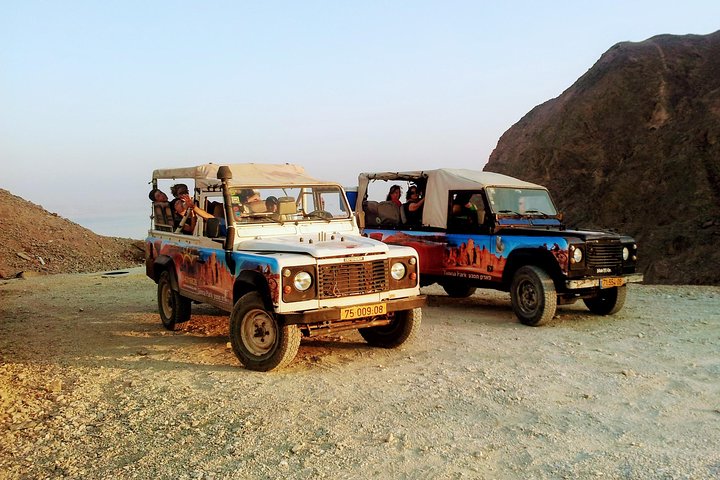
The jeep hums, tires whispering over red gravel, as the low desert sun begins to hollow itself into the Gulf of Aqaba. You lean into the doorframe and watch the light change the bones of the landscape—granite ribs turned bronze—while the guide, hand on the wheel, points to distant ridgelines. Below, a dry riverbed carves the valley like a handprint. This is the Eilat Mountains at dusk, a place where borders feel like lines on a map and the horizon reads like a geography lesson: Jordan to the east, Egypt to the west, Israel beneath your boots and, further along the shoreline, the distant silhouette of Saudi Arabia. It’s the kind of view that makes you understand how a three-hour jeep tour can feel, momentarily, as wide as a long road trip.
The ride itself is compact but immersive: 150–180 minutes that steer you through Nahal Solomon’s river bed, up the slopes of Yoash, and to a final sunset perch overlooking Eilat Bay. You’re not simply observing the desert; the landscape tests you. The road slips from packed earth to scree and back again; wadi channels flirt with the wheels. At a small bonfire, a Bedouin host offers flatbreads baked over coals and a strong herbal tea—simple fare that tastes like place, warm and salty in the way of desert hospitality.
Geology is on full display. The Eilat Mountains are made up largely of Precambrian granite and metamorphic rocks—some of the oldest visible rocks in the region—weathered into jagged ridges and smooth domes. Those rocks tell a slow story: of uplift and abrasion, of sea levels long vanished, and of the erosive hands of episodic rains that rework the same riverbeds season after season. Culturally, the area is a meeting ground. For millennia, routes through these mountains linked the Arabian Peninsula to the interior of the Levant; today, Bedouin families keep those old skills alive—guiding, cooking, and reading the land.
The tour is ideal for travelers who want the speed and reach of a vehicle but the intimacy of a guided hike. You’ll get short stops to walk, stretch, and take in angles you’d miss from a car window: a cleft where lizards sun themselves, a narrow slot where the light goes thin and blue, and the quiet, expansive sky that makes the desert feel roomy rather than empty. The highlight is the Yoash viewpoint—an abrupt, wide-open ledge where the day folds into color and the four-border vista snaps into focus.
Practicalities are straightforward. The tour runs about three hours and is accessible to anyone who can manage short, firm-footed walks and get in and out of a jeep. There are no technical climbing skills required. Temperatures fall rapidly after sunset; a light jacket or windbreaker makes the bonfire and post-sunset drive comfortable. Bring layers, a camera with a wide-angle lens for the bay views, and water—enough for any short walks you take away from the vehicle. The included Bedouin flatbread stop offers a memorable taste of local hospitality—an authentic touch that connects the ride with the people who inhabit this landscape.
For photographers, dusk is an obvious draw: the warm light pulls pigments from the rocks and gives the bay a metallic edge. Composition here benefits from foreground anchors—an outcrop, a low scrub—so the vastness has scale. Slow down your shutter a touch and try bracketing the sunset to capture the fullest tonal range.
Safety and respect for the land are simple but important rules. Stick with your guide, respect private grazing areas, and leave fire rings and natural features as you find them. The Eilat Mountains are fragile; spiky desert plants and algae in seasonal pools can be easily damaged. Bringing cash for the small purchases from local hosts—like herbal tea or fresh flatbread—is a small way to directly support local people who rely on tourism income.
Why do this tour? Because it concentrates the best of southern Israel’s desert into a short, lively window: geology, history, welcome, and a view that makes the map feel immediate. It’s an efficient adventure—three hours that expand your sense of place and leave you wanting to learn more about the desert’s quieter corners.


