The Slingshot’s engine clears its throat, and the morning air answers back—cool, pine-tinged, and promising. You ease out from Peachtree Corners, the neon of Buford Highway falling away as the road unfurls toward the Chattahoochee. The river keeps pace to your left, nudging you forward like a steady-handed coach. It’s a two-hour window, a small slice of daylight to trade errands for asphalt and end at a waterfall that once powered a mill town and now powers quick escapes. This is North Atlanta at its most surprising: a suburban weave that still finds wilderness at the edges.
The route slips from neighborhood to river road, favoring the slow grace of Barnwell and Riverside over the thrum of GA-400. The Slingshot sits low and talkative, a three-wheeled grin made for sweeping turns. The Chattahoochee is never far, a long, muscular presence along this corridor that Georgians simply call “the Hooch.” Watch for herons stilt-walking across shoals and the flicker of river birch leaves. The water urges you on without hurry—take the bend, lift off the throttle, let the day expand.
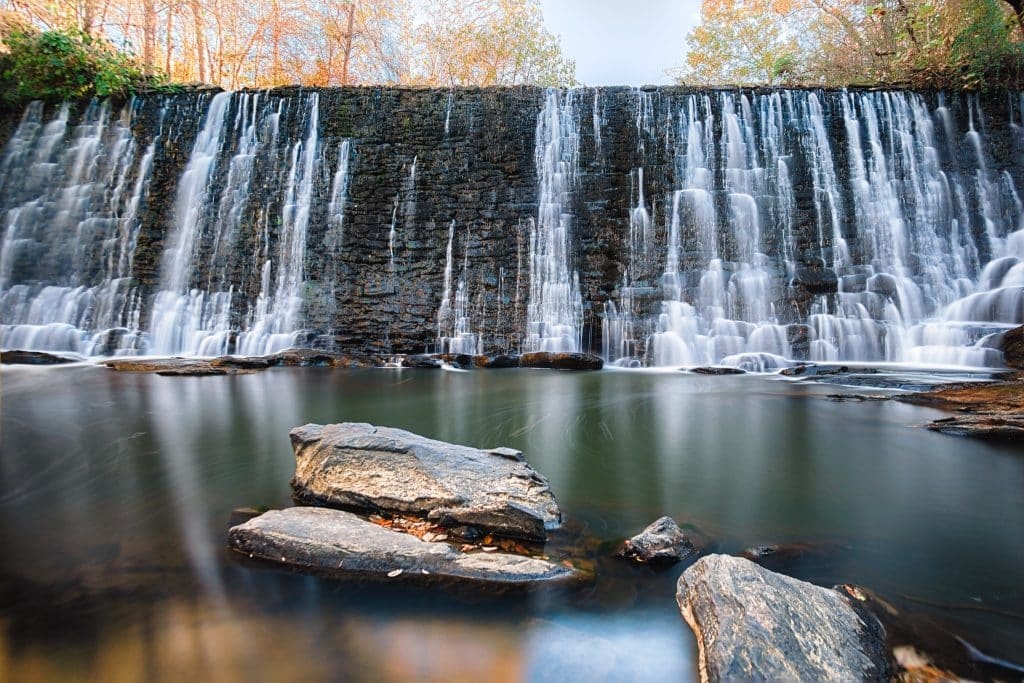
Aim the nose toward Roswell, a city that grew up on the work of water. The destination is Vickery Falls, the cascade in Old Mill Park where Big Creek—known here as Vickery Creek—drops through a man-made spillway into a churning pool, then slides toward the Chattahoochee’s steady pull. It’s a waterfall built by industry and reclaimed by time; brick ruins hold their ground amid sweetgum and oak, and a covered pedestrian bridge frames the sound of the falls. History doesn’t whisper here—it hums.
On paper, it’s a simple ride. In practice, it’s a micro-adventure: a quick out-and-back that trades interstates for river lanes, ending with a short, shady stroll to cold spray and bright stone. The Piedmont’s geology makes its case as you approach—gneiss and schist shouldering up through the soil, guiding creeks into sharp little gorges. Roswell’s mills thrived on these drops, converting falling water into cotton thread and community. Today, the Roswell Manufacturing Company’s remnants still shoulder the creek, reminders to look twice at the past beneath your boots.
This trip invites spontaneity, but a little strategy goes a long way. Start early to claim parking at Old Mill Park and keep traffic to a background murmur. Bring closed-toe shoes; the short walk to the falls can be slick after rain. Expect easy terrain on the main path—packed dirt and boardwalk—with optional spurs into the Chattahoochee River National Recreation Area’s network if you want to linger. Two hours is enough for an unhurried drive and a lingering look at the falls; if you crave a sandwich on Canton Street or a stop at Gate City Brewing, build in extra time.
What makes this run special is contrast: suburban lanes that suddenly smell like river rocks, modern throttle meeting 19th-century millwork, a tidy time window that still delivers a reset. It’s also approachable. You don’t need a motorcycle endorsement to drive an autocycle Slingshot in Georgia; a valid driver’s license and sound traffic sense are the keys. Helmets and eye protection are typically provided by the outfitter and are always a smart call. Confidence on public roads matters more than bravado here—these are community streets winding to a beloved city park. The reward for minding the speed limit is simple: you don’t miss the good stuff.
Along the way, history steps in. Roswell was built by water-powered ambition, and the Civil War left its scar; the mill complex was burned in 1864 during Sherman’s campaign. The bones remain: stone foundations, raceways, and interpretive signs that give shape to the valley’s story. Vickery Creek’s name likely nods to an early settler family, but the creek’s older name—Big Creek—still shows up on maps, a reminder that geologic clocks run longer than ours. An afternoon wind might knock a leaf from the sycamore above you; it lands on water that’s been moving toward the Gulf longer than any of us have been moving toward the weekend.
The payoff arrives with sound. Park the Slingshot, step out, and follow the path toward the covered bridge. The falls announce themselves before you see them, a steady roar that drowns out small talk. The air cools; the gorge breathes. Stand at the overlook and let the spray find your forearms. The Slingshot is a machine that heightens motion; the falls are a place that makes stillness feel earned.
If you want to turn this quick escape into a fuller day, Roswell’s Canton Street awaits with patios and platefuls (Table & Main if you’re in the mood for fried chicken done right; coffee at Roswell Provisions before the drive back). Or keep it simple: return along Riverside and let the late light slant through river birch and loblolly pine. The Hooch keeps pace, unbothered. You’ll get the kind of tired that arrives after a good drive and a better view.
For a mapped route, rental details, and local expertise, see the guide at https://app.advcollective.com/local-experts/2-hour-self-guided-tour. It’s the easiest way to lock in your two-hour window and follow a river-road rhythm that never gets old.
Practical notes for planners: Expect roughly 18–25 miles each way depending on the streets you favor; Riverside Road, Barnwell Road, and Holcomb Bridge Road make a scenic skeleton. Old Mill Park parking can fill on weekends; arrive early or have a backup lot in the Chattahoochee River National Recreation Area (CRNRA) system nearby. The Old Mill Park lot is typically free; CRNRA lots require a daily pass. Cell service is generally reliable, but offline maps are smart in the creek valley. And yes—bring a camera. The covered bridge frames the falls in a way your future self will appreciate.
When you’re ready to trade scroll time for throttle time, book through https://app.advcollective.com/local-experts/2-hour-self-guided-tour. Two hours later, you’ll wonder why you ever thought adventure had to take all day.