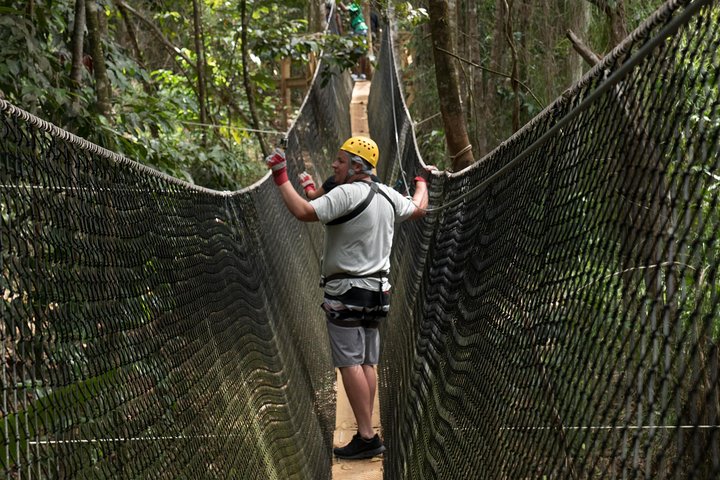
You step off the shuttle and the forest swallows the edges of the world. Heat and sugar-sweet foliage press close; orchids and ferns crowd the trail while the distant Atlantic flashes between palms. Then a guide clips a harness to your waist, slides a helmet down, and for the first time that morning you look up—high, green, and threaded with steel. The canopy here is not a backdrop. It's a playground.
Treetop Adventure Park's Canopy Tour in St. Lucia is the kind of half-day that reorders perspective. Twelve zip lines stitch the rainforest together, including the island's longest, highest, and fastest runs. Over roughly four hours you’ll move from platform to platform, sometimes flying solo, sometimes tandem, always held by a redundant system of carabiners and trained hands. It’s physical in a pleasantly uncomplicated way: short climbs, a couple of canopy staircases, and long, lung-opening glides that end with palms fanning around your boots.
The island itself is older than the idea of tourism here—volcanic fire sculpted the mountains that rain now chisels into verdant valleys. Geologically, St. Lucia sits on the boundary of the Caribbean Plate; the dramatic topography—the same processes that raised the Pitons—also fed the soils that grow the rainforest you’ll cross. Historically, these forests were contested ground: indigenous Arawak and Carib peoples first lived off them long before French and British colonists carved cocoa and banana plantations into the slopes. The canopy tour threads through land that was once agricultural estate and is now a mix of protected forest and community-managed property, where local guides often trace family histories back through the trees.
The culture around the experience is as important as the adrenaline. Guides are islanders who know the forest the way sailors know the swell—species of tree named, a bird call identified, a medicinal leaf pointed out between safety checks. They are part naturalists, part mechanics, part storytellers. Beyond the tour, Soufrière—a short drive away—offers seafood shacks, rum shops, and the slow spatial pleasure of Caribbean towns: market mornings, fishermen mending nets, and the tangible scent of garlic and thyme drifting from street kitchens.
For travelers, this canopy tour offers an excellent balance of thrill and accessibility. It’s not technical climbing, but you will get airborne. Expect bursts of speed on the longer lines, a few platform-to-platform scrambles, and multiple vantage points for photographer-friendly views of the lower rainforest and glimpses of coastline. The operation runs about four hours door-to-door at the park and typically includes a safety briefing, harnessing, guided transfers between lines, and a final debrief that often ends with a coconut or cold water.
Practicalities: the tour runs year-round, but the dry months (roughly December to May) give you the clearest lines of sight and the driest platforms. Bring closed-toe shoes with good tread, lightweight clothing that won’t snag, and a small daypack for sunscreen, water, and a camera with a secure strap. Operators generally provide helmets, harnesses, and gloves; still, check the provider’s kit policy if you want to bring a personal harness or gloves.
Safety is taken seriously: cables are inspected regularly and guides run redundant attachment systems. If you’re nervous about heights, tell your guide—staff here are practiced at incremental comfort-building and can offer tandem or controlled descents until you feel confident. Families with older children often find the course exhilarating but manageable; operators set age and weight minimums, so confirm before you book.
Why go? Because this is an efficiency of experience: in one half-day you get exercise, education, and a physical rush that makes the rainforest feel immediate rather than decorative. The zips erase the distance between the human and arboreal worlds, offering you a literal and figurative high view into St. Lucia’s geology, ecology, and coastal silhouette.
Timing your visit: morning slots tend to be cooler and quieter; afternoon runs can come with more haze and an increased chance of passing showers. If you’re on a cruise schedule, confirm pickup times—operators often coordinate with the Castries port. And because the park shows up on many travelers’ itineraries, book in advance to lock in your preferred time and to take advantage of free-cancellation options.
To make the most of it: hydrate the night before, eat a balanced breakfast, and wear layers that breathe. Leave loose valuables behind or secure them to your person; most guides will offer a locked bin or vehicle storage. Finally, stay present—zipline travel is fast by design, and that speed is the gateway to a different kind of island intimacy.
Whether you’re a first-time zipliner or someone who chases new lines around the world, St. Lucia’s Treetop Adventure Park delivers a tidy, local-flavored thrill: rainforest underfoot and the ocean at the edge of your view. It’s part technical outing, part cultural exchange, and pure, uncomplicated fun—an elevated way to meet the island on its own terms.


