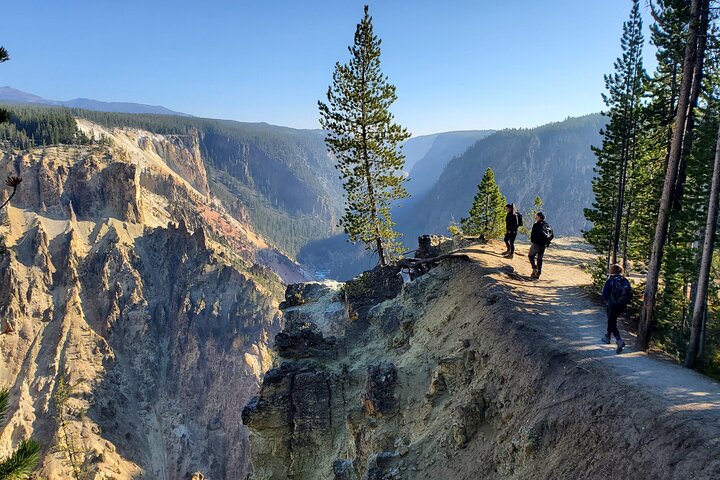
You round a bend on a shaded rim trail and the canyon opens like a set-piece: a serrated gorge of burnt-gold walls streaked with ochre, a river threading silver at its bottom, and a column of white spray that announces the Lower Falls before you even see it. Wind scours the canyon lip, playful and insistent, and the river, far below, seems to dare you to come closer. On a guided day hike through the Grand Canyon of the Yellowstone, that push-and-pull between caution and curiosity becomes the day's rhythm.
Yellowstone’s canyon is not the work of a single dramatic event but a slow ledger of forces. Deep within the park’s geological story is the caldera that makes the whole place exceptional: rhyolite flows, hydrothermal alteration, and later the patient work of the Yellowstone River, which cut through weakened rock to create cliffs that drop hundreds of feet. The Hayden Geological Survey’s 1871 maps and paintings transformed the canyon into a national curiosity; early tourists followed, laying the trails that modern hikers now use.
On the trail with Wildland Trekking guides—seasoned pros who balance natural history with route management—the hike becomes both a field lesson and a moving meditation. Guides point out telltale stripes of oxidized iron and the pumice-laced tuff that hint at volcanic tantrums tens of thousands of years ago. They stop to show you how the river’s course has shifted, where glacial action steered meltwater, and why the canyon’s palette ranges from cream to crimson. When the group approaches Artist Point or Lookout Point, conversation softens: people lean on their trekking poles and let the view do the explaining.
This is a hike that satisfies both senses and logistics. Expect a day that runs roughly 4–7 hours—the Viator listing notes variable durations of 240 to 420 minutes—covering approximately 4–8 miles of mixed terrain with modest but steady elevation changes (plan for 500–1,200 feet of cumulative gain). Trails along the rim are well-defined dirt paths with sections of exposed rock and short stairways at the more popular viewpoints; Uncle Tom’s Trail gives a steeper, stair-heavy option for those who want to descend toward the falls and feel the spray. The footing isn’t technical, but the canyon’s exposure rewards careful attention to steps and weather.
Wildlife interrupts the scenery in the best possible ways. Early mornings and late afternoons bring elk and bison to meadows, and you’ll often spot ravens or golden eagles tracking the thermals above the canyon. Guides emphasize leave-no-trace ethics and bear-aware behavior—bear spray within easy reach, food stowed, voices kept at a respectful pitch. The canyon is both a spectacle and a living habitat; its management as part of Yellowstone National Park balances access with protection.
Practicalities are woven into the experience. The guides bring a picnic lunch and snacks, so you don’t have to carry a heavy daypack full of food, though a liter of water per two hours of hiking is a good baseline. Layering matters here: mornings can be cool and windy at the rim, while midday warms quickly. Sunburn from the canyon’s reflected light is a common rookie mistake—sunscreen and sunglasses are worth banking on. Cell service is spotty; this is a place to be present, not to stream. The entry fee into Yellowstone applies, and guided groups benefit from the expertise of leaders who manage pacing, route choice, and safety, particularly when wildlife is on the move.
Culturally, the canyon sits in a landscape inhabited for millennia. Indigenous peoples traversed and hunted these plateaus long before Euro-American surveys turned them into mapped attractions. Today, the canyon is interpreted in the park’s visitor centers and through ranger talks—avenues worth tapping into before or after your hike to deepen the experience.
Who should do this hike? It’s ideal for adventurous travelers who want a day of varied scenery without committing to multi-day backcountry travel. Families with older kids, active adults, and photographers will find the route rewarding. For seasoned hikers it’s a satisfying half-day or full-day journey that pairs easily with other Yellowstone highlights—Old Faithful, Mammoth Hot Springs, and wildlife corridors—if you’re making a circuit of the park.
Timing makes a difference. Summer delivers reliably warm weather and full services, but the rim trails can be busy. Spring and fall lower the crowds and load the canyon with different light and wildlife activity—early fall is especially dramatic as aspens begin to yellow. Winter conditions close many park roads, but the canyon’s frozen vistas and quiet are unmatched for those who travel by snowcoach or cross-country ski.
On balance, a guided day hike of the Grand Canyon of the Yellowstone delivers curated viewpoint access, geology lessons you can actually see, and wildlife encounters that unfold with a guide’s patience. It’s a place where the river’s stubbornness and the caldera’s history read plainly across the rock, where the tension between danger and beauty keeps you alert, and where even a single day can alter your sense of scale. If you want a Yellowstone day that feels like a concentrated version of the park’s best parts—waterfall, canyon, wildlife, and a deep geological backstory—this route gives it to you in tidy, unforgettable measures.