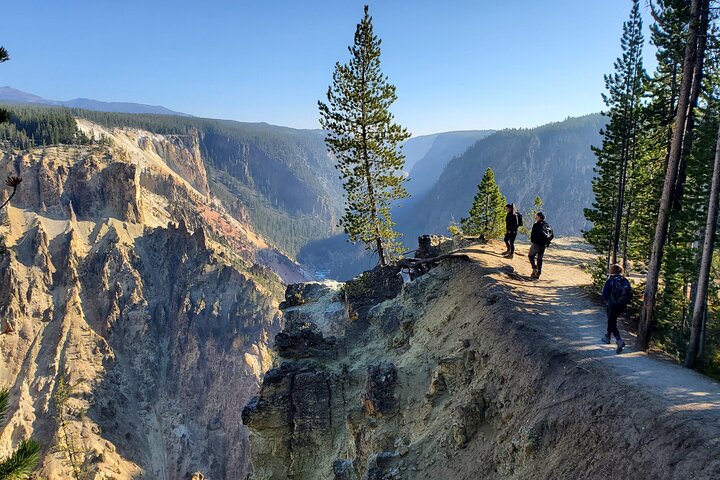
The canyon opens before you like an honest wound in the earth: jagged walls of pumice and rhyolite banded in ochre, rust and lemon, steam ghosting from distant hydrothermal seams. Your guide sets a steady pace on the rim trail, voice low and matter-of-fact, pointing out the thinning aspens and a sweep of river that has, over millennia, dared the rock to keep its colors. The river won. You keep walking.
A six-hour guided loop through Yellowstone’s Grand Canyon is less about conquering distance than it is about choreography—balancing viewpoints, geology, thermal features, and the slow work of the landscape’s history. Over roughly 6 miles (10 km) and about 800 feet (240 m) of cumulative ascent, you’ll move from wide canyon overlooks to forested switchbacks, past meadows where marmots sun themselves and through stands of lodgepole pines that smell like resin and rain. The route is stitched together by history: Native tribes traveled and hunted these valleys long before the Yellowstone River began its patient incision, and 19th-century explorers wrote of a “great canyon” that would later help define the park founded in 1872.
Geology isn’t dry here; it’s theatrical. The canyon owes its color palette to hydrothermal alteration—hot water altering and bleaching the volcanic rock—leaving the yellows and reds that give the canyon its name. The river carved the chasm after the last major volcanic events in the Yellowstone Plateau, exposing layers and sculpting the dramatic falls that thunder at points along the loop. On clear days you can see steam plumes where geothermal activity persists, like the landscape’s exhalation.
Culturally, the area sits at a crossroads. Early Euro-American trappers and later park superintendents helped codify trails, while the National Park Service shaped modern stewardship—balancing visitor access with wildlife protection and geothermal preservation. Your guide’s role is part historian, part traffic cop: watching for bear sign, keeping the group on official trail junctions, and steering you toward photo compositions that look effortless until you try to replicate them.
The hike moves in rhythms. The rim trail rewards short, focused exertion with sweeping panoramas—bring binoculars for far canyon walls and eagles—but the under-story is quieter and smaller: yellow butterflies flitting over alpine grasses, the brittle creak of dead lodgepoles, and the sudden, birdlike scolding of a willow ptarmigan. Nature here has personality; the river rushes as though bored of being admired, the steam vents simmer like private hot tubs, and the trail itself feels aware of every footfall.
Practicality keeps pace with wonder. Expect a day that starts with a crisp park-morning chill and can end under thicker afternoon cloud. Weather in Yellowstone can change fast; accumulate fewer regrets by layering and bringing a windproof shell. Hydration matters—6 hours on uneven ground at altitude saps energy—and the guide will carry a small first-aid kit and know the protocols for encountering wildlife. The loop is accessible to hikers with steady footing, but parts include narrow switchbacks and short steep sections; trekking poles are helpful if you prefer extra balance.
Why book a guided loop here? Navigation on the canyon rim is surprisingly tricky—trail junctions and intersecting side paths can disorient even experienced hikers. A guide reads the land and the map, spots animal sign you might miss, and times lunch for views, not shade. The inclusion of a lakes, mud pots, and meadows means you’ll see Yellowstone’s contrasts in a single day: the quiet of high meadows, the smell and hiss of geothermal ground, and the open, windy grandeur of the canyon rim.
If you go: arrive early to minimize time in the busiest overlooks, and pack a camera with a mid-range zoom (70–200mm is ideal) plus a wide-angle for the canyon sweeps. Leave room in your itinerary for a post-hike detour to Canyon Village for a hot meal or to compare notes with ranger staff at the visitor center.
On the more practical side: the loop is best from late spring through early fall, when trails are clear of snow and facilities in the park are open. The guide service provides safety context and a midday lunch with views, but personal gear—good boots, sun protection, daypack, and water—remains your responsibility. The payoff is undeniable: a day that teaches you to read rock, listen for river cadence and leave with a clear sense of why Yellowstone was set aside in the first place.
This hike is for people who want their big panoramas framed by deeper, tactile experiences—those who like to break up a long vista with a quiet observation of moss or a careful discussion of the canyon’s painted walls. It’s not a sprint; it’s a well-paced, interpretive walk along one of America’s most elemental landscapes.


