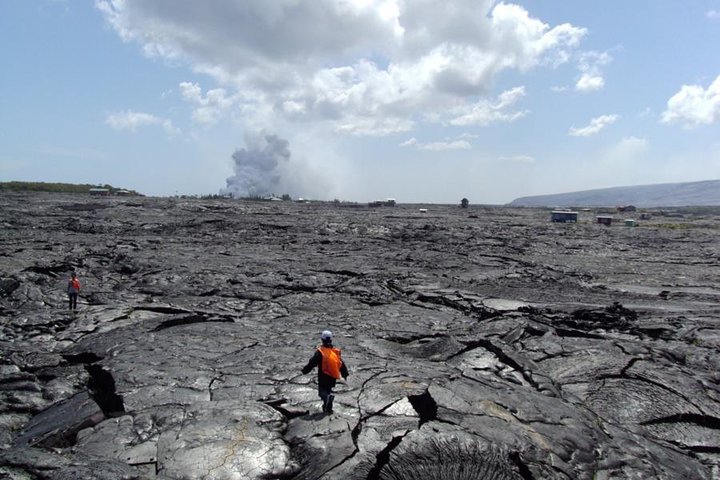
The road unfurls like a black ribbon around the lip of an open wound. You start at the Kīlauea Visitor Center, the smell of coffee and sunscreen lingering in the air, and within minutes the landscape changes from roadside tropical overgrowth to a lunar vocabulary—obsidian glass, lichen-pocked lava, and the low, yellowed steam that tells you the earth is exhaling. Crater Rim Drive is less a single hike than a sequence of short, precise encounters with an active volcanic system. Each pullout is a chapter: the steam vents that hiss like tide pools, sulfur banks stinging the wind, Thurston Lava Tube swallowing light, and overlooks that stare directly into a caldera whose floor has been reshaped by fire time and again.
The drive itself is compact—roughly 11 miles of two-lane pavement that loops around Kīlauea’s summit crater within Hawai‘i Volcanoes National Park—yet you should plan hours for the stops. Walks range from short, wheelchair-accessible boardwalks at steam vents to the 0.4-mile loop through Nahuku (Thurston Lava Tube). If you want to stretch legs, the Kīlauea Iki trail begins from a nearby trailhead and descends into a frozen lake of cooled lava; that 4-mile round-trip drops about 400 feet and offers a more intimate, gritty look at the park’s volcanic history.
Geology here is a living textbook. Kīlauea is one of the most active volcanoes on Earth—the long Pu‘u‘ō‘ō eruption from 1983 to 2018 reshaped vast swaths of the island and reminds visitors that the terrain you drive on was molten within living memory. The caldera you skirt is a sunken arena where steam vents and sulfur banks mark places where volcanic gases escape. Rocks you touch are recent, often formed in the last few hundred to thousand years; you can literally feel the newness of land here. For native Hawaiians this land is not just science—it's the domain of Pele, the goddess of volcanoes, and the place is saturated with cultural layers: petroglyph fields, ancient trails, and modern-day reverence.
Crater Rim Drive pairs well with a day of island contrasts. Many guided excursions that include the drive also visit Akaka Falls and Rainbow Falls to the north and Punalu‘u Black Sand Beach on the southern coastline, giving you a quick curriculum in Big Island diversity—waterfalls that tumble through ferned gullies, beaches crusted in glassy black sand where green sea turtles sometimes bask. If you’re on a tight schedule—say, a cruise ship shore excursion in Hilo—these combined tours are efficient, delivering geology and culture in a single long day.
Practicalities matter here. The summit sits around 4,000 feet in elevation; temperatures can be cooler and weather changes fast. Volcanic gases—vog—collect in downwind areas and can irritate lungs and eyes, particularly for those with respiratory issues. Cell service is patchy; maps and a printed park guide are useful. Parking at popular pullouts can fill early in high season; arrive at dawn for solitude and soft light on the caldera or aim for late afternoon for long shadows and less mid-day glare.
Footing varies. Boardwalks and paved viewpoints make the main stops accessible, but many of the best views require short, rocky walks or uneven, root-strewn trails. Sturdy shoes with good grip are smart; a light daypack with water, a rain shell, and sun protection will keep the day comfortable. If your plan includes Kīlauea Iki or a longer trail off the rim you should be prepared for a 3–5 hour outing and changing microclimates—from misty tree ferns to exposed, wind-swept ridgelines.
Culture and community live in Volcano Village, a few miles from the park entrance, where bakeries, local art galleries, and the Volcano Art Center provide a softer counterpoint to the raw geology. Ask locals about the names tied to the land—many sites are known by Hawaiian names that carry stories and genealogies. Respect those connections: stay on trails, don’t remove rocks or plants, and observe kapu (sacred) signs.
Safety tips you should treat as essential: keep a wide berth of steam vents and sulfur banks—ground can be unstable and gases harmful. If vog levels are high, adjust plans and avoid strenuous activity. Pets are restricted on park trails; plan accordingly. Finally, check the National Park Service alerts before you go—closures and access restrictions can change based on volcanic activity.
Why drive Crater Rim Drive? It’s an efficient, high-impact way to read the language of fire across a landscape: a short boardwalk can tell you about ongoing geological processes, a lava tube can teach you about subterranean flows, and an overlook can force a humbling confrontation with scale. For families and seasoned outdoor travelers alike, the route offers layered experiences—easy interpretive walks, a few more physical hikes, cultural context at the visitor center, and, importantly, photographic moments that feel earned rather than staged.
If you go: start early, give yourself time, respect the land’s cultural significance, and balance the spectacle with quiet attention. The island moves slowly here, but it moves—always reshaping, always making new. Crater Rim Drive is a short circle around a fierce heart. Listen to it.