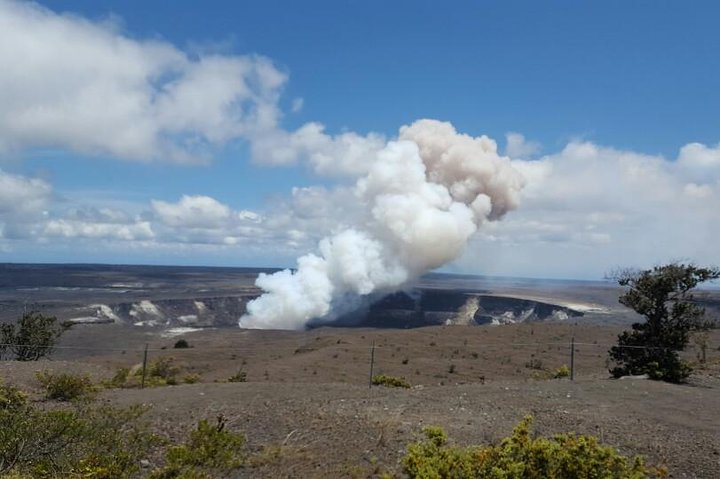
The first time you descend Chain of Craters Road, the landscape rearranges your sense of scale. The asphalt unspools from the cool, forested rim of Kīlauea and, mile after mile, gives way to black, glassy sheets of lava that shine like a hard ocean frozen mid-swell. Wind moves differently here — it has to negotiate cliffs, cooled flows and the open Pacific — and it carries salt and the faint sulfurous breath of the caldera. At the end of the road the ocean bites at a lava coastline and has carved the Holei Sea Arch, a doorway to the relentless surf.
Chain of Craters Road is both a scenic drive and a geological classroom. It’s about 19 miles from the Kīlauea summit down to the coast, with an elevation change on the order of several thousand feet; you can feel the air thicken and thin as you move through mesic forest, alien lava plains and coastal scrub. Drive slowly, stop often. Look for the textures: ropy pahoehoe that looks like stitched leather; jagged ʻaʻā that shouts where lava cooled in chaos. The road is a timeline of eruptions — scarred, rebuilt and sometimes swallowed whole by newer flows. Parts of Chain of Craters Road have been repeatedly buried and reopened since the mid-20th century; the landscape is not static, and neither is the road.
The story here is volcanic and Hawaiian at once. Geologically, the road threads a volcanic rift system fed by magma from Kīlauea and Mauna Loa; older flows overlap like pages in a book. Culturally, this is the domain of Pele, the Hawaiian goddess of fire, and the park asks visitors to move with humility: photography and curiosity are welcome, but respect for sacred sites and for the park’s living geology is required. You’ll hear guides—many of them local—splice science with moʻolelo (story), giving context to steaming vents, the blackened tree skeletons, and the petroglyphs that mark older human footprints on fresh lava.
What travelers often miss until they stand there is scale: cliffs that were once the caldera rim plunge into the ocean, steam plumes where hot lava meets cold seawater, and the Holei Sea Arch, patient and dramatic, shaped by waves that will outlast any visitor. Birdsong is sparse on the flows, but if you slow to listen you’ll find endemic life taking refuge in kipuka, islands of older land surrounded by younger lava where native plants survived and thrived.
For people planning a visit, Chain of Craters Road is ideally paired with guided experiences that both enhance and simplify the day. Private guided tours of Hawaii Volcanoes National Park concentrate your time efficiently: a 3–4 hour park immersion will hit steam vents, the Kīlauea caldera and the roads’ highlights, while full-day or custom tours from Hilo can add Thurston Lava Tube (Nāhuku), Rainbow Falls, and local stops like Volcano Winery or Hilo’s food stalls. If you have limited time, choose a guided tour that meets you in the park; if you want more freedom, drive yourself and use park maps and ranger updates to navigate closures — the park’s conditions change with eruptions and flows.
Practicalities are straightforward but important. The road is paved, but shoulders can be narrow and parking limited at popular viewpoints. Temperatures vary with elevation and exposure—dress in layers. Bring sun protection for the exposed flows, sturdy shoes for short hikes over rough lava, and plenty of water: the landscape drinks sunlight and can be harsh. Park entrance fees apply (check current rates before you go) and always obey closure signs — sections of Chain of Craters Road have been cut short by lava in recent decades, and the park closes areas when conditions are hazardous.
For photographers, the road rewards early light and late-day warmth. Dawn softens the landscape; sunset paints the flows gold and the sea arch into silhouette. If you’re chasing lava glow or active flows, go with a certified guide who monitors activity and keeps you safely distant. Helicopter tours from Hilo or combined land-and-air adventures offer a dramatic perspective of the rift zones and coastal vents — and are worth considering when you want a fuller sense of how the road fits into the larger volcanic anatomy.
Chain of Craters Road is not a passive postcard destination; it asks you to move, to listen and to adapt. Walk a short spur into a kipuka and you’ll find native ʻōhiʻa and fern gardens that feel like pockets of time preserved from older ecosystems. Stand at the cliff edge and watch the sea work on lava older than many nations. It’s a place where geology persuades you that patience is a landscape-scale virtue, and where culture teaches that the land is not merely backdrop but participant.
If you go with the right expectations — slow, curious, prepared — Chain of Craters Road gives an accessible, unforgettable encounter with volcanic power and coastal drama. For a day trip from Hilo or as part of a longer Big Island circuit, it’s essential: a road that leads you to an edge, and the choice to look over.