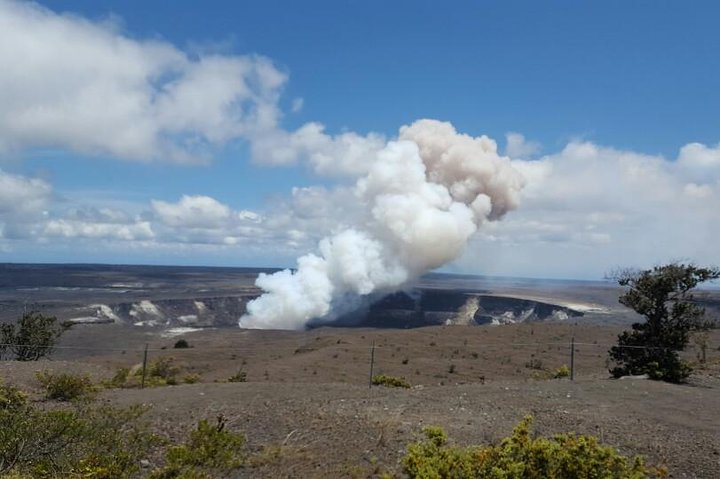
You step from fern-shrouded rainforest into a bowl of black that looks like something from another planet. The trail drops away in switchbacks and the air changes—warmer, drier, humming with the low breath of the earth. Below, the floor of Kilauea Iki Crater stretches like a frozen sea: pahoehoe and ʻaʻā flows folded and cracked into rippled textures and glassy crusts, painted in a dozen shades of charcoal and umber. Steam vents skirt the rim and the crater exhales the park’s history—hot, slow, inevitable. This is Kilauea Iki Crater, a compact, unforgettable classroom on the Big Island where geology writes itself in lava and rainforest.
The scene you encounter today was shaped most dramatically in 1959. For 35 days the crater was the theater for one of the park’s most spectacular eruptions: fountains of basalt shot skyward, a lava lake boiled and settled, and the new surface cooled into the tabletop you walk across now. Geologically recent and visually raw, Kilauea Iki gives hikers a rare intimacy with volcanic processes—close enough to see the flow lines and old skylights, far enough to feel the scale.
Kilauea Iki sits inside Hawaiʻi Volcanoes National Park, a UNESCO World Heritage Site and International Biosphere Reserve. The crater’s rim is ringed in native ʻōhiʻa and fern that recolonized after fire and heat. The contrast between the black lava floor and the glossy green forest is one of the most striking ecological transitions you’ll hike through in the islands. Cultural history threads this landscape too: native Hawaiian stories and chants reference the fire goddess Pele, and the area around Kīlauea holds deep spiritual significance. Guides in the park often weave natural science and cultural context together, providing more than a hike—they offer a sense of place.
There are a few straightforward ways to experience Kilauea Iki, from self-led day hikes to private guided treks that include lava tubes and deeper interpretive background. Guided options—ranging from three-hour private tours to full-day expert-led experiences—are popular for good reason: an experienced naturalist or volcanologist points out the subtle details that make the crater legible: where lava fountains once roared, how the 1959 vent behaved, and why the Thurston and Nahuku lava tubes formed. Specialized trips also support conservation efforts in the park when partnered with nonprofit guides.
Practicalities are simple but essential. The classic Kilauea Iki Trail is about a 4-mile loop with roughly 400 feet of elevation change; allow 2–4 hours depending on pace and how many stops you take. Terrain ranges from well-maintained switchbacks and packed volcanic cinders to the uneven, sometimes jagged crust across the crater floor. Footwear with good traction is non-negotiable; expect a bit of loose rock and occasional slick spots near steam vents. Water and sun protection matter even when the rim is shaded—the crater floor is exposed and can be significantly warmer.
Timing shapes the experience. Start early for quiet trails and softer light—sunrise gilds the rim and the steam vents pick out shapes on the floor. Midday brings harsher glare and more vog (volcanic smog), which can reduce visibility and affect sensitive travelers. Rain is common in the park and can turn trails slick; breathable layers and a light rain shell are handy. Always check current volcanic activity and park alerts before you go; conditions can change and certain areas may close for safety.
On the itinerary, many hikers combine the Kilauea Iki descent with a visit to a lava tube, like Nahuku (Thurston Lava Tube), and overlooks on the crater rim. Private guided hikes often add the stories behind the rocks: the 1959 eruption’s record-setting lava fountains, the fifteenth-century Ailaʻau flows that formed the older lava tube system, and the ways native plants recolonize new ground. For photographers the crater is a study in contrast—bring a wide-angle lens to capture the sweep and a polarizer to cut glare on the black glass.
Leave-no-trace rules are strict here: the park asks that you stay on maintained trails, don’t remove rocks or cultural artifacts, and respect sensitive habitats. Conservation-minded tours funnel revenue back into park projects or employ local specialists who understand both the science and the cultural protocols. If you can, choose an expert-led option that gives you context while supporting the park’s stewardship.
Kilauea Iki doesn’t demand technical climbing skills, but it rewards curiosity and respect. Walk with steady shoes, slow down at overlooks, and let the landscape do its work: it teaches patience, offers geology in motion, and provides a rare chance to tread across a place where the planet’s heat once rewrote the surface. The crater is compact enough to be accessible, complex enough to linger over.
On the rim, the forest seems to stand guard; on the floor, the cooled lake remembers its boiling. Between those edges you feel like a visitor in a living archive—one step, one black stone at a time.
Why go: Kilauea Iki is a concentrated, walkable lesson in volcanism and recovery—spectacular, educational, and physically approachable for most hikers. Whether you do a self-guided loop or a private guided hike with a lava-tube add-on, you’ll leave with clear images, sharp questions, and an appreciation for the forces that shape islands.