By the time the city skyline blurs behind you, the air changes—less glass and glassy heat, more stone and a dry breeze that smells faintly of sage. The private transfer hums up a widening valley, and you feel the pulse of the Hajar Mountains before you see them: low, jagged ribs of rust-colored rock, terraces cut by time and the occasional concrete road that climbs where camel tracks once did. On this private Hatta tour you spend six hours moving through a landscape that’s part natural amphitheater and part living museum—winding by Hatta Water Dam, pausing at Heritage Village, and threading short, accessible walks in wadis that dare you to look away from the road.
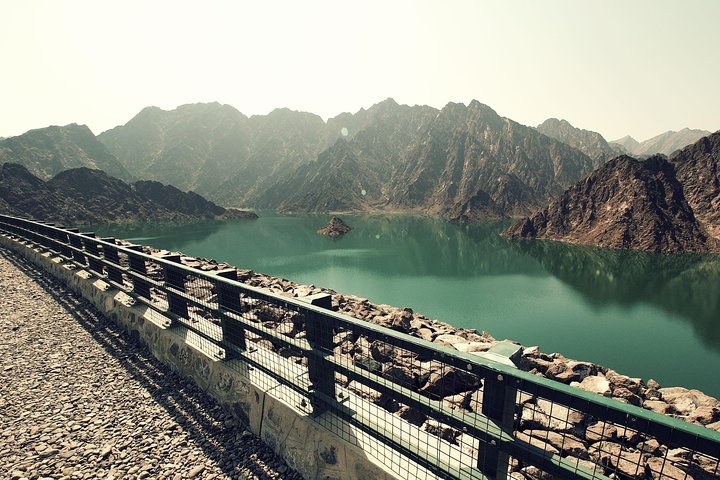
The first stop is almost cinematic: Hatta Dam opens like a calm blue lung pressed into the mountains. From the lookout, the water’s surface holds the sky and the high cliffs that frame it, a rare sight in a country most travelers know for beaches and skyscrapers. Here, the modern meets the ancient—man-made engineering set inside a setting shaped over millennia by tectonics and erosional patience. The dam’s low-slung reservoir invites quiet reflection and, for many visitors, a quick photo break and a short walk along its shoreline to feel the cool microclimate the water creates.
A short drive away sits Hatta Heritage Village, a carefully restored cluster of stone houses, watchtowers, and date presses. It’s a museum of rhythm and resourcefulness: rooftop wind towers, compact courtyards, and rooms that speak to a time when life depended on clever water capture and shade. Guides and local interpreters will point out how mantled roofs and narrow alleys were design decisions to fend off sun and secrecy alike. The village is a compact, teachable moment that links the mountain passes you’ll drive through with the people who carved a living from them.
Geologically, Hatta is an outcrop of Hajar Mountain uplift—layered limestone and ophiolite that give the region its tone and texture. The driving itself is part of the experience: serpentine roads, switchbacks with sudden panoramas, and wadis—dry riverbeds that flash to life after rare rains. Wadi Hatta Park, where many visitors spend time trying out short activities, is family-friendly and intentionally accessible, with options for gentle walks, canoeing on the dam in season, and easy viewpoints for panorama shots.
Culturally, Hatta sits at the margins of Dubai’s urban story. The area is an exclave of the Emirate of Dubai, historically tied to tribal life and trans-mountain trade routes rather than port wealth. These days it’s a curated mix: heritage projects preserved by public and private investment, small-scale local farms, and new hospitality nodes—guesthouses and cafés that serve sourdough sandwiches alongside Emirati dates and local honey. The private nature of this tour—an air-conditioned luxury car and a 4WD for mountain tracks—lets small groups move at a pace that suits them, linger longer at views, and take the kind of short hikes that reward curiosity without demanding high fitness.
Practical things matter here. The tour is a full-day outing—roughly six hours total—and is ideal for travelers based in Dubai who want mountain scenery without complicated logistics. The private vehicle can handle steep, unpaved roads that public transport can’t, and guides know where to pause for the best light and the least crowded viewpoints. Walks range from brief, flat loops (a few hundred meters at the Heritage Village) to slightly longer, undulating paths around the dam and in neighboring wadis (1–3 km). Elevation gains are modest compared with alpine hikes: expect gentle climbs and stony steps rather than long ascents.
Timing is everything. Cooler months—October through April—are the sweet spot, when mornings are crisp and afternoons are pleasant. In summer, the heat can be punishing; even short walks feel more strenuous. Bring sun protection, a refillable water bottle, and sturdy shoes with good traction for gravel and stone. A light layer for early mornings is smart: desert and mountain temperatures can drop unexpectedly.
Why take a private tour versus going it alone? Local drivers shave time off routing, unlock access to lesser-known viewpoints, and often share on-the-ground context—where a particular tower was used for lookouts, which family used a specific courtyard, or which wadi blooms with seasonal wildflowers. For families and small groups, the single-price model is practical: one vehicle, a guide, and a private rhythm.
If you leave Hatta with just one memory, let it be the contrast: a deep, deliberate silence at the dam; the low-key bustle of the restored village where you can press palm dates between your fingers; the way the mountains hold the light an extra beat at dusk. The tour isn’t extreme—there’s no technical climbing or long trekking—but it’s rich in variety: geography, history, a taste of daily mountain life, and the kind of roadside panoramas that harden into postcards in your head.
For a practical day out, think simple packing, sensible shoes, a camera with a polarizing filter for the dam and sky, and a readiness to slow down. The rest is logistics—the private pick-up, the drive, the choice to sit with a view for ten minutes longer—and the reward is a clear, immediate sense of place. Hatta is a compact mountain argument against the idea that the UAE is only coastal gloss: it’s rocky, human-scaled, and quietly stubborn. A single day here rewires expectations and proves that adventure in this part of the world can be at once relaxed, instructive, and undeniably scenic.