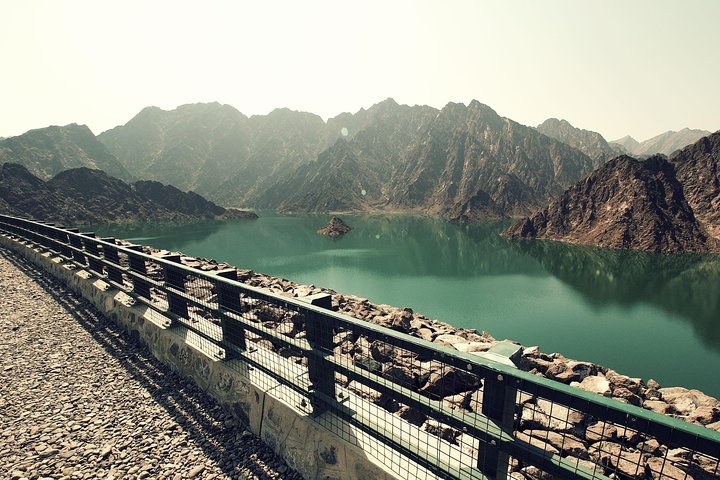
You leave Dubai’s glass-and-concrete pulse behind and, in under two hours, find yourself moving slower, the highway unspooling into a landscape that behaves like it owns its silence. The road climbs into the Hajar foothills, and when the mountains finally settle around you, the water appears like a secret: a broad sliver of turquoise wedged between weathered ridges. That is Hatta Dam—the locus of this well-paced day trip that threads cultural history, desert geology, and a calm paddle into a single, accessible outing. The experience is simple on paper: a stop at the Heritage Village, a guided kayak on the lake, views from the dam. In practice it’s an exercise in perspective. The mountains press in, the wind tests your balance on the paddle, and for a few hours the city’s hum feels like someone else’s radio.
Hatta is an exclave of the Emirate of Dubai, set in the Hajar Mountains. Geologically, the Hajar are older than the surrounding sands; ridges here are sculpted limestone and ophiolite that tilt and fracture, creating the kinds of steep walls that hold turquoise reservoirs. The lake itself is the product of the Hatta Dam, and its calm water contrasts with the rough, sun-bleached slopes that give it a dramatic frame. Cultural context arrives at the Heritage Village, where narrow compounds, date presses, and reconstructed structures offer a compact portrait of life before oil transformed the Gulf. The village is not museum-slick—its point is to connect everyday practices to the desert’s harsher logic: water management, seasonal migration, and craft.
On the water, the kayak becomes a small, honest measure of the place. The paddle is a metronome; the lake answers with a rippled reflection of the mountains. Wind will tease, sometimes line the shoreline with small chop, other times lay the surface out like glass. The tour’s cadence is deliberately moderate—enough time to work a few strokes, to drift near reed beds, and to find a vantage point for photography before returning. Guides emphasize technique and safety, and the equipment is straightforward: sit-in or sit-on kayaks, lifejackets, and waterproofed briefings.
Why do this tour rather than drive to a private beach or a city park? There’s an immediacy to the Hatta landscape that’s hard to fake. The mountains physically reduce the sensory clutter. Sounds gain a distance and a clarity; birds cut clean lines; the water dares you to slow down and match it. It’s also a chance to layer experiences: a short cultural primer at the Heritage Village, a moderate-effort paddle, and the simple satisfaction of seeing a different geography within the same emirate that houses one of the world’s busiest airports.
If you’re thinking of timing and comfort, late fall through early spring is the season that fits most travelers: cooler temperatures, cleaner light, and consistent winds that are breezy without being problematic. Summers in the UAE are intense and can make mid-day paddling uncomfortable; tours are scheduled to avoid the worst of it, but expect heat through June to September. The tour is family-friendly in structure; younger paddlers should be comfortable with basic balance and following simple safety directions. For those who travel for photos, the light in the hour after sunrise and the hour before sunset is exceptional—the water softens and the mountains form graphic silhouettes.
Practically speaking, the tour is a day trip built around convenience. Most itineraries include pickup in Dubai, a guided stop at Hatta Heritage Village, a lakeside safety briefing, and a guided paddle that ranges from gentle exploration to line-of-sight crossings depending on group ability. The guides are locals and regional pros who know how to read wind and light; they’re as helpful with route choices as they are with a quick lesson on efficient strokes. Cost sits in a range that reflects guided transport, local entry, and equipment hire; it’s a surprisingly affordable way to escape the city without the logistics of self-organizing the drive and equipment rental.
There are a few straightforward cautions. The sun on the water intensifies exposure—sunscreen, hat, and hydration aren’t optional. The lake is generally calm, but wind will make you work; listen to your guide and keep to the planned route if you’re new to paddling. Respect for the Heritage Village and local customs is expected: dress modestly in public spaces and treat cultural artifacts and structures with tact.
If you leave Hatta with anything, it’s a sense of scale. The day is compact, but the contrasts are broad: traditional village life rendered in clay and reed, a modern dam holding an almost postcard blue basin, and a mountain range that seems set on reminding you that the Arabian Peninsula isn’t all dunes and neon. This tour is not a mountaineering feat, nor a whitewater rush. It’s a measured invitation to swap a skyline for a ridge line and a city soundtrack for paddles tapping water. For travelers who want a quick, thoughtful escape from Dubai, Hatta offers a version of the UAE that stays on your skin a little longer.


