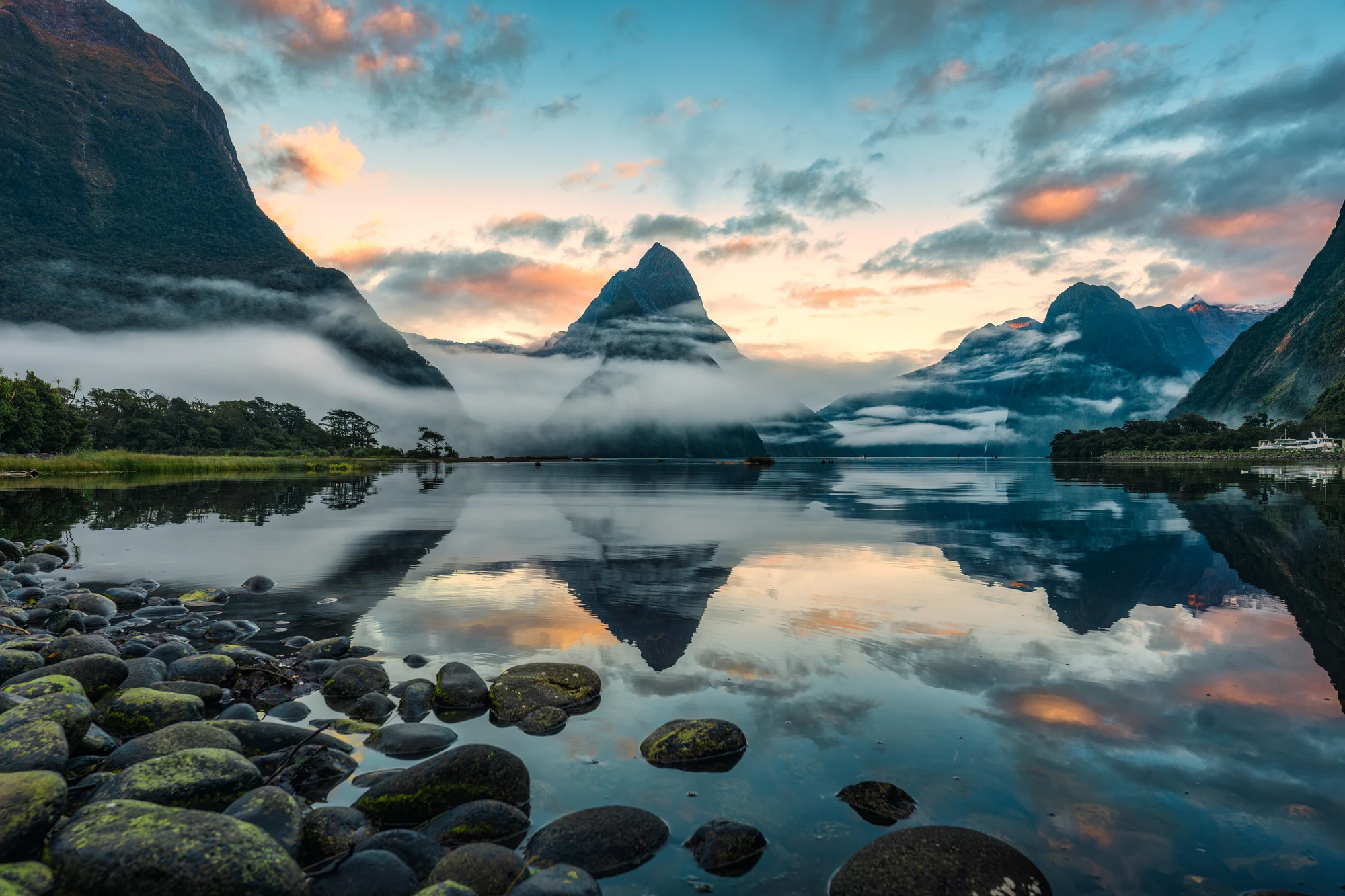
You arrive at Monkey Creek on a gray, low-slung morning: rain threads from the beech canopy, the creek is a ribbon of quicksilver cutting through moss and fallen timber, and the mountains loom like pages of a weathered atlas folded sharply into the sky. The air smells of wet stone and kawakawa; a torrent somewhere upriver is daring you to follow the sound. Here, on the edge of Fiordland National Park, Monkey Creek is not a destination so much as a prelude — the kind of place that announces, quietly but unmistakably, that you are about to enter one of the most dramatic coastal landscapes on Earth.
Monkey Creek sits on the approach to Milford Sound, a narrow theatre of cliffs and waterfalls where the Tasman Sea pushes itself into a gap carved by ice. For most travelers, the day that begins with the creek’s mossy bridges ends aboard a catamaran, circling beneath Stirling Falls and watching fur seals haul out on sun-washed rocks. Those two parts — the roadside intimacy of Monkey Creek and the wide, ocean-dark drama of Milford Sound — pair naturally. The creek readies your senses: wet, green, and close; the fiord explodes them open.
Geology made this place slowly and with force. Fiordland was sculpted by glaciers over tens of thousands of years; the valleys are U-shaped and the cliffs shear off at right angles. Water here behaves as an active sculptor: waterfalls appear from nowhere during a rain and run like white paint down basalt walls. Maori navigators and seasonal hunters first knew these sounds as rich, practical places. They came for pounamu (greenstone), fish and a predictable run of birds and seals. European explorers arrived later — John Grono is credited with naming Milford Sound after Milford Haven in Wales — and writers such as Rudyard Kipling would call it the “eighth wonder of the world.” The history is short but dense, layered like the rock you stand on.
Today, the most straightforward way to experience this stretch of coastline is the coach-and-cruise circuit. From Queenstown the drive is long (expect around 4–5 hours each way if you’re self-driving), but modern operators have turned the route into part of the show: panoramic coaches with glass roofs and commentary let the road become a prelude rather than a slog. From Te Anau, the gateway town, the run shortens to roughly two hours; for a compact itinerary that preserves energy for the water, Te Anau is the sensible base.
Once you reach the sound, boat-cruises range from short nature tours to extended outings that push out to the Tasman. On most operators’ itineraries you’ll get close enough to funnels of water to feel the spray and hear the roar in your chest; Stirling Falls and Sutherland Falls dominate the list of must-sees — each is a demonstration of vertical waterpower. Naturalist guides point out kea and kaka in the trees and, on good days, bottlenose dolphins or playful New Zealand fur seals will shadow the vessel.
Practicality matters here. Fiordland’s weather is famously volatile — the region can receive several meters of rain annually — so plan in layers and prioritize waterproofs. If you're booking from Queenstown, consider an outbound coach and a scenic flight back (the flyback options exist for a reason: they transform the road home into a cinematic descent over glacier-carved valleys and alpine lakes). If you're based in Te Anau, morning departures leave you time on the water and a calmer return drive.
The personality of the place is worth talking about. Monkey Creek is soft and intimate: the creek itself seems to be nudging you toward alertness, encouraging you to notice small things — a warbler’s call, the architecture of lichen. The fiord is more blunt and theatrical: sheer rock, the smell of cold salt, waterfalls that drop in ribbons and guts. Together they form the rhythm of Fiordland: small-scale, slow-breath observation alternating with moments of raw, elemental power.
For the traveler who wants to do more than pass through, there are short nature walks near the road and longer tramps into the heart of the park. If you have the time and fitness, booking a multiday experience or a guided kayak in the sound will let you experience the silence of the water at dawn, when the cliffs feel concentrated and alive. But even a day, sensibly planned, can be transformative: a morning at Monkey Creek, a mid-day cruise with wildlife watch, and an evening return. It’s full, not frantic.
Good planning beats good weather. Book reputable operators that prioritize safety and sustainable practice; many coaches now use lower-emission fleets and partner with DOC for minimal-impact shore access. Bring a waterproof camera or a weather-sealed mirrorless body, but more importantly bring patience: Fiordland rewards quiet attention more generously than it rewards checklist ticking.
Monkey Creek and the road to Milford are a study in contrasts — green snugness vs. oceanic scale, trickle vs. cascade — and that tension is why the trip remains a highlight for visitors to New Zealand’s South Island. You come for the waterfalls and the seals, but you leave with something quieter: the sense that you’ve moved through a landscape that changes your pace and asks you to do the same.
Whether you choose a premium coach with commentary, a small-group minibus with local guides, or a combined coach-and-flyback option for a different perspective, treat the day as a choreography: dress for variability, pack for time on the water, and give yourself space to stop at places like Monkey Creek, where the country begins at ankle level before it opens into a world-class fiord.