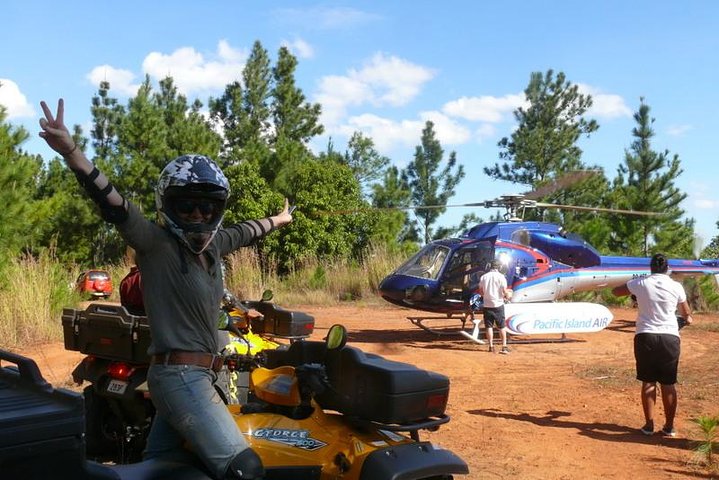
You hit the throttle and the world tilts—pine needles and sugarcane become a green blur, wind sharp in your ears. The quad vibrates under you, jittery and alive, as the Nakala Mountains open up above Nadi. Below, the Mamanuca Islands sit like spilled coins on the Pacific, salt glinting where reef breaks the ocean. For two to three hours this is not a postcard; it’s a motion picture where you are both spectator and actor.
The ride begins on Nadi’s back road, past the ornate Sri Siva Subramaniya Temple—often described as the largest Hindu temple in the South Pacific—its gopuram a riot of carved color against the sky. That first stretch is a gentle introduction, a chance to lock into the bike’s balance and to listen to your guide, who threads local history and jokes through engine noise. Then the bitumen gives way to tracks that narrow, steepen, and begin to finger into the mountainside: pine forest, cane fields, and the occasional muddy patch that, depending on the season, will either oblige a playful splash or demand a careful line.
There’s a particular rhythm to this tour. The tracks climb, the trees change, and the views expand. Sunlight sifts through needles; the scent of earth and crushed cane rises. When you crest the mountain plateau, the guide eases the group to a stop. Light snacks appear—tropical fruit, biscuits, and sometimes a local treat—while everyone leans against the quads and drinks in the panorama. It’s the instant when the island’s two great characters reveal themselves at once: lush interior highlands and the wide, luminous ocean beyond.
This ride is as much cultural as it is kinetic. The Nakala region is stitched together by a history of sugar cane and small rural farms, the same land that shaped modern Fiji. Your guide—usually from a nearby village—points out shifts in land use, explains how roadside shrines mark family histories, and jokes about the weather you didn’t pack for. A short drive back descends past Nadi town and finishes with a pause at a local beach: a deliberate punctuation that lets sand and surf rinse the engine’s smell from your boots.
Practical realities keep the thrill accessible. The tour runs two to three hours, fits small groups, and comes with instant confirmation and free cancellation—nice if you’re building a tight Fiji itinerary or have fluctuating plans. Expect a mix of surfaces: paved approach roads, narrow dirt tracks, rocky sections, and seasonal mud that’s part of the fun. The price is a mid-range, experience-driven fare—currently around $160 USD—which includes guide leadership, basic safety gear, and snacks.
Why do this? Because it’s a compressed way to meet the real spine of Viti Levu. You get a kinetic sense of the landscape—how the lowland cane gives way to pine (a colonial planting), how villages perch on roadsides, and how the ocean appears, always sudden and always persuasive. For travelers who like movement, local stories, and the occasional adrenalin jolt without committing to a full-day expedition, a quad-bike run is an ideal balance.
Tips on timing and temperament: aim for the dry months (May–October) for cleaner trails and clearer views; arrive early in the day to avoid the midday heat and tourist traffic; and choose a small-group run if you want more stops and more local conversation. Bring closed-toe shoes, long pants, and a lightweight shell—pine needles scratch, and even short rides can fling rocks or mud. And keep your camera strapped; the views of the Mamanucas are the sort of wide, blue frame that prints beautifully.
Safety is straightforward but non-negotiable. Guides give a short orientation—how to throttle, how to brake, how to read a line through a muddy rut—so pay attention even if you’ve ridden quads before. Respect farmland boundaries and follow your guide’s track choices; the region mixes private farms with village lands, and local etiquette matters.
If you want to deepen the day, pair the ride with a late-afternoon visit to Port Denarau for a sunset dinner, or sample kokoda—Fiji’s coconut-cured fish—at a village stall if your guide offers a local stop. The day ends with a sensory contrast: the earthy, motorized interior and the laid-back Pacific coast where drinks and cold beer taste of salt and accomplishment.
For anyone who wants equal parts scenery, culture, and motion, the Nakala quad-bike tour delivers. It’s not about breaking record speeds; it’s about moving through place on a machine that lets you feel the island’s geology under your wheels and hear its human stories through an engine’s rhythm. Bring curiosity, a moderate level of fitness, and the willingness to get a little muddy—Fiji rewards the adventurous with views you’ll carry long after the engine cools.