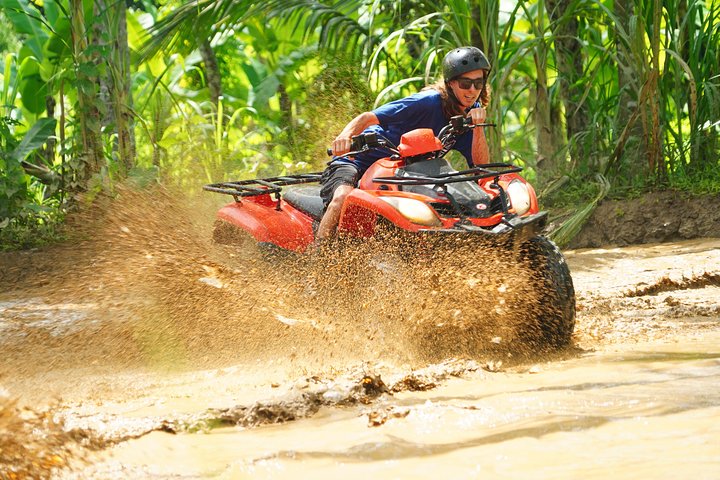
You smell hot earth and diesel at first light—a sweet, loamy perfume warmed by the rising sun. The quad’s engine thrums beneath you like a heartbeat. Ahead, the trail unfurls through a mosaic of emerald rice terraces, clove trees and small village compounds. Later in the day that same engine silence will be replaced by the river’s voice: the Ayung giving and taking, daring you through tight canyons and sudden drops. This is Bali in motion—compressed into one long, honest day of dirt, sweat, laughter and a river that obliges thrills.
The tour is elegantly simple: a morning on an ATV through Bali’s cultivated backcountry, lunch at a local warung, and an afternoon rafting the Ayung River. But simplicity belies variety. On the quad, you navigate semi-jungle tracks and muddy lanes between rice paddies irrigated by the island’s famous subak system—centuries-old communal waterworks that shape both landscape and ritual. The bikes are forgiving but alive; you don’t need off‑road racing experience, only steady hands and an appetite for speed. Guides tailor the pace to the group, pushing the fun where the terrain allows and easing up near village houses.
The Ayung is the island’s most popular rafting river and for good reason. It cuts a narrow, green gorge with limestone cliffs and carved temples tucked into the banks. The rapids on a standard commercial stretch are typically class II–III: punchy, playful, not teeth-knocking. You’ll read the river as you go—eddies that toy with your raft, current that nudges you toward a narrow chute, sunlight that shatters across white water. Between runs you’ll see coconut palms nodding like spectators and, if you look closely, stone carvings half-swallowed by ferns. Water here feels purposeful, not menacing—insistent in the way a good guide is insistent: respect the current and it will show you a good time.
This combo does more than check two adventure boxes. It compresses Bali’s layered textures—agricultural rhythms, Hindu village life, and island geology—into a single-day narrative that is accessible and decidedly local. The quad routes often skirt or pass through families’ front yards where children wave, dogs bark and elders go about offerings. The lunch break is frequently at a modest warung where food is about balance: fresh vegetables, grilled fish or ayam betutu, sambal calibrated to make you sweat just enough to feel alive. The rafting guides, many of whom grew up along the river, will point out historic shrines or explain how volcanic soils and centuries of terrace farming shape water flow.
Practicalities are straightforward. Expect an 8–9 hour day (transport and change time included). The morning typically begins with a short safety briefing and helmet fitting, followed by 1.5–2 hours of quad riding across varied terrain. After lunch, rafting segments last roughly 1.5–2 hours on the water depending on flow and chosen section—enough time to feel the river’s personality without draining you. The operation usually offers English-speaking guides, and many packages include hotel pickup and drop-off, which is recommended for the logistics of a long day.
Safety is baked into the experience but not automatic. Wear closed-toe shoes for the quad and quick-dry clothing for rafting. Hydrate—Bali’s humidity can flatten even the most enthusiastic traveler by midday. For non‑riders, ask about tandem options or a milder quad loop. For the river, life jackets and helmets are standard; listen to the briefing, practice the “paddle forward/back” calls, and keep your feet up if you go swimming. Operators with local certification and clear environmental policies are worth the small premium—this river and field system are livelihoods, not playgrounds.
Timing matters. The dry season (May–September) yields predictable river conditions and drier trails for the quads. Shoulder months provide fewer crowds and softer light for photos. Peak tourist months bring longer transfer times and busier rivers; if you prefer quieter runs, schedule weekday departures and early starts.
You come for adrenaline, but you leave with context: an appreciation for the subak that makes those rice paddies glow, a new respect for the Ayung’s current, and a memory of a day that stitched high-rev excitement to quiet cultural exchange. It’s an accessible thrill with a local heartbeat—fast enough to feel like an adventure, measured enough to welcome most travelers.