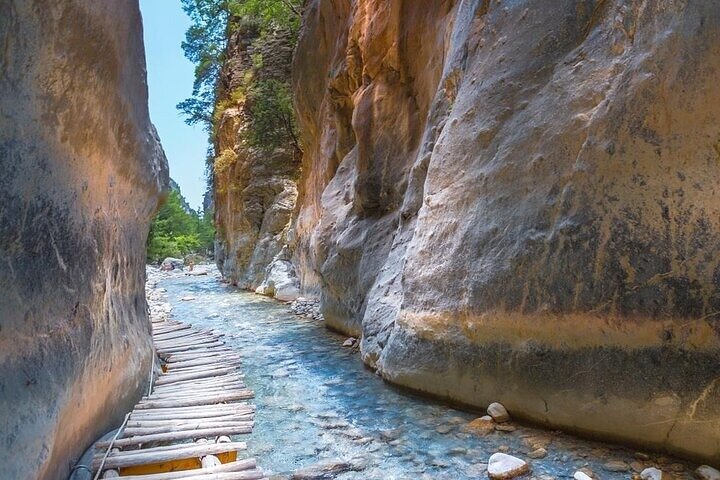
You start under a green ceiling. The trail narrows and the light goes soft—filtered through plane and chestnut leaves—and for a moment the island’s famous heat feels like someone else’s problem. Stones, slick with centuries of footfall and a trickle of clear water, guide you through a canyon that keeps its secrets close: cliff walls that hum with history, olive groves clinging to terraces above, and a hush that only an off-the-beaten-path Crete can hold. By midday, the gorge unzips into the southern coast and a slice of beach appears, small and honest—Sougia—where the sea rolls in dark blue and the town moves at a different clock.
Agia Irini Gorge is, by design, quiet. Unlike its more crowded neighbor, Samaria, this canyon attracts fewer buses and more people who want a thoughtful day outside rather than a checklist item. The tour threads these two pleasures together: a steady, shaded walk through the gorge, then the reward of a slow afternoon at Sougia Beach—lunch, a swim, maybe a nap under an umbrella. It’s the kind of itinerary that reminds you why travel is often about contrast: one moment you’re negotiating rooted steps and canyon cool, the next you’re sorting wet hair and sea salt.
The geology here is textbook Mediterranean: limestone folded and fractured, carved over millennia by seasonal streams that swell and recede. The gorge heads west from the highlands that separate central Crete from the southern coast, its walls revealing strata and weathering patterns that create narrow passages, surprising clearings, and small cascades. Vegetation is generous for this part of the island—stands of pine, plane, and chestnut provide shade and a soundtrack of wind-through-leaves; herbs like thyme and oregano perfume the air underfoot. In spring the gorge is a patchwork of green and wildflower, while summer tightens the palette to sun-bleached stone and deep coastal blue.
Culturally, the region is a study in persistence. Villages like Sougia were historically fishing and agricultural hamlets; they remain small, with a handful of tavernas, rooms-for-rent, and a slower rhythm than Crete’s busier north coast. Traditions are visible in everyday things—the way bread is shared, the raki that punctuates post-hike conversations, and the architecture of stone houses that lean into the wind. Locals who’ve stayed put know the trails and the weather and are often happy to point out a good swimming spot or the best lemon pie in town.
Practically, this is a full-day outing. The tour runs roughly six to seven hours end to end—counting transport from a meeting point, a measured 2–4 hour walk through the gorge depending on pace, and time to relax at Sougia. The trails are well-worn but uneven: expect rock steps, packed dirt, and occasional stream crossings. Elevation change is moderate; the gorge moves from higher inland terrain down toward the sea, so your legs will feel it, especially on the return or if your transport leaves you to retrace steps. A reasonable level of fitness and steady footwear is important.
Timing is everything: mornings are for the hike—cooler temperatures and softer light—while the beach is best in the hotter hours when the sea promises real refreshment. Bring a light daypack, plan for 1–2 liters of water per person in summer, and pack sun protection even though much of the gorge is shaded. If you’re aiming for photography, the narrow sections of the gorge give dramatic contrasts; at the beach, go wide to capture the sweep of southern Crete’s coastline.
Why go? Because Agia Irini offers an attainable version of Cretan wilderness: a gorge that asks for deliberate steps rather than trail racing, and a seaside village that rewards the slow traveler. It’s a day that balances movement and rest, geology and human scale, and—if you let it—the kind of quiet that makes you notice the small things: a lizard sunning on a rock, the way the water sounds when it narrows between stones, the discrete chorus of a taverna preparing lunch.
If you’re the kind of traveler who likes a single, layered day rather than two mismatched halves, this is a tidy, satisfying choice. It’s also a good primer on walking in Crete: read the terrain, respect the heat, and leave time to sit with your feet in the water. The practical edge is simple: plan for comfort, not speed.
On the map it’s a compact journey; in practice, it can be the sort of day that reshapes your feeling for the island. You return to the van quieter than when you began, with sun on your forearms and sand between your toes—proof that a day’s worth of walking and a few hours of sea can recalibrate how you travel for the rest of your trip.