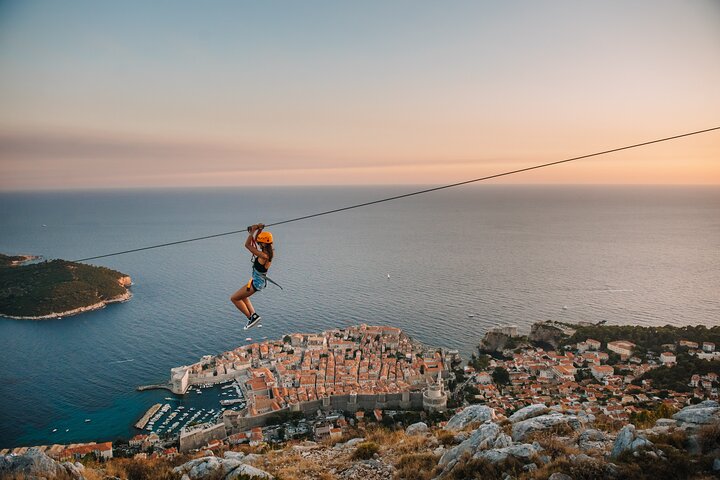
The wind greets you first—salted by the Adriatic, quick with a dare—as you clip into the line high above Dubrovnik’s terracotta rooftops. The Old Town’s famed walls ring the city like a steady heartbeat below, while Lokrum Island lounges in the blue, pretending not to watch. A guide nods, the pulley hums, and you step into the open. The hillside falls away. Gravity takes the lead, the sea flashes a grin, and for a few clean seconds the world moves at your speed.
This is the Panorama Zipline experience above Dubrovnik, a simple equation of cable, harness, and cliffside vista that multiplies into far more than the sum of its parts. Here, the city’s medieval geometry becomes a map you can hold in your eyes: church domes, the grid of limestone lanes, the black commas of kayaks edging the walls. The line draws an arrow across that view and invites you to follow.
The setting is an education in stone and story. Dubrovnik rose on karst—hard, folded limestone shaped by water and time—so the slopes you step across are stitched with low holm oak, fragrant maquis, and the occasional shy tortoise. Above it all stands Mount Srđ, the city’s lookout since long before it became a destination. Fort Imperial, the Napoleonic-era stronghold on the summit, has watched over every chapter: Ragusan traders charting the Adriatic, the 1667 earthquake that reshaped the city, and the 1991–92 siege when the hillsides crackled with a different kind of tension. Flying here folds those narratives into the present—history drawn as contour lines under your feet.
Local guides keep the mood easy and the safety uncompromised. They brief you clearly—hands, posture, braking—and give you time to breathe into the height. Harness lines chatter as riders come and go, laughter spilling as often as adrenaline. The incline trails between launch points double as micro-hikes: a few minutes of walking on rocky track and terrace steps, the pines doing their part to provide shade. The sea is never out of view; even the wind has an opinion, nudging you forward, leaning into your momentum, sometimes hushing the hillside to let the gulls have the last word.
Timing shapes the experience. Mornings bring a softer light, the Old Town brushed in pale gold while the air is still cool. Late afternoon rides land you squarely in golden hour, when the rooftops ignite and the fortress stones warm from within. Summer heat demands strategy—hydrate, go early or late—while spring and fall bring breezier, quieter days. Winter, when operations run, can be a gift: bright skies after rain, the sea a darker, glossier blue, and fewer crowds to share it with.
Dubrovnik’s culture is never far from the edge of the cable. At the end of your run, you’re minutes from a plate of peka—slow-cooked veal or octopus under an iron bell—and the Dingač and Pošip wines that have powered local toasts since the Ragusan Republic had an embassy network that put modern diplomats to shame. The city’s layered identity—merchant, maritime, meticulously independent—shows up in details: the carved stone coats of arms, the measured pace of the Stradun, the way locals will debate gelato with academic rigor. A zipline can’t tell the whole story, but it hands you a cliff-note version with the rooftops spread like a chapter.
Practicalities steer the day. Closed-toe shoes make the short walks comfortable; a small daypack keeps your hands free for the line and the camera. Most providers run small-group departures with transfers from central Dubrovnik—often near the cable car station or a designated pick-up point—so you can leave the parking puzzle to someone else. Expect around 2.5 to 3 hours for the full experience, including briefing, multiple rides, and transfers. Age and weight limits apply; if you’re on the border, check before you book. If you fly with a phone, tie it down with a lanyard case; the wind has a thief’s touch, and the hillside will not return what it takes.
Beyond logistics, the value is in contrast. Few cities reward you with such an immediate aerial perspective. You see the Old Town as a whole—where kayakers thread the shore below Lovrijenac Fortress, how the wall-walk bends with the coastline, how the city’s medieval grid gives way to modern neighborhoods further out. On the line, you’re moving fast enough to feel it, slow enough to notice. The sea teases with a change of color from sapphire to teal over shallows; a kite hovers and edits your frame; the bell tower keeps its own time, unimpressed by your velocity.
If you arrive early, stand still before you fly. Listen to the cicadas stitch their summer song through the scrub. Smell the resin in the pines. Watch a ferry angle toward Gruž Port and imagine the centuries in which this was the view of homecoming for sailors. Then step in, clip on, and give the hillside its due. When you land, gravity returns what it borrowed, the guide grins, and you realize you’ve learned something spatial: a mental map that alters how you walk the city afterward. Later, when you trace the wall, you’ll look up at the ridge and know the exact pocket of air you flew through—and the Adriatic, ever playful, will wink again.
For travelers seeking a clean, high-return dose of Dubrovnik—views, story, motion—this zipline delivers. It’s both invitation and orientation, a reminder that the best vantage points often ask you to meet them halfway and let go for a moment. Bring sturdy shoes, a calm head for heights, and the curiosity to see the city as a living topographic map. The cable is waiting, humming its line, pointing straight at the heart of a place that keeps rewriting itself in light.


