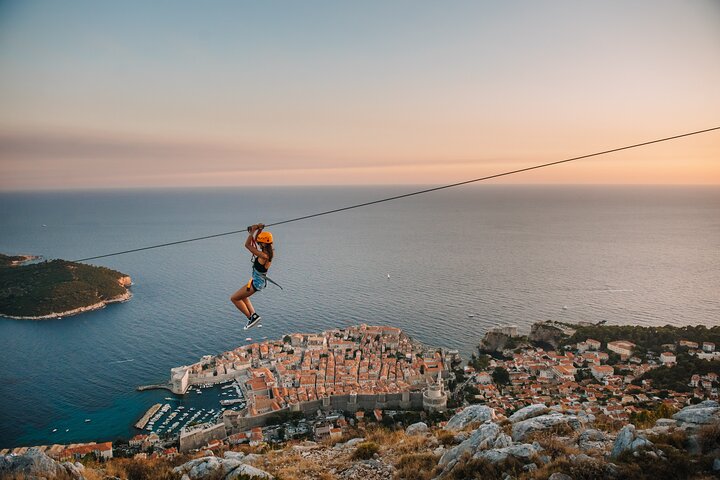
It takes only a few steps to understand why Fort Lovrijenac grabs the imagination. Push through Pile Gate, thread past the clustered limestone houses of Dubrovnik’s Old Town, and the city’s red-tiled rooftops fall away; ahead, a sheer limestone promontory juts out from the western wall into the Adriatic. Perched on that outcrop is St. Lawrence Fortress—Fort Lovrijenac—a squat, stubborn bulwark that has watched the harbor for a millennium. From the plateau you can feel the city’s geometry unfold: the 2-kilometer sweep of the city walls, the ribbon of Stradun below, and the dark green smudge of Lokrum Island across the bay.
The encounter with Fort Lovrijenac is both cinematic and tactile. The stone is warm under the Mediterranean sun, gulls wheel and chatter, and the wind off the sea has an appetite for sound—announcing waves against the cliffs and the distant clink of moored boats. It’s no accident film crews chose this place. The fort’s compact interior, its crenellated parapets and its cliffside silhouette became the backdrop for King’s Landing’s Red Keep in Game of Thrones, and even without a script the site delivers drama.
History here is layered into the mortar. Lovrijenac’s origins are medieval; local chronicles reference a defensive tower on this rock as early as the 11th century, but the fort took on the shape you see today through major rebuilding campaigns from the 14th to the 17th centuries as the Republic of Ragusa fortified itself against Venetian and Ottoman ambitions. The fortress functions as a statement of intent—three-meter-thick walls facing the sea, a narrow entrance designed to funnel attackers, and an internal courtyard big enough to marshal a garrison. That mix of austere defense and dramatic placement is what makes this spot feel both ancient and immediate.
Geology plays its part. Dubrovnik sits on karstic limestone, a dense, fossil-specked rock that resists erosion and forms the towering cliffs that make the town defensible. The fort’s foundation is literally hewn from that limestone; climb to the parapet and you can see where mortar meets bedrock. The Adriatic, clear and cold beneath, still shapes local life—fishing boats, ferries to nearby islands, and the tidal pull that made Dubrovnik a maritime power.
Culture and contemporary life overlap seamlessly with the past. Morning market stalls on the Stradun still sell olive oil, figs and sun-dried tomatoes; terraces pour out coffee; and in summer the narrow streets ring with languages from across Europe. Local guides—many with childhoods played out under the city walls—deliver history with a practiced economy of anecdotes: the city’s quarantine station established in the 14th century, siege stories, and the peculiar traditions of a maritime republic that survived by diplomacy and trade.
For travelers, Fort Lovrijenac is a compact but rewarding objective that pairs naturally with other Dubrovnik experiences. The most common combination is the City Walls loop: a roughly 2 kilometer walk that wraps the Old Town and takes 1–2 hours at a steady pace. Add Fort Lovrijenac and allow an extra 30–45 minutes to explore the battlements and read the plaques. Guided options run from short private half-day tours focused on the fort and walls (about 2–3 hours) to themed walks—Game of Thrones-labeled itineraries that linger at filming spots and animate the set locations with behind-the-scenes lore.
If you want to see the fortress from sea level—where its cliff face looks even more dramatic—book a late-afternoon boat cruise or a private speedboat sunset. Kayak tours launch from the small beach near Pile Gate and paddle toward Lokrum Island, skirting the fort’s sheer face and offering a rare sense of how Dubrovnik sits within its maritime landscape. Longer boat trips add snorkeling stops at hidden caves and a few hours on Lokrum’s pebbled shores.
Practical beats: Fort Lovrijenac sits above a short but steep stone stair; expect an elevation gain of roughly 30–40 meters from the base at Pile Gate to the fort’s top terrace. Wear sturdy shoes—slick stone and staircases reward grippy soles—and carry water; shade is limited. The old town can be crowded midday in summer, so aim for first light or late afternoon to beat both the heat and the tour groups. City Walls and Fort Lovrijenac are ticketed in high season; buy your wall pass online or arrive early to avoid lines.
Combine sensibly: a 2–3 hour city walls + fort private tour gives history and vantage points; a 2-hour sea kayaking and snorkeling trip offers a physical counterpoint—paddling, sea spray, and the chance to slip into the Adriatic. If your schedule allows, cap a day with a private sunset boat ride: the sun slides down behind Lokrum, and from the water Dubrovnik’s stones take on an amber glow.
The fortress rewards slow observation. Pause on the parapet and watch the harbor traffic—ferries to the Elafiti islands, private yachts and fishing boats—then step into the courtyard and imagine the sentries who once kept watch. Whether you come for history, for the film-set cool factor, or simply for the view, Fort Lovrijenac delivers a concentrated, manageable slice of Dubrovnik’s character: fortified, maritime and stubbornly beautiful.
For planning: combine a wall-and-fort tour in the morning, break for lunch and a market visit, and take a sea-based activity in the afternoon. That sequence balances perspective—above, within, and from the water—and leaves you time to linger at a konoba with grilled fish and a glass of malvasia as the day cools.