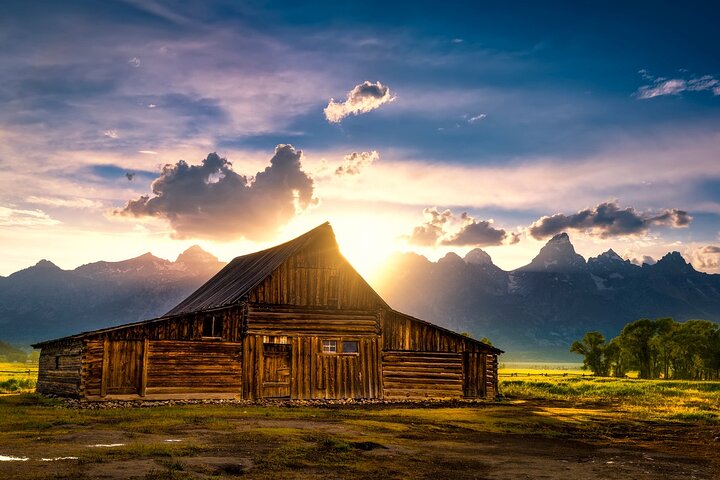
You wake before the town has smeared its first coffee stain across the sidewalk. The road out of Jackson is a ribbon of cool air; the SUV's headlights pick out willows heavy with dew. By the time the valley begins to untuck its blue-gray layers, the jagged teeth of the Tetons are already sharpening into silhouette—an honest, unapologetic skyline that feels older than your phone and more immediate than your next to-do list. On a private full-day tour of Grand Teton National Park, a guide drives, plans the stops, and reads the landscape like a living map; you get to move through its drama without the bother of logistics, and with better chances of witnessing wildlife when the park itself is waking up.
The Teton Range is the youngest mountain front in the Rocky Mountains; its uplift began only a few million years ago, leaving steep, angular summits and clean, raw ridgelines. What looks wild and spontaneous is the result of geology that prefers suddenness over slow erosion—massive faults, glaciation that scraped the valleys, and rivers that keep insisting on new courses. That combination makes for brilliant photo windows: mirrored flats on Jackson Lake, sculpted cirques around Jenny Lake, and the long, stacked planes of the valley that guide both light and life. Historically the valley was a corridor for Shoshone people, and later a zone of mountain men, trappers, and settlers. Today's visitors get the benefits of that history: a park network of trails, access points, and interpretive stories laid out by stewards who’ve worked hard to balance access and preservation.
A private tour lets you follow a rhythm that public shuttles can’t: dawn at Oxbow Bend for steam over the Snake River, a slow stop where bison graze in the distance, then a pivot to quieter spurs where elk browse willow thickets. Guides here don't just point at peaks; they narrate the park’s ecology—where moose prefer willow bogs and elk travel corridors, or why bald eagles favor the open reservoirs for quick fish grabs. Beyond biology, you'll hear about the Park Service’s long tug-of-war with development pressures, ranchland conservation easements, and how local communities work to keep Jackson Hole's character intact. Because the tour is private and flexible, if someone in your group wants a photography clinic, your guide can linger at the right light; if someone wants to chase geology, they'll outline the tectonic events that raised these mountains.
Practical benefits are why many travelers choose a private SUV tour: the route is tailored to your interests, the timing is optimized for wildlife viewing (long shadows, low human traffic), and you get context—history, geology, and ecology—on the move. The eight-hour format gives enough time to cover the highlights—Oxbow Bend, Jenny Lake, Signal Mountain, and the Snake River overlook—without the shotgun-fire pacing that leaves you frenzied at five pullouts and tired of the car. Guides will often bring spotting scopes and knowledge of recent wildlife activity; their experience is the difference between seeing a distant dark shape and watching a moose feed while its calf tests the water.
But a private tour is also about being prepared. Winters are deep and the roads are sometimes closed; in shoulder seasons, early mornings are cold even when days warm up. Even in summer you’ll appreciate a wind layer on exposed overlooks and a pair of binoculars for scanning flats. Respecting wildlife is non-negotiable: keep your distance, listen to your guide, and understand that animals are not props for a photo. The best cues for behavior are quiet observation and patience; those who rush get nothing but a flurry of legs disappearing into willows.
For photographers, this itinerary is a study in light, scale, and reflection. Jenny Lake gives mirror images if the wind permits; the willows at Oxbow Bend add foreground texture; long telephoto lenses compress distance to make bison and elk feel monumental. Your guide’s timing—arriving at locations at first light or holding until the sunset rim light—translates into pictures with depth, not just snapshots.
If you want to lean into a luxury angle, add requests before booking: post-hike picnic with locally sourced fare, private stops at quieter trailheads for short walks, or focus on a naturalist theme instead of pure sightseeing. It’s a day that reconciles the ease of a chauffeured tour with the rawness of one of North America's great mountain ranges.
Why go? Because Grand Teton is a place where topography reads like a story and wildlife punctuates the chapters. A private full-day tour removes the friction—parking, timing, and crowded viewpoints—so your attention stays on what matters. You come away having seen more, understood more, and carried home a set of moments made quieter and more personal by the decision to turn the park into a private classroom for the day.


